
Dr. Germar Schneider appointed honorary professor
The honorary professorship in Chemical Processes in Semiconductor Production is based in the Faculty of Natural and Environmental Sciences.
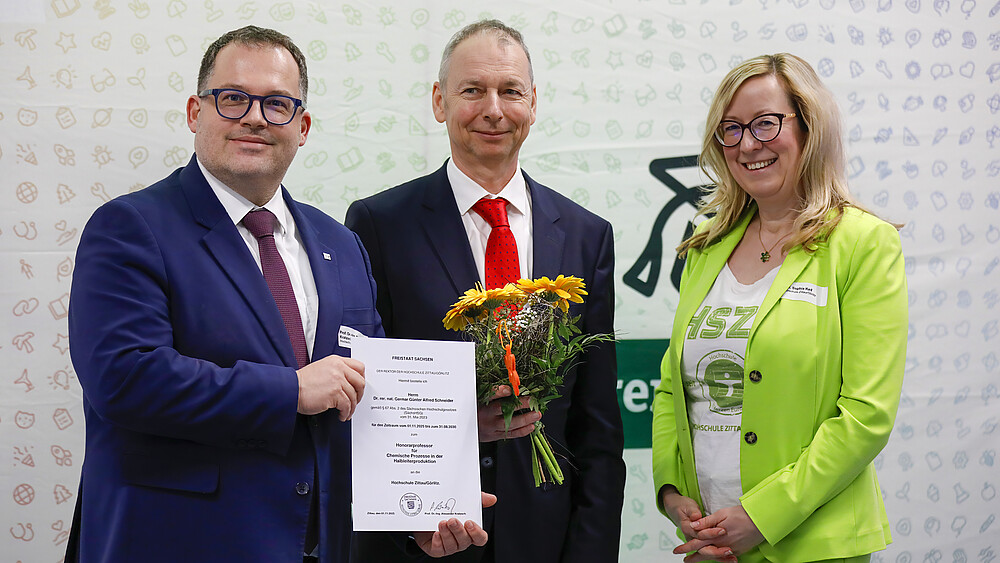
Prof. Dr.-Ing. Alexander Kratzsch, Rector of Zittau/Görlitz University of Applied Sciences (HSZG), has appointed Dr. Germar Schneider as an honorary professor at HSZG. The honorary professorship, which is limited to five years, bears the title “Honorary Professorship for Chemical Processes in Semiconductor Production” and is based in the Faculty of Natural and Environmental Sciences.
Dr. Schneider has many years of scientific and industrial experience in the field of chemical processes and technologies used in semiconductor manufacturing. His professional career is characterized by a combination of application-oriented research, industrial practice, and involvement in technologically sophisticated development and production processes. He thus brings proven expertise in a key area of modern high technology to the HSZG.
As part of his honorary professorship, Dr. Schneider will teach a course amounting to 2 semester-week hours (SWS). In his classes / courses, he will provide students with in-depth insights into chemical processes involved in semiconductor production and address current issues in research and industrial applications to integrate theoretical foundations with the real-world requirements of the semiconductor industry.
With the appointment of Dr. Schneider, the Zittau/Görlitz University of Applied Sciences is strengthening its profile in the Natural and Environmental Sciences as well as in the strategically important field of semiconductor technologies. The honorary professorship underscores the HSZG’s commitment to offering excellent teaching with high practical relevance and to further positioning Upper Lusatia as an innovative hub for science and technology.
The Zittau/Görlitz University of Applied Sciences looks forward to this collaboration and wishes Dr. Germar Schneider every success in his role as honorary professor.
When cutting-edge industrial research, an understanding of chemical processes and academic teaching come together, new perspectives are created for students. With Prof. Dr. Germar Schneider as an honorary professor, the HSZG is specifically strengthening the practical relevance and future orientation of its teaching. The experienced senior manager from the semiconductor industry has been working for Infineon in Dresden for over 25 years and stands for technological excellence, international networking and the transfer of knowledge from current industrial development and innovation processes directly into the lecture hall.
In this interview, he talks about how much he enjoys working with students, what he expects from teaching and how he manages to combine industrial work and teaching.
A warm welcome to Professor Dr. Germar Schneider. Could you briefly introduce yourself to our readers?
My name is Germar Schneider, and I have been teaching at Zittau/Görlitz University of Applied Sciences since October 2020. I was very pleased to be appointed an honorary professor in November 2025. In the Faculty of Natural and Environmental Sciences, I teach chemistry and bring my many years of experience in industrial semiconductor manufacturing to my university teaching. I was born in Augsburg in 1964.
In addition to my professional career, I also have strong personal ties to Upper Lusatia. My father is from Lower Silesia, and parts of my family were already living in Dresden. When I came to Dresden in 1998, my aunt told me about the charming towns of Upper Lusatia—Zittau, Oybin, Jonsdorf, and Lückendorf. She raved about the vacations she had spent there during the GDR era and how much this region meant to her. I, too, quickly came to appreciate this landscape and the people here. In particular, the proximity to Poland and the Czech Republic opens up a wide range of opportunities for close, successful cooperation in the heart of Europe.
What has your career path been like?
My professional career has been shaped by the close connection between science and industrial practice. After studying chemistry at the University of Ulm, where I earned my Diplom in 1991, I completed my doctorate in analytical chemistry. My path led me into industry early on, first as a process engineer for wet chemistry at Siemens in France. This was followed by positions as a product manager for semiconductor chemicals at Merck in Darmstadt, as well as various leadership roles at Siemens and later at Infineon in Dresden.
For many years, I worked there as a lead engineer in the areas of wet chemistry, automation, and wafer testing, and since 2012 I have been active as a senior manager at Infineon Dresden in the Innovation & Funding division. In this role, I am committed to advancing cutting-edge technologies and supporting innovation projects to sustainably strengthen Infineon’s competitiveness and Germany’s position as a hub for innovation.
What personally motivated you to contribute your industrial expertise to university teaching through an honorary professorship?
I have always maintained contact with the academic world. While at the company, I supervised a large number of final dissertations in collaboration with various universities—ranging from project work to Bachelor’s theses and Master’s theses, and even doctoral dissertations. As part of my work on national funding projects, I have been collaborating with numerous universities across Europe for many years and have built up a large network in the process. I have been working with HSZG on major research and development (R&D) projects since 2017. And since 2020, I have been delighted to teach Engineering Management and Mechanical Engineering at HSZG. I really enjoy working with young people. I look forward to the lectures with the students and early-career researchers at HSZG,
You continue to work in the private sector—how does this specifically benefit students in your teaching at HSZG?
Especially in the semiconductor industry, technology and manufacturing are advancing so rapidly that I’m still learning something new every single day—and that’s exactly what inspires me. I want to continue actively contributing to technical developments in collaboration with companies and partners from industry and research, attending conferences, and authoring new publications.
I’m happy to pass on to students the knowledge I gain and am able to share in the process. It’s deeply fulfilling to spark their curiosity, show them new perspectives, and accompany them on their own journey toward a fascinating future in technology.
Why are chemical processes such a key success factor in modern semiconductor manufacturing—and thus also for future engineers?
Chemical processes play a central role in the semiconductor industry. Every day, a wide variety of materials, chemicals, and gases are required to produce the intricate circuits on the wafers. These processes are highly complex and must work together seamlessly—which is why a deep understanding of chemical and physical principles is essential.
Especially in fields such as wet chemistry, etching and deposition, chemical-mechanical polishing, or lithography, engineers must possess a solid and broad-based knowledge of chemistry. From my own experience, I can say: Anyone who has studied chemistry has a good foundation and the best chances of gaining a foothold in the semiconductor industry and shaping an exciting professional future there.
How do you structure your teaching to bridge the gap between theoretical fundamentals and industrial requirements?
In my lectures and seminars, I make a point of asking students right at the start about their expectations—of me, of the course, and of our collaborative learning. It’s important to me to understand what motivates them and what they hope to gain. In addition to theoretical knowledge, I especially want to give them a feel for real-world applications. That’s why I incorporate many examples and experiences from my daily professional life to make the material come alive, engaging, and tangible.
I’m deeply committed to motivating students and showing them just how relevant and fascinating these topics really are. Through various exercises after the lectures and targeted exam preparation, I help them solidify what they’ve learned and go into the exam feeling good about it. It’s a personal priority for me that they not only pass, but also truly take something away from the experience.
What advice would you give to students who would like to work in the semiconductor industry or in applied research in the future?
I always make it clear to students just how incredibly diverse work in the semiconductor industry is. This industry is growing steadily, and those who enter it generally have excellent opportunities for career advancement. And in our highly dynamic industry, things never get boring—flexibility is always required. To prepare students as best as possible for the real world, I share many personal experiences and give them tips that helped me along my own path and that can make it easier for them to get started later on.
In your view, what skills or competencies are particularly important today for success in this high-tech field?
For future degree programmes at HSZG—for example, in the field of chemistry—it’s truly important to me to do more than just teach students the fundamentals of semiconductor processes and chemical procedures. I also want to give them a solid understanding of manufacturing processes and lean management. When entering industry or research, I want students to start with broad, practical knowledge that gives them confidence and paves the way for their professional future.
And on a practical note: Do you have any personal survival tips for students during exam periods or when tackling challenging technical courses?
My most important recommendation is to attend lectures and seminars regularly and to find a good balance between studying and relaxation. For me, both are inseparable parts of successful exam preparation.
I often think back to my own exam periods: When I felt good, I made a point of taking short breaks—whether hiking, biking, swimming, or playing sports. These moments helped me clear my head and then go into the exam with more composure and self-confidence. I’d like to encourage my students to find this same balance.
It’s also important to me to convey just how crucial perseverance, self-confidence, and a positive attitude are. With these qualities, it’s much easier to master not only exams but also future professional challenges.
How do you manage to combine your work in industry with teaching at the university?
Through my work in industry, I learn something new every day and am constantly expanding my expertise. I share much of this directly with professional circles and in publications. Anything that’s particularly well-suited for teaching, I incorporate into my lecture materials. To make this work, good time management is incredibly important to me.
That’s why I often find myself working on my materials in the evenings or on weekends—not because I have to, but because it’s truly important to me. In my projects, I make sure to organize my work as efficiently as possible. I try to avoid unnecessary meetings and consciously focus on what’s essential. That’s how I make room for what really matters to me: sharing knowledge that immediately offers real added value.
What still fascinates you most about semiconductor technology—even after many years of professional experience?
What excites me most about the semiconductor industry is that every day I get to work on technologies for a future worth living. And this dynamic appeals to me immensely: hardly any other industry is evolving so rapidly. Every new generation of chips presents us with exciting challenges that demand creativity, expertise, and team spirit. I’ve never really been bored in all these years.
But I’m also particularly motivated by the thought that the products we’re working on are indispensable to our everyday lives today: smartphones, medical devices, cars, communications technology, energy efficiency—semiconductor technology plays a key role everywhere. Knowing that my work helps ensure these technologies function and continue to advance fills me with pride.
And last but not least, I really enjoy collaborating with colleagues from different departments. Tackling complex problems together, exchanging ideas, and ultimately developing a solution is, for me, one of the best parts of the job. This blend of innovation, teamwork, and genuine relevance to the world is why the semiconductor industry continues to inspire me so deeply to this day.
Is there a professional or personal motto that guides you?
My motto has always been “A crisis is an opportunity” and “there are never problems, only challenges.”
What are the three things that absolutely must be present in your work environment—whether at a university or in industry?
Enjoyment of the work, good teamwork, good equipment, and expertise.
Where do you find the good balance to your professional life?
At home with my family, and in the summer while working in my garden. I enjoy growing fruits and vegetables, and weeding and watering the garden helps me relieve stress.
The interview was conducted by the Office of University development and communication, University of Applied Sciences Human Resources Division.
1st floor