

Research focus on transformation processes in business and society
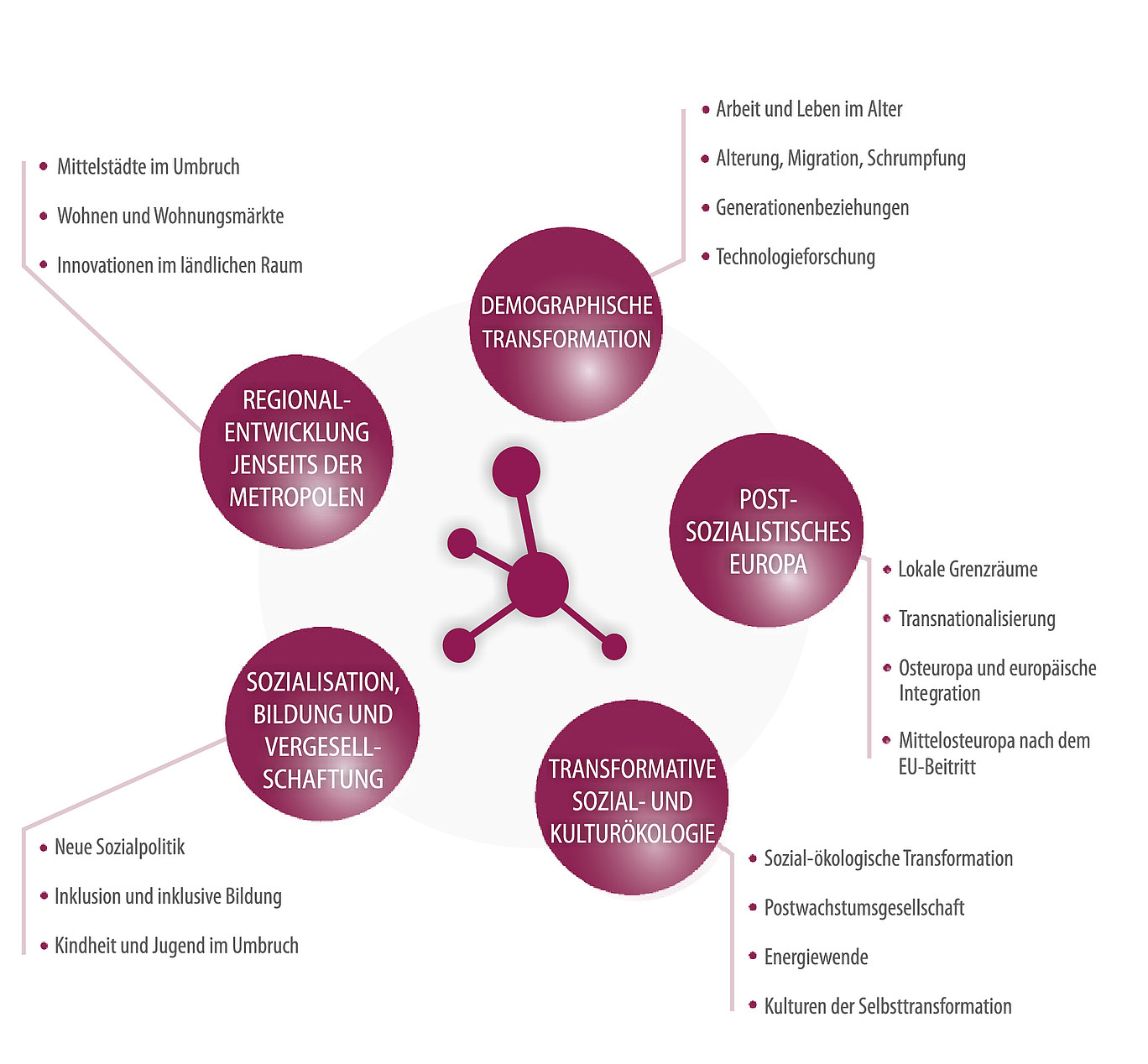
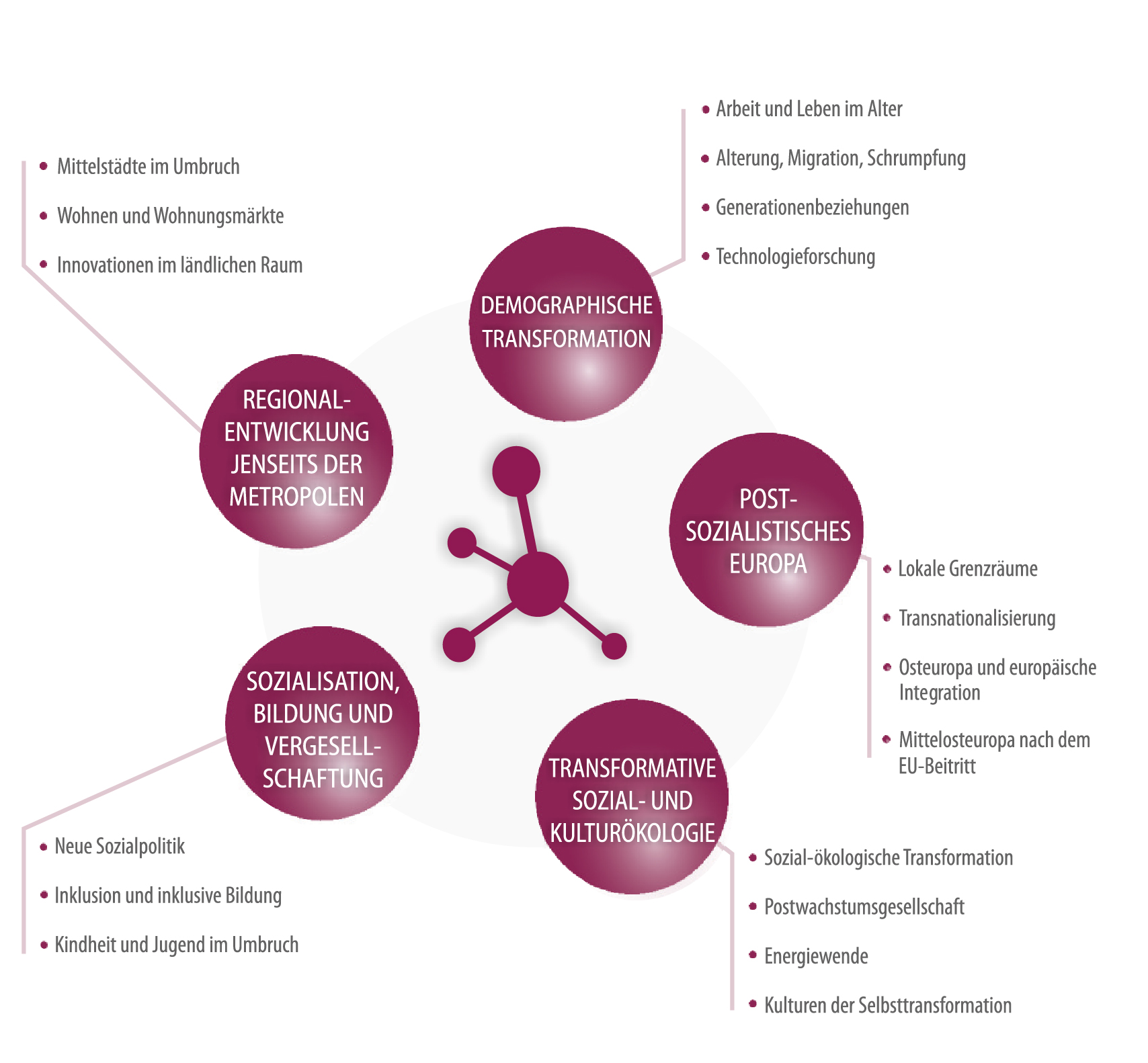
Download graphic
Our research encompasses sociological, economic, and environmental issues. We examine structural change in rural areas (regional development) and its historical causes (post-socialism). At the same time, we investigate how demographic change affects our way of life and which new concepts in education and cultural ecology are sustainable for the future.
-
Guiding orientation and overview
Our contemporary societies are undergoing profound processes of change that encompass virtually every aspect of the systems, work environments, and lived experiences of individuals and social groups. The research focus“Transformation Processes in Economy and Society”at the Zittau/Görlitz University of Applied Sciences examines these complex processes of change—in terms of subject matter, society, and time—and the opportunities they present for shaping the future.
The research focuses on transformation processes stemming from the university’s regional location; however, in light of the growing global interconnectedness of all developments, it also extends far beyond this scope. The overview below highlights the most important areas and focal points of the research.
The research focus is characterized by its application-oriented approach and strong collaborative relationships with practice partners in the region (government agencies, businesses, and political and civil society organizations). This includes a wide range of consulting and expert advisory services.
This explicitly interdisciplinary focus is, on the one hand, integrated with the university’s “Energy and Environment” area of expertise and, on the other hand, cooperates closely with the in-house institutes of the Zittau/Görlitz University of Applied Sciences “TRAWOS” (Institute for Transformation, Housing, and Social Spatial Development) “GAT” (Institute for Health, Ageing, Technology).
The FSP TWG represents an interfaculty structure within the University of Zittau/Görlitz that aims to initiate, consolidate, and network research projects and research perspectives.
Any faculty or staff member of the university who is interested in the topics of this research focus and is actively engaged in relevant research processes may become a member of the FSP.
-
Current research topics (selection)
Demographic Transformation
- Health in Schools and in Old Age
- Assistive Technologies for Older Adults (VATI Project)
Post-Socialist Europe
- Social Transformation and Post-Transformation Processes
- Perspectives on the Financial System and Banking Sector in Eastern Europe
- Cross-Border Dialogue on Cultural and Sociopolitical Developments
Transformative Social and Cultural Ecology
- Socio-ecological Transformation Processes
- Energy and the Environment
- Environmental Education and Landscape Planning
- Development of Tourism Destination Concepts
- (Cultural) Self-Transformation
Socialization, Education, and Social Integration
- Inclusive Education in Schools (ZINT Project)
- Inclusion in Childcare Facilities – Professional Development for Early Childhood Educators
- Development of new (multimedia) continuing education programs
- Gender Equality Policy
Regional development beyond metropolitan areas
- Management of regional transformation and development processes
- Resilience in Saxony’s medium-sized cities
- Housing Market Research and Real Estate Dialogue
- Historic Preservation and Building Research
- Strategy Development in the Görlitz District
-
Membership and organization
Members of the research focus are members of the HSZG who have at least a first academic degree (usually: BA), who express their interest in the topics, networks and events of the FSP and who are themselves involved in corresponding research processes.
If you are interested in the work of the FSP and would like to be informed about its work or become a member, please contact the spokesperson(m.hosang(at)hszg.de).
Our research topics
-
Demographic transformation
-
NXTM - Development of a connector for live integration into database management systems
NXTM - Development of a connector for live integration into database management systems (2015 - 2016)
Project management: Prof. Dr.-Ing. Jörg Lässig
-
VATI - Trust in assistance technologies for the inclusion of older people
VATI - Trust in assistance technologies for the inclusion of older people (2014 - 2017)
Project management: Prof. Dr. Andreas Hoff
-
Youth Vision Action / Youth moves region - Region moves youth
Youth Vision Action / Youth moves region - Region moves youth (2024 - 2027)
- Contact person
- Prof. Raj Kollmorgen (Project management)
- Ms. Mara Börjesson
- Ms. Mara Börjesson
- Ms. Marie Melzer
- Contact person
-
NXTM - Development of a connector for live integration into database management systems
-
Post-socialist Europe
-
Social transformation: On the sociology of a type of social change
Social transformation: On the sociology of a type of social change (2012-2017)
Project management: Prof. Dr. Raj Kollmorgen
-
Stability of the financial system and banking regulation in Ukraine in the context of its European integration
Stability of the financial system and banking regulation in Ukraine in the context of its European integration (2014-2015)
Project management: Prof. Dr. rer. pol. Mario Straßberger
-
Transformation to a "post-growth society"
Transformation to a "post-growth society" (2013-2015)
Project management: Prof. Dr. Raj Kollmorgen
-
Social transformation: On the sociology of a type of social change
-
Transformative social and cultural ecology
-
REFUGIUM (Refugees in urban area for migration)
REFUGIUM (Refugees in urban area for migration) - Effects of migration on rural areas in the Free State of Saxony and the scope for action of the civilian population, especially the tourism industry (2016-2017)
Project management: Prof. Dr. Ute Pflicke
-
InnoTour - Innovation networks for the development of regional cross-provider concepts...
Innovation networks for the development of regional cross-provider concepts and innovative products for small and medium-sized enterprises (SMEs) in cultural and health tourism as drivers of destination development in rural areas in eastern Germany - InnoTour (2015-2016)
Project management: Prof. Dr. Ute Pflicke, Dr. Maik Hosang
-
SPUR - Hurvinek's journeys into nature
SPUR - Hurvinek's journeys into nature (2014-2015)
Project management: Prof. Dr. rer. nat. Christa Maria Heidger
-
Socio-ecological transformation processes: Actors, orientations for action and modes of transformation - using the example of renewable energies
Socio-ecological transformation processes: Actors, action orientations and modes of transformation - using the example of renewable energies (2013-2014)
Project management: Prof. Dr. Raj Kollmorgen
-
Lofe - Landscape of future (Landscape of the future)
Lofe - Landscape of future (2011-2013)
Project management: Prof. Dr. rer. nat. Christa Maria Heidger
-
REFUGIUM (Refugees in urban area for migration)
-
Socialization, Education, and Social Integration
-
Study on the pedagogical attitude of professionals
"Study on the pedagogical attitude of professionals" (2013-2014)
Project management: Prof. Dr. Andrea Eckhardt
-
Study on the pedagogical attitude of professionals
-
Regional development beyond the metropolitan areas
-
Improving opportunities for young women to stay in Upper Lusatia
Improving opportunities for young women to stay in Upper Lusatia (2015)
Project management: Prof. Dr. Ulrike Gräßel, Prof. Dr. Raj Kollmorgen
- Current projects at the Institute for Transformation, Housing and Social Spatial Development
-
Improving opportunities for young women to stay in Upper Lusatia
Search for specific topics, keywords or institutes. Our Research Information System (FIS) offers you free access to all ongoing and completed research, development and transfer projects.
This research focus serves as an interfaculty platform for pooling expertise at the university and initiating new projects. In doing so, we work closely with the TRAWOS (Transformation, Housing, and Social Spatial Development) and GAT (Health, Ageing, Technology) institutes. The following overview lists the members who are actively shaping this interdisciplinary collaboration.
Your contact in the research focus area
2nd upper floor