
Research data management
Why does this affect me specifically?
The amount and complexity of scientific data is constantly increasing in everyday research. This increases the need to organize, document, store and make this data available to others. Responsible data management
supports researchers and helps to make research results
traceable and easier to reuse. In addition, data management is an essential
cornerstone of good scientific practice (GWP) and is increasingly expected by research funders.
What is research data management?
"The term research data management refers to structured measures in the context of working with research data that aim, among other things, to make data usable or reusable in the long term, regardless of the persons involved in collecting it, and thus to increase the efficiency of research (e.g. in the context of a working group's research, but also with a view to global scientific progress). Another goal is to implement legal requirements and ethical good practices when handling sensitive data, such as personal data. Research data management includes not only the publication of data(open data), but also measures along the preceding steps of the entire data life cycle as well as data archiving and subsequent use."
Source: Editorial team of forschungsdaten.info. "Glossary". forschungsdaten.info, February 05, 2026. forschungsdaten.info/praxis-kompakt/glossar/.
What is research data?
"Research data are digital or analog data that are created, developed or evaluated during scientific work (e.g. through measurements, surveys, source work) or are based on these. It forms the basis of scientific work and documents its results. What exactly falls under the term research data varies from discipline to discipline."
Source: Editorial team of forschungsdaten.info. "Glossary". forschungsdaten.info, February 05, 2026. forschungsdaten.info/praxis-kompakt/glossar/.
Data life cycle
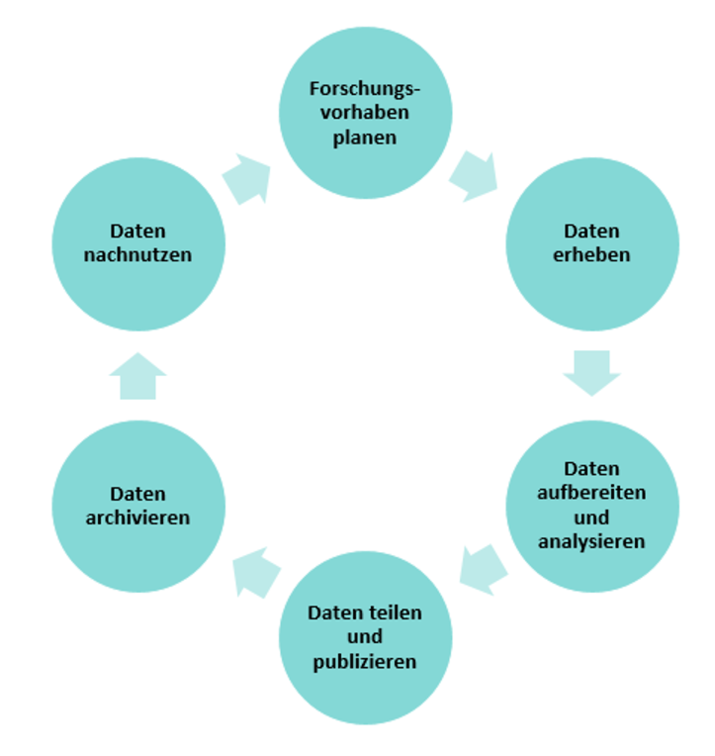
"The data lifecycle model covers all phases
that research data can go through from collection to subsequent use. The structure of the data life cycle varies from model to model,
but in general it comprises the following phases:
- Plan work and handling of data (see data management plan)
- Collecting data
- Preparing and analyzing data
- Sharing and publishing data
- Archiving data
- Reuse data"
Source: Editorial team of forschungsdaten.info. "Glossary". forschungsdaten.info, February 05, 2026. forschungsdaten.info/praxis-kompakt/glossar/.
Where can I find further information and advice?
In the spring of 2026, Zittau/Görlitz University of Applied Sciences organized an introductory workshop on research data management (RDM) for its research staff through the Saxon State Initiative for Research Data Management (SaxFDM). In addition to providing a general overview of the topic, the event also offered highly discipline-specific insights.
Learn more here.