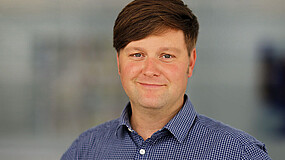
Professor Sonja Schellhammer on individualized teaching, surprising learning moments and new approaches in physics.
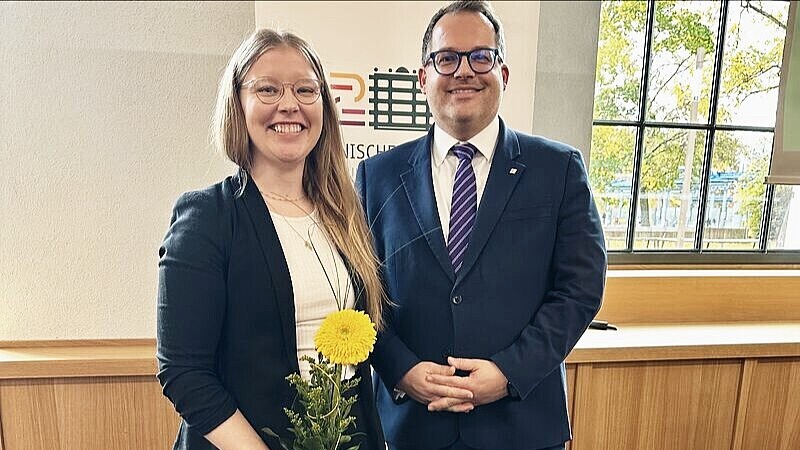
After Professor Sonja Schellhammer was awarded the Saxon Teaching Prize 2025, we wanted to find out more about her understanding of teaching, how she gets students excited about physics and what impetus she sees for the future teaching culture at our university.
Our conversation revealed that individualization is not a method for her, but an attitude. An attitude based on trust, diversity and appreciation.
Professor Sonja Schellhammer, you received the Saxon Teaching Award for your teaching concept in physics, a subject that is often considered difficult. What was your key to getting students interested in physics?
I would say that's exactly the point: this key looks different for all students. I therefore give out lots and lots of keys and let the students try out for themselves which one suits them best.
From a didactic point of view, I therefore offer numerous learning approaches from which students can choose and combine. The content is clearly defined. A second important aspect for creating a connection between me as a representative of physics and the curiosity of the students is appreciation and communication at eye level.
Your project workshop in the degree program Green Engineering is considered an example of individualized teaching. How do you manage to involve students with different prior knowledge and interests?
What I can absolutely recommend are clear, self-explanatory and visually appealing lecture slides, which can also be used directly as scripts for learning and are available for students to download before the start of each lecture. This has several advantages. On the one hand, most people learn primarily visually, which means that good slides with appropriately embedded images and videos can make a big difference in terms of motivation and comprehensibility. On the other hand, it reduces barriers, for example for students who cannot be physically present, have poor hearing or a short attention span (in addition, the slides are comprehensively provided with screen reader-friendly alternative texts for visually impaired and blind people). At the same time, the examination material is documented transparently for the students.
Above all, however, and this brings me closer to the question, this creates freedom for us - for the students to concentrate on learning instead of taking notes correctly, and for me to address alternative explanations, approaches, examples, repetitions and links to further topics such as fields of research. For example, when it comes to the superposition principle for multidimensional kinematics, it makes a difference whether I simply recalculate the oblique throw in the classic way or motivate those interested in sports with a motivation from the long throw and those interested in video games with Link's bomb throw from the Zelda game series. In addition to such everyday or hobby topics, socially relevant topics also play a role here, as well as examples from nature, the animal world and technology and current pop culture in the form of memes and reels or shorts.
Then there is optional content, for example in a math self-test at the start of the semester, from which students are guided to material for independent revision depending on their results. I address the fact that some students have very different learning biographies, as well as frequent misunderstandings about physics. For students who are interested in more complex topics, I am happy to provide suitable additional material on more advanced topics on the learning platform. I usually prepare a short learning sequence for the start of the next lecture to answer students' questions that go beyond the subject matter but are of interest to them. I also offer several freely selectable excursions related to physics. Before lecture experiments, I like to ask students what outcome they expect and then compare this with the actual outcome of the experiment. The practical course is also organized as a project workshop in which students can choose a topic according to their own inclinations and then work on it at their own pace and in their own way, guided by inputs and milestones.
Perhaps worth mentioning is a subgroup of students who have been taught throughout their lives that they simply cannot do physics. What often helps here is to create experiences of competence. I can facilitate these in a targeted way, for example through quizzes and small tasks in the lecture on the material they have just learned, which can be solved without much background knowledge, through think-pair-share and through home exercises that become progressively more difficult. Behind a wrong answer, there is usually a largely correct train of thought that needs to be appreciated. I have also learned that it is demonstrably helpful to directly address the fact that the idea that girls are simply worse at science than boys has been comprehensively refuted scientifically.
In your opinion, what role does university didactics for the further development of teaching quality?
From the perspective of a user, university didactics shines above all in offering us as teachers alternatives. It can draw pictures of what teaching can look like today - in comparison to what we ourselves may have experienced as students back then. It can draw our attention to solutions to problems that we may have had for a long time or only recently. It can show us tools, concepts and ideas from which we can freely choose and develop our own signature as teachers. It can also provide us with evidence-based guidance on decisions that we might otherwise only be able to make on instinct, e.g. on psychological biases in different forms of assessment. It can strengthen us in our role as teachers, and of course connect us with each other, creating community and belonging.
What impulses would you like your teaching concept to set for the future teaching culture at our university?
To be honest, I was totally amazed to be nominated by several students for the university's teaching award in my first semester as a professor, for a subject that is more notorious than popular, and now even to be able to provide impetus for the future teaching culture at the university. I am just as amazed when I sometimes see students who suddenly realize how interested they are in physics, or that they can do something they would never have dared to do before. And perhaps that is precisely my impulse: we can dare to break new ground and be open to being amazed.
The interview was conducted by Daniel Winkler, University Didactics Officer at the Zittau/Görlitz University of Applied Sciences.
The interview impressively shows why Professor Sonja Schellhammer's teaching performance was awarded the prize: She combines subject-specific depth with inclusive approaches, creates learning spaces that understand heterogeneity as a strength and exemplifies what contemporary teaching at a university of applied sciences can look like.
With her attitude and commitment, she provides impulses that reach far beyond physics - and contribute to the further development of the teaching culture at the HSZG.
From the summer semester 2026, the format "Austausch Lehre HSZG" will enter a new round with current university and media didactic topics.
The main content of the initially planned monthly meetings via video conference will be topic-related impulses in the form of short presentations and their subsequent discussion. Lecturers at the HSZG can use this platform to exchange their experiences with university teaching on a cross-faculty / trans-faculty basis and to promote the transfer of practical approaches.
Further information can be found here.
The programs of Hochschuldidaktik Sachsen are aimed at teachers of different levels of experience, status groups and departments who want to deal with selected topics of higher education didactics in a structured way and/or want to make their commitment to teaching visible.
You can find the entire range of programs and registration for the university didactics training courses here.