Dear students and lecturers of the Faculty of Social Sciences,
Modern universities are places of innovation and inclusion. The knowledge imparted to students makes a significant contribution to shaping the future and to social cohesion. The diverse requirements of a pluralistic society are not only addressed in research and teaching, but also require a respectful and non-discriminatory coexistence of all.
In order to discuss opportunities and challenges for the future, we cordially invite you to the symposium: "Inclusive University/Faculty of Social Sciences - Perspectives for Equitable Studying".
The symposium will take place on 18 June 2026 from 10.00 - 16.00 in the auditorium and rooms of the Blue Box of the Faculty of Social Sciences in Görlitz.
All teaching staff and students of our degree programs at the Faculty are invited to attend in order to discuss questions of inclusion together and to identify their relevance for practice and develop possibilities for multi-professional action.
There will be no classes / courses at Faculty S on this day. We would therefore like to enable all teaching staff and students to take part in the symposium. We look forward to your registrations and your commitment. You can find further information on the agenda of the symposium in the program.
If you have any questions, please contact Cordula Lasner-Tietze.
Kind regards
Prof. Dr. habil. Andrea G. Eckhardt
Dean of the Faculty of Social Sciences
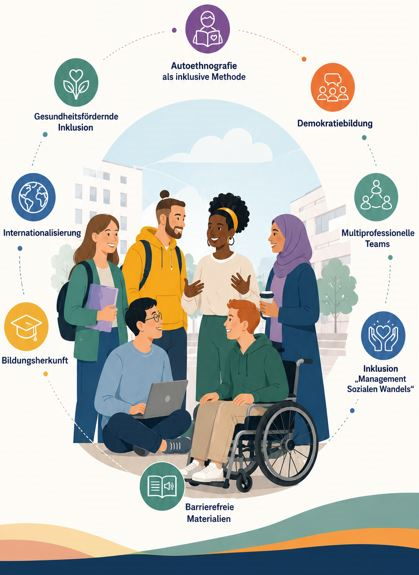
WS I and WS IX: Autoethnography as an inclusive method
- V-Prof.in Dr. Anne Goldbach -
How do our own experiences, biographies and social notions of normality shape our view of inclusion? In this workshop, students and lecturers will gain a compact insight into autoethnographic work and its potential for inclusion-oriented university teaching.
A concrete example will be used to show how autoethnography can be used in teaching and learning contexts to connect personal experiences with social power relations, norms and exclusions. The participants then work with autoethnographic reflection questions, deal with their own biographical and socialization-related imprints and enter into conversation with each other.
Together, they will reflect on how autoethnography can open up new perspectives on inclusion and what possibilities the method offers for teaching, learning and pedagogical practice.
The workshop invites participants to question their own perspectives, make experiences visible and understand inclusion as a joint process of reflection.
WS II: Health-promoting inclusion (mornings only)
- Prof. Dr. Martin Goldfriedrich -
The workshop "Health-promoting inclusion" is dedicated to the question of how inclusive settings can be designed to strengthen the physical, mental and social well-being of all participants. The focus is on the exchange of ideas on how participation can be implemented in a way that promotes health, taking into account different dimensions of heterogeneity. Practical perspectives and experiences of the participants will be included. The aim is to jointly develop impulses for an inclusion-oriented and health-promoting design of educational and living spaces.
WS III and WS XI: International Affairs
- Prof. Dr. MandySchulze -
International Affairs at universities can be viewed along several levels (student mobility, internships abroad, research projects and course development), which bundle different perspectives and interests.
In the workshop, after an introduction to the topic as profile building in university development, we will examine the level from the perspectives of all status groups in order to gather impulses for further university development.
WS IV and WS XII: Educational background
- Daniela Keil (Arbeiterkind e.V.) -
"ArbeiterKind.de is the largest non-profit organization for all those who are the first in their family to study. In Germany, the likelihood of going to university is still strongly influenced by the parents' level of education. In our session, we would like to use our many years of experience in working directly with the target group of first-time graduates and our best-practice knowledge to address the challenges they face - especially in social, financial and cultural terms. We will also explore the question of how educational disadvantage is experienced and what opportunities for action exist to make first-generation students visible, valued and empowered."
WS V and XIII: Democracy education
- Prof. Dr. Nadine Jukschat / Daniela Ahrens, M.A. / Hannah Willuhn (SWb22) -
"Democracy gambled away?!" - Can political education be fun? What actually is democracy? Do educational professionals need political education? How can democratic discourse be strengthened? Questions like these are at the heart of the workshop "Demokratie verspielt?!".
Through various low-threshold impulses and playful activities, we invite you to exchange ideas and reflect on fundamental rights, your own understanding of democracy, privileges, forms of discrimination, democracy education at universities, but also civil society involvement in the region, so as not to gamble away democracy.
WS VI and WS XIV: Multi-professional teams
- Prof. Dr. Steffi Tollkühn / Alexandra Walter, B.A. -
Heterogeneous working environments, especially those in the social and educational sectors, require multi-layered skills, so that multi-professional teams are inextricably linked to them. Team spirit", "cooperation" or "transparent communication" are ascribed to these teams as a matter of course - but what sounds so logical and sensible also creates discrepancies as soon as it encounters the reality of human behavior. Inclusive design of joint work processes that takes all perspectives into account and involves all participants is therefore of considerable importance.
The workshop provides methods, techniques and procedures with which, for example, negotiations, decision-making or idea consensus can be designed as cooperative and participative processes in teams.
WS VII or WS XV: Inclusion "Management of social change"
- Dr. des. Cornelia Müller / Benjamin Soldan, SMm25s -
Social change is omnipresent in modern societies. It affects population structures and state institutions as well as technologies and business organizations, but also family forms and social identities. Current key dynamics - from "demographic change", "digitalization" and "globalization" to "socio-ecological upheaval" - make it clear that social change processes are taking place at all levels and in all subsystems of society. We cannot ignore them, but are faced with the task of recognizing them and - as far as possible - shaping them. In an interactive workshop, together with students from the Master's degree program, we will address topics of social change processes and discuss them with students.
WS VIII and WS XVI: Accessible materials
- Dr. Stefanie Dreiack, Coordination Office for Equal Opportunities Saxony -
What does accessibility mean and when is it fulfilled? Accessibility is a central component of an inclusive university culture. But what does "barrier-free" actually mean in concrete terms - and how can this goal be implemented in everyday working and studying life, especially when creating documents?
In this short workshop, participants will receive a compact introduction to the topic of accessible documents. Together we will approach fundamental questions and develop an understanding of why accessibility is a quality feature of good teaching and administration.
WS X: "HSZG for all - How inclusive are we?" (only in the afternoon)
- Robert Viertel, M.A. / Claudia Döring, B.Sc.
Participation, diversity, accessibility, equality, participation and self-determination... Behind this is the reduction of disadvantages in an appreciative university community.
Our attitudes and structural processes shape everyday university life, both on the staff side and towards our students. In the workshop, we will examine what we have achieved so far and also express our wishes for an inclusive HSZG in the (near) future.