
Culture at Heart, Management in Focus
Prof. Dr. Andreas Heinen brings together many years of experience in the fields of culture, management, and academia, and has been contributing this perspective to the HSZG since March 2026 as a professor of cultural management and cultural policy.
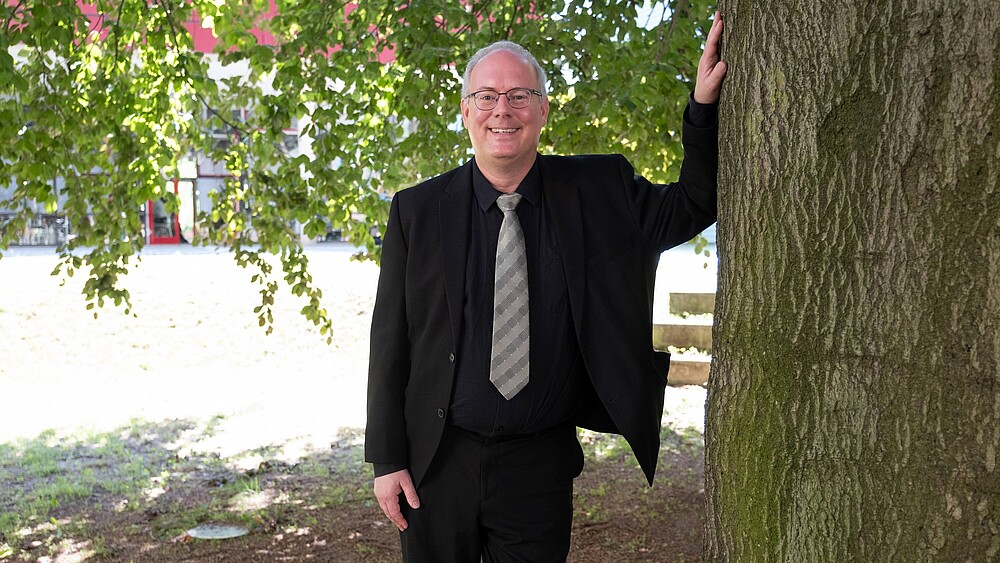
His professional career combines cultural practice, management, research, and university teaching. With his professorship at HSZG, Andreas Heinen is returning to his original field of expertise: cultural management. A key focus is the new Master's degree programme in Culture and Transformation Management, which will begin in the upcoming winter semester.
In this interview, he discusses his journey between cultural institutions and universities, his research on audience development and cultural financing, and his passion for teaching.
Prof. Dr. Heinen, welcome to Zittau/Görlitz University of Applied Sciences. Would you mind briefly introducing yourself to start?
I’d be happy to. My name is Prof. Dr. rer. pol. Andreas Heinen. Since March 1, 2026, I have been a professor of cultural management and cultural policy in the Faculty of Managerial and Cultural Studies at Zittau/Görlitz University of Applied Sciences. I was born in 1973 in Nordenham and grew up in Jever.
What has your career path been like so far? What milestones have shaped your journey?
I grew up in Jever and learned to play the flute and double bass while I was still in school; I also founded a school orchestra together with my brother. After graduating from high school, I completed a business apprenticeship as a music retailer at Neuwerk Buch- und Musikalienhandlung, part of the Bärenreiter publishing building in Kassel.
I then studied at the University of Lüneburg. With majors in music (and musicology) and business administration as part of the master’s program in Applied Cultural Studies, I wanted to enter the field of cultural management.
After completing my studies, I began my professional career as a project coordinator at the Hundertwasserbahnhof in Uelzen. There, I was responsible for exhibitions, concerts, and theater performances, as well as construction projects. At the same time, I took on a teaching position in cultural management at the University of Lüneburg.
I then moved into academia and worked at the Chair of Marketing and Technology Management at the University of Lüneburg, where I also earned my doctorate. After completing my doctorate, I took a position as Marketing Director at the National Theater in Mannheim. I then returned to the university—which had since been renamed Leuphana University of Lüneburg—and helped develop new Bachelor’s and Master’s degree programmes.
This was followed by a move to the University of Music and Theater in Leipzig, where, as a fundraiser, I was responsible, among other things, for securing funding for a festival and three new organ constructions. Later, I moved to the Dresden University of Applied Sciences, where I served as a visiting professor of marketing.
My move to Zittau/Görlitz University of Applied Sciences has now brought me full circle: I am returning to my original field of cultural management and have found an environment here where I can combine my experience in culture, management, academia, and practice and play an active role in shaping the future.
What inspired you to pursue a career in academia?
When I moved from Uelzen to the University of Lüneburg, I focused on teaching and degree programme administration, but I also held one of the coveted doctoral positions. A PhD thesis on the sustainability of symphony orchestras was the obvious choice. In addition, I primarily conducted commissioned research for theaters and museums—especially studies on visitors and non-visitors—and that’s how I developed a taste for it. On top of that, I really enjoy teaching.
My move to Zittau/Görlitz University of Applied Sciences brings me full circle: I am returning to my original field of expertise, cultural management, and have found an environment here where I can combine my experience in culture, management, academia, and professional practice—and play a significant role in shaping the future.
”What brought you to Upper Lusatia, or more specifically, to the HSZG?
First of all, quite pragmatically: the job! The opportunity to shift my focus back to culture after working in business marketing at the HTWD was reason enough to move to the HSZG. Plus, Görlitz is about the same size as Lüneburg and has a comparable infrastructure of cultural institutions. In Lüneburg, I succeeded in establishing close ties between the university and the museums, the theater, the church congregations, and other stakeholders. This is much easier outside of major cities because networks form more quickly and stakeholders can benefit much more from collaboration. In Görlitz, there is already a trusting collaboration between the university and cultural institutions on many levels—that’s a wonderful foundation for future projects.
What exactly do you do? What are your main areas of focus at the HSZG?
As with anyone starting out at a university of applied sciences, the focus in the first two years is on teaching. Every module you take on requires a lot of preparation, and it’s only after the second or third time through that you can draw on a certain pool of materials. My main task will be to ensure a good launch of the new master’s degree programme in Culture and Transformation Management starting this coming winter semester.
At the same time, I’m gradually making introductory visits to cultural institutions in the city and region. I certainly hope that this will lead to the development of a network over the long term that benefits everyone involved.
In Görlitz, there is already a trusting collaboration between the university and cultural institutions on many levels—this provides a wonderful foundation for future projects.
”Which research areas are particularly important to you, and why?
One focus is on audience development and visitor research at cultural institutions, because a sufficiently large audience and a corresponding reach into society enhance a cultural institution’s legitimacy and, consequently, its room for negotiation. Cultural production is usually not an end in itself, but rather only unfolds its impact through audience reception.
The second focus is on cultural funding—resources have always been a limiting factor, particularly in the live performing arts (music, theater). Today, public funding has largely replaced patronage, but the structural problem remains; it is therefore worthwhile to explore best-practice examples and seek further solutions.
How do you structure your teaching to inspire students’ enthusiasm for your subject?
I try to highlight the relevance of what I want to convey. When students understand why I’m harping on a particular dry theory, it immediately takes on a new dimension.
If you’re a true believer in your field, it’s easier to draw students out of their shells. And after all: docendo discimus! Latin for “We learn by teaching!” That’s a privilege—isn’t it?
What are your good survival tips for exam season?
It’s old hat: The good preparation starts at the beginning of the semester. Almost every professor has their favorite topics or areas of focus that may not be explicitly mentioned in the lecture notes but do come up in the lecture. For presentations, practice is key; a little public speaking training can’t hurt, and you can pick up some dramaturgy from theater. When writing 'written assignments / semester papers / term papers', try to put yourself in the reader’s shoes. This doesn’t replace substance, but it supports it, so a thorough edit before submission is well worth the effort.
Once the students understand why I keep harping on a certain dry theory, it immediately comes to life.
”What is your favorite TV show or movie?
I’d rather go to the opera than to the movies—and I haven’t owned a TV for twenty years. Most recently, I was captivated by *Akhenaten* by Philip Glass and *Der Zusammenstoß* by Ludger Vollmer (libretto by Kurt Schwitters). I’m looking forward to *Nabucco* in Görlitz—that was the first opera in which I actually performed on stage myself in Kassel.
Do you have any hobbies or interests that perhaps not everyone knows about?
I’ve been singing in choirs since I was a child—starting with a boys’ choir in the English tradition, then church choirs, opera choruses, chamber choirs… As a “lowland Tyrolean” (the highest point in my home region is the dike at 8.40 m), I’m regularly drawn to the mountains for hiking in the summer.
What’s your favorite spot on campus or in the surrounding area?
I’m still exploring that. The view from the Landskrone was a good start…
Thank you very much for the interesting conversation, Prof. Dr. Andreas Heinen. We wish you continued success at the HSZG.
The interview was conducted by the Office of University development and communication, University of Applied Sciences Human Resources Division.
2nd upper floor