
Toolbox Biomedizin
Nachwuchsforschergruppe an der HSZG entwickelt neue Methoden für personalisierte Diagnostik und Therapie bei Krebs und chronischen Entzündungen.
Personalisierte Medizin gilt als wichtiger Schlüssel für die Behandlung komplexer Erkrankungen. Gerade bei Krebs und chronischen Entzündungen zeigt sich zunehmend, dass Therapien dann besonders wirksam sein können, wenn sie möglichst genau auf die individuelle Erkrankungssituation eines Menschen abgestimmt werden. An diesem Punkt setzt die Nachwuchsforschergruppe „Toolbox Biomedizin“ an der Hochschule Zittau/Görlitz an: Sie entwickelt neue methodische Bausteine, mit denen sich definierte Proteinkonjugate als spezifische Bindungspartner für Diagnostik und Therapie herstellen und gezielt modifizieren lassen.
Das Vorhaben trägt den Titel „Entwicklung einer Toolbox zur Selektion, Biosynthese und Modifizierung definierter Proteinkonjugate als spezifische Bindungspartner in Diagnostik und Therapie von Krebs und chronischer Entzündung“. Die Projektlaufzeit erstreckt sich vom 1. März 2026 bis zum 31. Oktober 2028. Gefördert wird das Projekt durch die Sächsische Aufbaubank (SAB); die Förderung erfolgt im Kontext der ESF Plus-Richtlinie 2021–2027 Hochschule und Forschung - Nachwuchsforschungsgruppen, mit dem Ziel, gemeinsame Forschungsarbeit von Nachwuchsforschenden zu unterstützen und ihre Einstiegschancen in Wissenschaft und Wirtschaft zu verbessern.
Von der Molekülselektion bis zur klinischen Anwendung
Im Kern arbeitet die Nachwuchsforschergruppe daran, hochaffine Bindungspartner, insbesondere Antikörper, zu selektieren, zu produzieren und kontrolliert mit Markierungen oder Wirkstoffen zu verknüpfen. Solche Konjugate können künftig dazu beitragen, krankheitsrelevante Strukturen präziser sichtbar zu machen oder therapeutisch gezielt anzusprechen.
Begleitend etabliert das Team zelluläre Assays, mit denen sich immuntherapeutisch relevante Zielstrukturen nachweisen und gezielt modulieren lassen. Damit verbindet das Projekt methodische Entwicklung mit einer klaren Anwendungsorientierung. Ziel ist nicht allein die Grundlagenarbeit im Labor, sondern die Schaffung einer Toolbox, die perspektivisch für klinisch relevante Fragestellungen nutzbar wird.
Interdisziplinäre Forschung an der Fakultät Natur- und Umweltwissenschaften
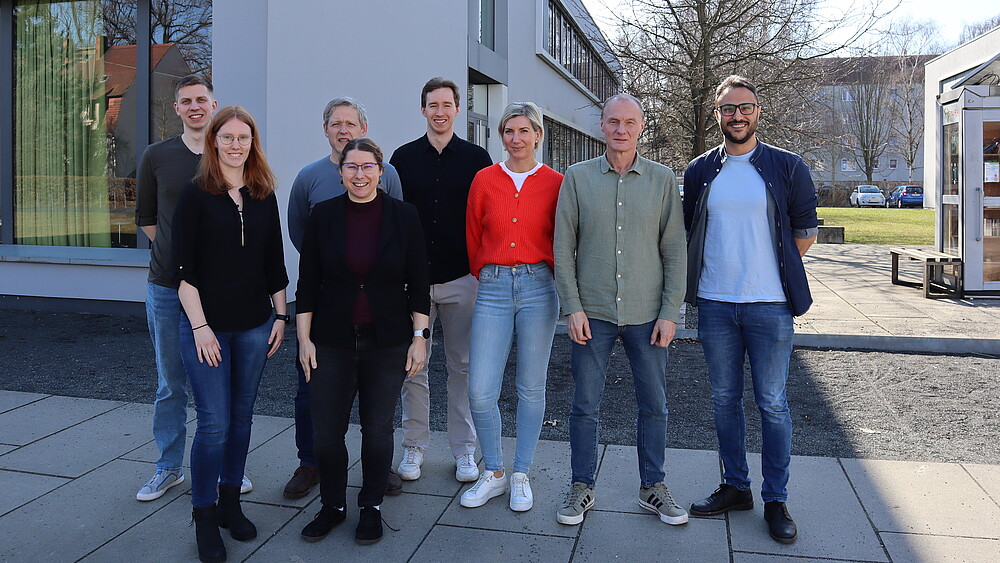
Getragen wird das Projekt von einem interdisziplinären Team aus vier Fachrichtungen, die an der Fakultät Natur- und Umweltwissenschaften der HSZG vertreten sind: Biochemie, Organische Chemie, Mikrobiologie und Zellbiologie. Beteiligt sind Prof. Dr. Eva Neugebauer (Biochemie und Technische Biochemie), Prof. Dr. Jan Mollitor (Organische Chemie und organische Spektroskopie), Prof. Dr. Thomas Wiegert (Mikrobiologie) und Prof. Dr. Elisa Wirthgen (Zellbiologie). Gemeinsam mit den Nachwuchswissenschaftlerinnen und -wissenschaftlern Dominik Günther, Pia Schubert, Ali Al Hamad und Dr. Max Brendel arbeitet das achtköpfige Team an neuen Ansätzen für Diagnostik und Therapie. Die fachliche Breite ist dabei ausdrücklich Teil des Konzepts: Der Austausch zwischen den Disziplinen soll neue Impulse für Methodenentwicklung und Anwendung schaffen.
Forschung mit Praxisbezug
Die Stärke des Projekts liegt in seiner Verbindung von methodischer Innovation und medizinischer Relevanz. Während in der biomedizinischen Forschung vielerorts an zielgerichteten Therapien gearbeitet wird, setzt die Nachwuchsforschergruppe in Zittau auf einen Ansatz, der verschiedene Prozessschritte zusammendenkt: von der Auswahl geeigneter Bindungspartner über deren Herstellung bis hin zur kontrollierten Modifizierung für diagnostische oder therapeutische Anwendungen.
Damit entsteht keine einzelne Technologie, sondern ein methodischer Werkzeugkasten, der perspektivisch flexibel auf unterschiedliche Fragestellungen angepasst werden kann. Gerade in der personalisierten Medizin ist diese Anpassungsfähigkeit entscheidend, weil sich Krankheitsverläufe und molekulare Zielstrukturen oft deutlich zwischen einzelnen Patientinnen und Patienten unterscheiden.
Gemeinsamer Auftakt und langfristige Perspektive
Ein erstes gemeinsames Treffen des Teams markierte den Start in die Zusammenarbeit und die nächste Arbeitsphase des Vorhabens. In den kommenden Jahren sollen die einzelnen methodischen Bausteine weiterentwickelt, miteinander verknüpft und im Hinblick auf ihren Einsatz in Diagnostik und Therapie erprobt werden.
Die Nachwuchsforschergruppe steht damit exemplarisch für ein Förderformat, das wissenschaftliche Qualifizierung, interdisziplinäre Zusammenarbeit und anwendungsnahe Forschung miteinander verbindet.
Erdgeschoss
Erdgeschoss
