Research, Skilled Workers, the Future: Politicians Visit the HSZG
During the visit by Prof. Dr. Andreas Handschuh and Christian Hartmann, the focus was on research excellence, STEM education, HighTech@HSZG, and the university’s future-oriented development.
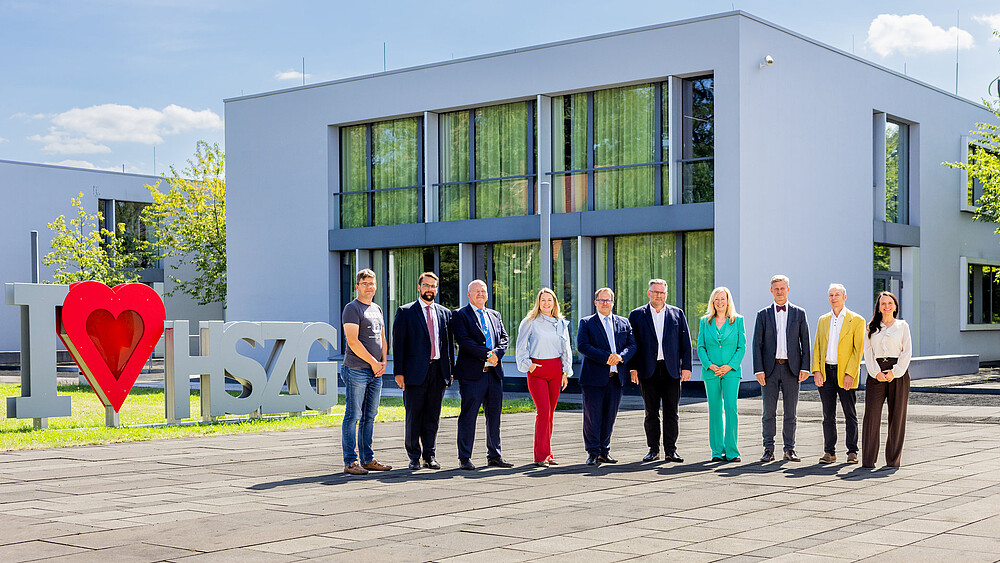
How can we ensure tomorrow’s energy supply? Where will the skilled workers for new key industries come from? And how should a university position itself as society, the educational landscape, and the world of work undergo fundamental changes? These questions were the focus of the visit by Prof. Dr. Andreas Handschuh, Head of the Saxon State Chancellery and State Secretary for Federal and European Affairs, and Christian Hartmann, Chair of the CDU parliamentary group in the Saxon State Parliament, on August 27, 2026, at the Zittau/Görlitz University of Applied Sciences.
Together with Rector Prof. Dr.-Ing. Alexander Kratzsch, Vice President Prof. Dr. rer. pol. Sophia Keil, Chancellor Christoph M. Duscha, and other university representatives, the guests discussed research, securing a skilled workforce, International Affairs, and the University Development 2030+ initiative. The program deliberately spanned topics ranging from specific research projects to extracurricular educational offerings and the university’s strategic development.
Research with an Impact on the Region and Beyond
The first stop was the Zittau Power Plant Laboratory. Prof. Matthias Kunick and Rector Alexander Kratzsch gave the guests a tour of the lab and provided insights into the research being conducted there. Three large-scale test facilities enable research into flexible power plant processes, thermal energy storage, and thermochemical conversion processes. Among other things, the research examines how energy systems can adapt to fluctuating feed-in from renewable energy sources.
Right next door, Thomas Gubsch presented the project’s test facility to the guests: AQVA-Heatproject. The technology, developed in collaboration with partners, demonstrates how alternative approaches can contribute to the heat transition: It uses rivers and open-pit mining lakes as heat sources, thereby directly linking application-oriented research to one of the central issues facing the future of the Lausitz region.
These two examples are representative of a research landscape that is significantly broader in scope. The HSZG focuses its research on the key areas of energy and the environment, transformation processes in the economy and society, and materials, structures, and surfaces. With approximately 14.3 million euros in third-party funding —about 135,000 euros per professorship, which is 2.6 times the average for universities of applied sciences—its research strength is also evident in the numbers.
The diversity of research on display here is impressive. From flexible power plant processes and energy storage systems to new solutions for the heat transition, the HSZG demonstrates how application-oriented research can provide concrete answers to the challenges of our time. This combination of scientific expertise, regional responsibility, and technological innovation is of particular importance for the structural transformation in Lusatia.
”


Inspiring a Passion Early On for Tomorrow’s Skilled Workers
The next item on the agenda made it clear that future technologies don’t just begin in college. At the DLR_School_Lab at Zittau/Görlitz University of Applied Sciences , students have the opportunity to conduct their own experiments, explore scientific concepts, and gain hands-on experience with STEM topics.
Dr. Fester, director of the DLR_School_Lab, demonstrated to the guests exactly what this looks like through a student experiment involving natural fibers that can be used to create new materials. The focus is not merely on understanding scientific concepts, but above all on trying things out for themselves and experiencing technology firsthand.
“Experiments like these spark a love of hands-on creation in students. For many of them, this is their first time using a 3D printer or laser cutter. That sparks curiosity,” says Rector Kratzsch with confidence. Vice President Sophia Keil also sees this as an important approach to securing tomorrow’s skilled workforce: “The DLR_School_Lab at the Zittau/Görlitz University of Applied Sciences is an ideal way to break down barriers to STEM subjects. Many students do not choose to pursue a STEM degree after graduating from high school because they fear they won’t be able to meet the demands. Programs like this one create new pathways through direct contact and hands-on experience.”
The learning center, which opened in May 2025, is part of the educational initiative ZukLOS (Upper Lusatia Learning Center for the Future). A unique feature: The students’ perspectives were directly incorporated into the design of the School_Lab from the very beginning. Children and teenagers, schools, and other regional partners were actively involved in the development process.
“The students were extensively involved in the design of the DLR_School_Lab. The university listened to them, took their ideas on board, and passed them on to the planners. This creates a completely different sense of connection between the students and the HSZG’s DLR_School_Lab,” emphasizes Vice President Keil.
The School_Lab thus exemplifies the HSZG’s approach of not only inspiring young people to take an interest in mathematics, computer science, natural sciences, and technology, but also actively involving them and enabling them to gain their own experiences with science and technology at an early age.
Christian Hartmann, chairman of the CDU parliamentary group in the Saxon State Parliament, also highlighted the importance of such programs:
When discussing the skilled workers of tomorrow, we must also consider where enthusiasm for technology and the natural sciences takes root. Extracurricular learning environments like the DLR_School_Lab serve as a vital bridge between school, science, and future career paths. Together with the impressive diversity of research at HSZG—ranging from energy and power plant research to innovative high-tech applications—this demonstrates how a region can open up concrete future prospects for young people.
”


A University in Transition
During the subsequent discussion, the strategic development of the HSZG took center stage. After all, it’s not just technology that’s changing. Social expectations, educational backgrounds, and the demands placed on skilled workers are also evolving.
With the University Development 2030+ initiative, the university is responding to these changes and making its structures, academic programs, research, knowledge transfer, and internationalization fit for the future. The transformation process, which has been underway since 2020, includes, among other things, new faculty structures, the further development of academic programs, greater internationalization, more efficient structures, and the continued strengthening of research.
Universities must adapt as the world around them changes. Our goal is therefore not merely to react to developments, but to actively shape them together with our partners. The University Development 2030+ initiative creates the structural conditions for this: for strong research, modern teaching that is internationally compatible, and knowledge transfer whose impact is truly felt in the economy and society.
”The HSZG’s High-Tech Strategy. In collaboration with companies and stakeholders in the semiconductor industry, the university has developed two new degree programs: Semiconductor Processes and Materials Chemistry and Mechatronics for Manufacturing. The development process incorporated the requirements of leading companies in the industry. The degree programs were also presented to TSMC and ESMC, among others, and are intended to help train skilled professionals in a practical and tailored manner for one of Saxony’s most important industries of the future.
In this way, the HSZG combines regional responsibility with a broader impact: young talents gain new perspectives, companies gain access to qualified young professionals, and the region gains additional opportunities to position itself sustainably in the international high-tech landscape.
A university is at its strongest when it understands its region while also thinking far beyond its borders. That is exactly what we are working toward. The fact that our partners in politics and business are joining us on this journey, recognizing the strength of our research, and supporting the ongoing process of change is an important sign for us. Today’s open and constructive dialogue demonstrates just how valuable a genuine partnership is for the future of our university and the entire region.
”


A Campus Becomes a Place of Learning
During the subsequent campus tour, it became clear that education at HSZG doesn’t end at the lecture hall door. Stops along the tour included the nearly ten-meter-tall wind-photovoltaic tree, which combines wind and solar energy; the makerspace, equipped with 3D printers, laser cutters, and robotics; and the Green Classroom, an open-air space for learning and socializing.
These learning spaces are part of Campus4You, a key area of focus within the ZukLOS initiative, and bring together education, technology, sustainability, and community engagement. Schools were involved in the development of these programs from the very beginning. This creates spaces where K-12 students, college students, teachers, university staff, and people from the region can experiment, learn, and develop new ideas together.
The guests were particularly impressed by the combination of modern research infrastructure, accessible educational programs, and practical applications. The tour highlighted how the university is increasingly integrating research, teaching, knowledge transfer, and the support of emerging researchers.


Entry in the HSZG’s Golden Book
A special highlight of the visit was the entry in the Golden Book of Zittau/Görlitz University of Applied Sciences. It underscored the friendly nature of the meeting and the close ties between the university and its partners in Saxon politics.
Following in-depth discussions, many insights, and a joint tour, the visit concluded with a clear shared understanding: The major changes in energy supply, the economy, education, and the world of work can best be shaped collaboratively—through strong networks, bold ideas, and a university that consistently aligns its research and teaching with the future.


Discover. Experiment. Shape the future.
The Upper Lusatia Learning Center for the Future (ZukLOS) is the educational initiative of the Zittau/Görlitz University of Applied Sciences for extracurricular STEM education.
The initiative brings together various learning centers and programs:
- Zittau Junior Academy with the DLR_School_Lab at Zittau/Görlitz University of Applied Sciences
- Görlitz Experiment House
- Mobile Learning Spaces
- Campus4You with a makerspace, green classroom, and other learning and social opportunities
ZukLOS is not only aimed at children and young people but also views the university as a place of learning and community for people of all generations. The goal is to strengthen STEM skills, foster talent at an early stage, and thereby make a long-term contribution to education and future viability of Upper Lusatia.
Two new degree programmes. An industry with a bright future.
Starting in the 2026–27 winter semester, the HSZG will offer two new degree programs developed in close collaboration with the semiconductor industry.
– Bachelor of Science in 6 semesters | Zittau campus | No admission requirements
Semiconductor Processes and Materials Chemistry: This degree programme specifically prepares students for careers in the chip and semiconductor industry.
About the Semiconductor Processes and Materials Chemistry degree programme
Mechatronics for Manufacturing – Bachelor of Engineering, Double Degree
6 semesters | Zittau and Liberec | open admission
This international degree programme combines mechatronics with modern manufacturing technologies and is offered in collaboration with the Technical University of Liberec.
About the Mechatronics for Manufacturing degree programme
Submit your application by September 30, 2026, to secure a place at university for the winter semester. Both degree programmes have no admission requirements and begin in October 2026.


1st floor