
G
09. June 2020
Professor Kornhuber, his students and digital teaching
Word has already spread about the digital teaching of Professor Kornhuber from the Faculty of Electrical Engineering and Computer Science'. His students are simply thrilled. And so is the professor.
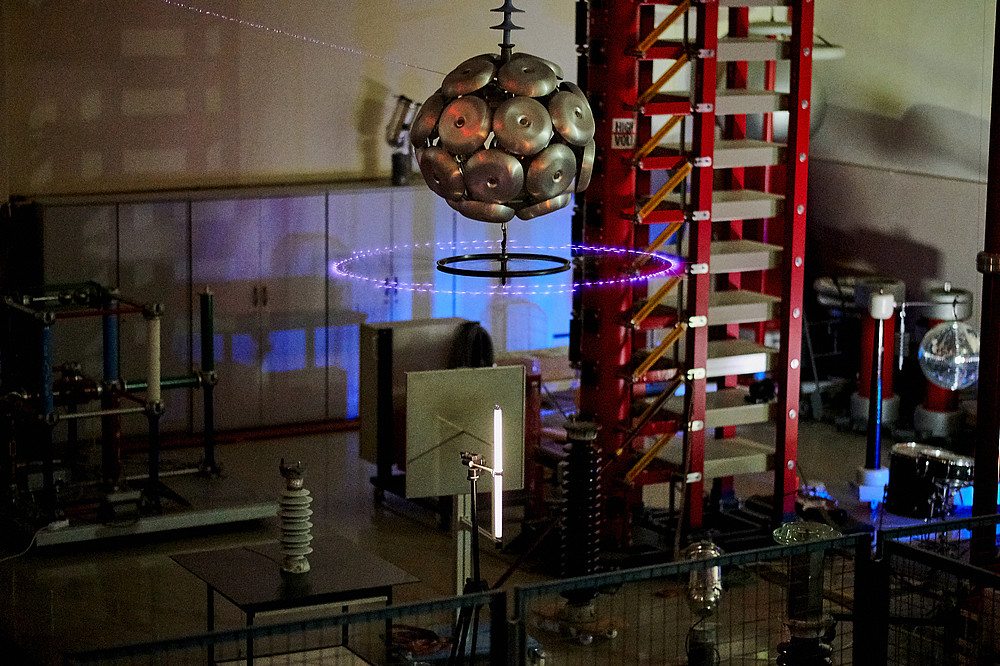
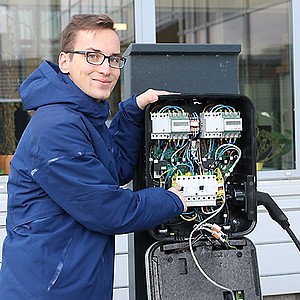
"In the summer semester, I have the privilege of accompanying 14 students in the high-voltage engineering module," says Prof. Dr.-techn. Stefan Kornhuber. He specializes in high-voltage engineering and theoretical electrical engineering. "We're doing classes / courses as usual," he says, "certainly - now restricted by the coronavirus pandemic - in a slightly different format." Lectures will take place via Microsoft Teams, i.e. in video conferences at the usual times. "So that the students' daily rhythm is maintained." Of course, certain things are different when you only meet digitally. Kornhuber's digital teaching was also inspired by the flipped classroom method. The content is prepared by the students. Some of the students form the expert group that evaluates the prepared content. This often results in fruitful discussions. "I'm not the content provider," says Kornhuber, "I'm the moderator."
“
"The amazing thing is the disciplined, professional and highly motivated approach of the students."
”
Kornhuber
Kornhuber says that the challenge is now to implement the former blackboard images with the help of online tools and to teach and learn with them. Even with the changed framework conditions: in the absence of a "missing blackboard", the expert groups created posters and slides in PowerPoint. This required attention, guidelines and discipline from everyone involved. "The amazing thing is the disciplined, professional and highly motivated approach of the students," says the professor. It is fascinating to see the flexibility that digital teaching brings compared to the real world. "Communication is much more active." It was important to Kornhuber not to deliver anything out of the box, as he says. Rather, to remain in a live discussion area, to offer teaching at the usual times, not at the blackboard, but via the online channel. "That's my job. I don't do anything special. The biggest thanks go to my students."
We asked two students what makes Professor Kornhuber's digital teaching special for them, what they like about it and what difficulties digital teaching can also bring.
“
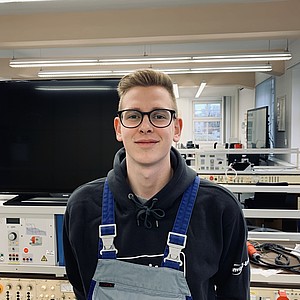
The synergy between professor and students is really pleasant. The whole subject feels like one big panel of experts, with Prof. Kornhuber imparting the most knowledge. Niklas Fabricius, KIA student
”-
What do I like about Prof. Kornhuber's digital teaching?
Since our faculty—and especially our class—offers digital versions of virtually all modules, we can easily compare Prof. Kornhuber’s teaching with other plans and procedures.
In particular, I think the use of MS Teams stood out , which makes the process much more relaxed for us, since it allows us to easily share files, make lectures interactive, and even create our own student groups.
This is a welcome change, since we really only need to use one tool for the lecture instead of countless different ones like Webex, BBB, filr, OPAL, etc.
“Interactivity” was indeed the key word here, as Prof. Kornhuber, more than any other professor, emphasizes student participation. In the High-Voltage Engineering module, for example, the in-person component originally called for students to create posters and prepare accompanying presentations on various topics. However, we have now carried these out almost unchanged in Teams, which, while certainly took some getting used to, was—for me, at least—very instructive for my future work in the corporate world.
Prof. Kornhuber also “encourages” students to pose questions to one another, which in turn are used to generate the exam questions. As a result, the synergy between the professor and the students is truly enjoyable, as the entire course feels more like a large panel of experts, with Prof. Kornhuber simply imparting the most knowledge.
Furthermore, the High-Voltage Engineering course is the only one that has succeeded, together with the other instructors, in conducting the numerous lab sessions digitally (in preparation for the upcoming in-person sessions).
Overall, it is the very extensive engagement in discussions on the topics Prof. Kornhuber raises that sets him apart from the other instructors. In short, his class simply feels the most like a conventional in-person course with a strong student-centered focus. -
What do I generally not like so much about digital teaching?
I have deliberately omitted the professor from the question, as my points do not relate directly to Prof. Kornhuber, but to digital teaching in general.
For me, the interaction between lecturers and students is particularly important, which sometimes feels strange in online teaching, as it is possible to simply remain silent, which is not possible in a face-to-face course.
In addition, the pace is often too fast in all courses, as the professors cannot check whether the students are still writing or similar, but most of them also get feedback on this.
“
A great feedback culture and appreciative communication at eye level, combined with binding persistence. Marcus Wöckel, KIA student
”-
What characterizes Professor Kornhuber's digital teaching?
For me, the course’s strengths can be summarized in five points:
- Proactivity—we had an almost seamless transition from in-person to online classes / courses. Communication always took place well in advance, primarily during the lecture and only via email when absolutely necessary, and was always to the point.
- Dynamism and interaction with students are often encouraged even before the actual class / course begins, through the requirement to submit three questions regarding the topic to be discussed as a group. If the momentum in a typical lecture without a group discussion starts to fade, Professor Kornhuber reacts flexibly and gives students time to let the content sink in for 5 minutes before asking questions.
- A culture of feedback and respectful communication on an equal footing, combined with a firm persistence when student feedback is obviously insufficient. In cases of uncertainty regarding assignment solutions, screen sharing is permitted during seminars.
- A goal- and practice-oriented teaching approach featuring expert lectures delivered by the students themselves, followed by a mandatory discussion. In addition, Professor Kornhuber relies on the MS Teams software, which is already in use by many dual-track students at their companies. The adjustment period was correspondingly short, and there were no capacity-related, predictable lecture cancellations, as is often the case in other courses at the beginning of the semester.
- He sees himself as a facilitator and moderator in the organization of his class / course. The delegation of responsibility and the development of collaborative solutions are achieved through his facilitation—not by decree—but in a way that ensures the good collective solution prevails and is also supported by the students.
Faculty of Electrical Engineering and Computer Science'
02763 Zittau
Hochwaldstrasse 2a
Building Z V,
Room 117
1st floor
1st floor
+49 3583 612-4365
Institute for Process Engineering, Process Automation, and Measurement Technology
02763 Zittau
2a Hochwald Street
Building Z V,
Room 117
1st floor
1st floor
+49 3583 612-4365