
Studying with the Saxon teaching award winner
Professor Sonja Schellhammer on individualized teaching, surprising learning moments and new approaches in physics.
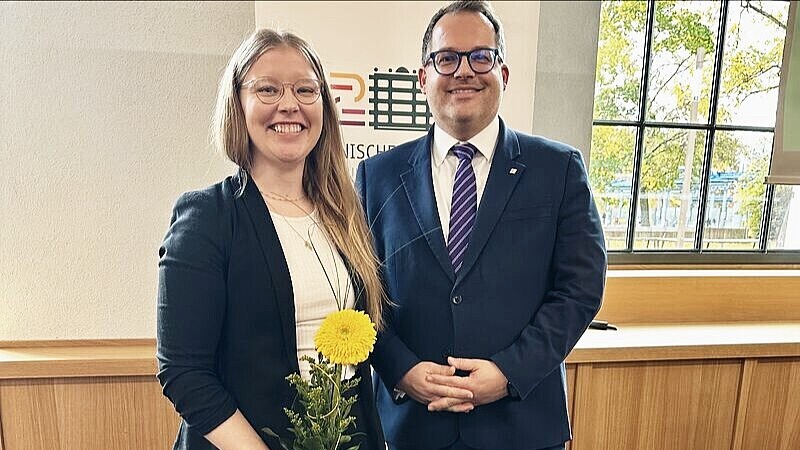
After Professor Sonja Schellhammer was awarded the 2025 Saxon Teaching Prize, we wanted to learn more about her approach to teaching, how she inspires students’ enthusiasm for physics, and what ideas she has for the future of teaching culture at our university.
In our conversation, it becomes clear that for her, individualization is not a method but an attitude—one based on trust, diversity, and appreciation.
I hand out a lot of keys, and students try to see which one fits.
Professor Sonja Schellhammer, you received the Saxon Teaching Award for your teaching approach in physics, a subject often considered difficult. What was your secret to getting students excited about physics?
I’d say that’s exactly the point: that key looks different for every student. So I hand out a great many “keys” and let the students try for themselves to see which one fits.
From a pedagogical perspective, I offer numerous learning approaches from which students can choose and combine as they see fit. The content is clearly defined. A second important aspect for fostering a connection between me, as a representative of physics, and the students’ curiosity is mutual respect and communication on an equal footing.
Structure, Freedom, and Motivating Examples
Your project workshop in the degree programme Green Engineering is considered an example of individualized instruction. How do you manage to engage students with different levels of prior knowledge and interests?
What I can absolutely recommend for this are clear, self-explanatory, and visually appealing lecture slides that can also be used directly as study materials and are available for students to download before each lecture begins. This has several advantages. On the one hand, most people learn primarily visually, so good-quality slides with appropriately embedded images and videos can make a big difference in terms of motivation and comprehension. On the other hand, it reduces barriers for students who, for example, cannot be physically present, have hearing impairments, or have a short attention span (in addition, the slides are fully equipped with screen-reader-friendly alternative text for visually impaired and blind people). At the same time, this ensures that the exam material is transparently documented for students.
Above all, however—and this brings me closer to the question—it creates freedom for us: for students to focus on learning rather than taking accurate notes, and for me to address alternative explanations, approaches, examples, reviews, and connections to related topics such as fields of research. For example, when discussing the principle of superposition for multidimensional kinematics, it makes a difference whether I simply calculate the projectile motion in the traditional way or, for students interested in sports, use the long throw as motivation, and for those interested in video games, use the left-handed bomb throw from the Zelda series. In addition to such everyday or hobby-related topics, socially relevant issues also play a role here, as do examples from nature, the animal kingdom, technology, and current pop culture in the form of memes, Reels, and Shorts.
Then there’s optional content—for example, at the start of the semester, a math self-assessment that directs students to topic-specific materials for independent study based on their results. I address the fact that students have, in some cases, very different learning backgrounds, as well as common misconceptions regarding physics. For students interested in more complex topics, I’m happy to provide relevant supplementary material on advanced topics via the learning platform. For questions from students that actually go beyond the course material but are of interest to them, I usually prepare a short, relevant learning sequence for the start of the next lecture. I also offer several optional physics-related field trips. Before lecture experiments, I like to ask students what outcome they expect, and then compare that with the actual outcome of the experiment. The internship is also organized as a project workshop, in which students can choose a topic based on their own interests and then, guided by input and milestones, work on it at their own pace and in their own way.
It may also be worth mentioning a subgroup of students who have been taught throughout their lives that they simply aren’t cut out for physics. What often helps here is creating opportunities for them to experience success. I can facilitate this in a targeted way, for example through quizzes and short assignments in class on the material just covered—which can be solved without much prior knowledge—through “Think-Pair-Share” activities, and through homework problems that gradually increase in difficulty. Moreover, behind a wrong answer there is usually a line of reasoning that is largely correct and deserves to be acknowledged. I’ve also learned that it’s demonstrably helpful to directly address the fact that the idea that girls are simply worse at science than boys has been comprehensively refuted by science.
University pedagogy shows us alternatives—and it fosters a sense of community
In your view, what role does university pedagogy in the further development of teaching quality?
Purely from the perspective of a practitioner, higher education pedagogy excels above all in offering us, as instructors, alternatives. It can paint a picture of what teaching can look like today—in contrast to what we ourselves may have experienced back when we were students. It can draw our attention to solutions for problems we’ve perhaps been facing for a long time or that have arisen only recently due to new developments. It can show us tools, concepts, and ideas from which we can freely choose and develop our own teaching style. It also provides us with evidence-based information for decisions we might otherwise make based solely on intuition—for example, regarding psychological biases associated with different types of exams. It can reinforce our confidence in our role as educators, and, of course, help us network and connect with one another, fostering a sense of community and belonging.
The Courage to Break New Ground
What kind of impetus do you hope your teaching concept will provide for the future teaching culture at our university?
To be honest, I was completely taken aback when, in my very first semester as a professor, I was nominated by several students for the university’s teaching award—for a subject that’s more notorious than popular—and now to even have the opportunity to help shape the future teaching culture at the university. I’m just as amazed when I sometimes see students realize how much they’re suddenly interested in physics after all, or that they’re capable of something they wouldn’t have dared to attempt before. And perhaps that is precisely my inspiration: We can dare to break new ground and be open to being amazed.
The interview was conducted by Daniel Winkler, Advisor on University Pedagogy at Zittau/Görlitz University of Applied Sciences.
The interview clearly demonstrates why Professor Sonja Schellhammer’s teaching was recognized with an award: She combines academic depth with inclusive approaches, creates learning environments that view diversity as a strength, and exemplifies what contemporary teaching at a university of applied sciences can look like.
Through her attitude and commitment, she provides inspiration that extends far beyond physics—and contributes to the further development of the teaching culture at HSZG.
From the summer semester 2026, the format "Austausch Lehre HSZG" will enter a new round with current university and media didactic topics.
The main content of the initially planned monthly meetings via video conference will be topic-related impulses in the form of short presentations and their subsequent discussion. Lecturers at the HSZG can use this platform to exchange their experiences with university teaching on a cross-faculty / trans-faculty basis and to promote the transfer of practical approaches.
Further information can be found here.
The programs offered by the Saxony Center for Higher Education Pedagogy are designed for instructors at various levels of experience, from different professional groups, and across various departments who wish to engage in a structured way with selected topics in higher education pedagogy and/or highlight their commitment to teaching.
You can find the full list of offerings and registration information for the higher education pedagogy continuing education programs here.
2nd floor
4th upper floor