
Event details
Three Students, Three Perspectives
Three IAESTE interns, three perspectives: advancing research at IPM through course-related practical experience and making the results accessible to others.
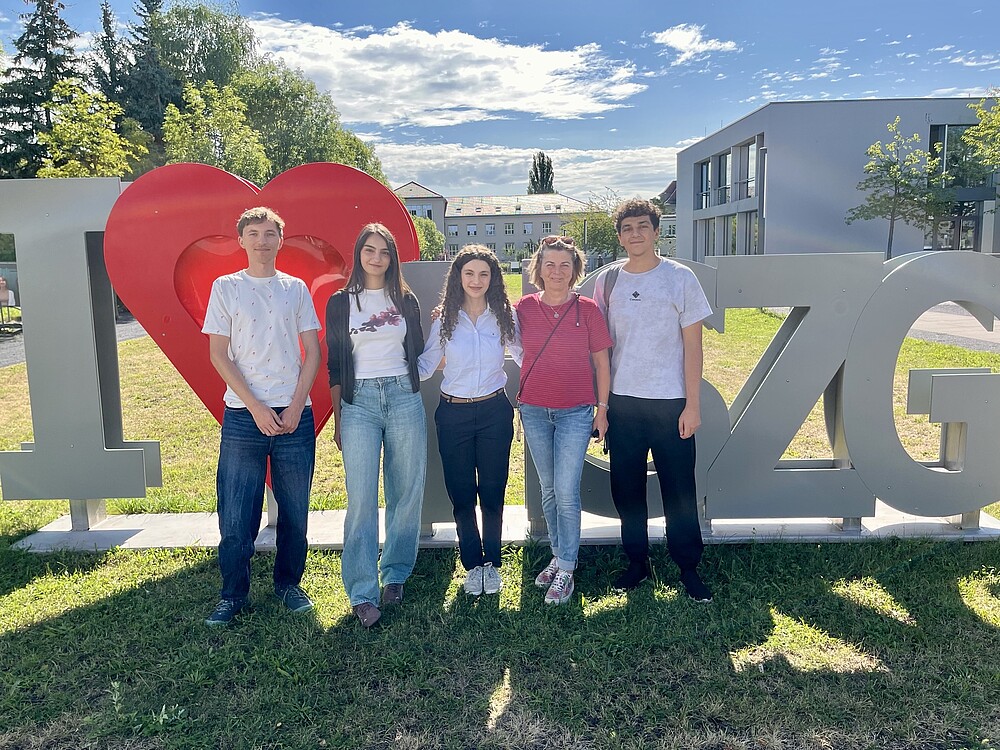
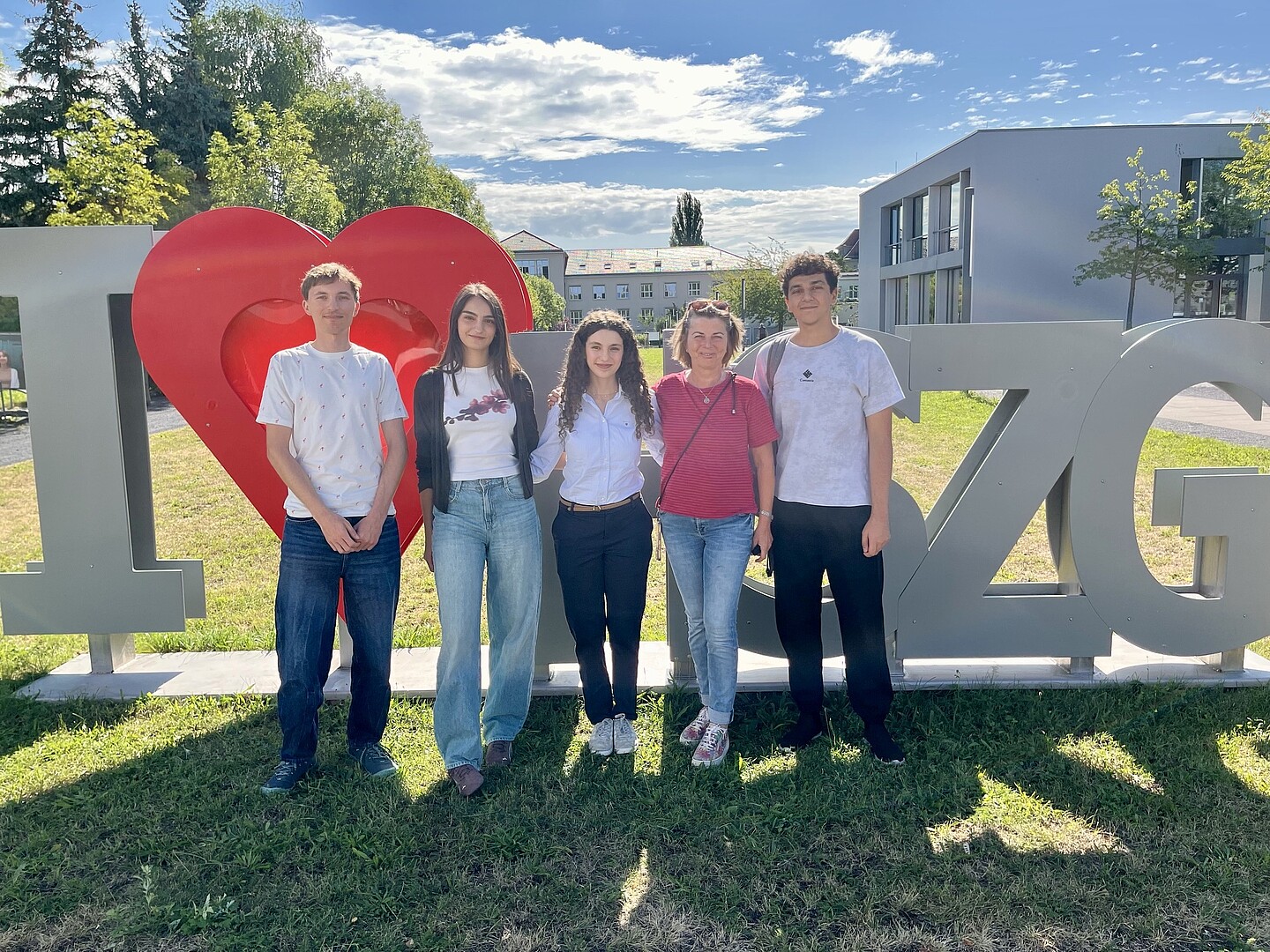
In summer 2026, the Institute for Process Technology, Process Automation and Measurement Technology (IPM) at Zittau/Görlitz University of Applied Sciences welcomed three international students who had been placed through the International Association for the Exchange of Students for Technical Experience (IAESTE) for paid, course-related internships.
Hussein Aldalou, Karma Ajaj and Ema Tashkovska worked on topics reflecting the institute’s broad range of expertise: cooperative mobile robotics, sensor-based vehicle control and the clear 3D visualisation of an innovative energy system.
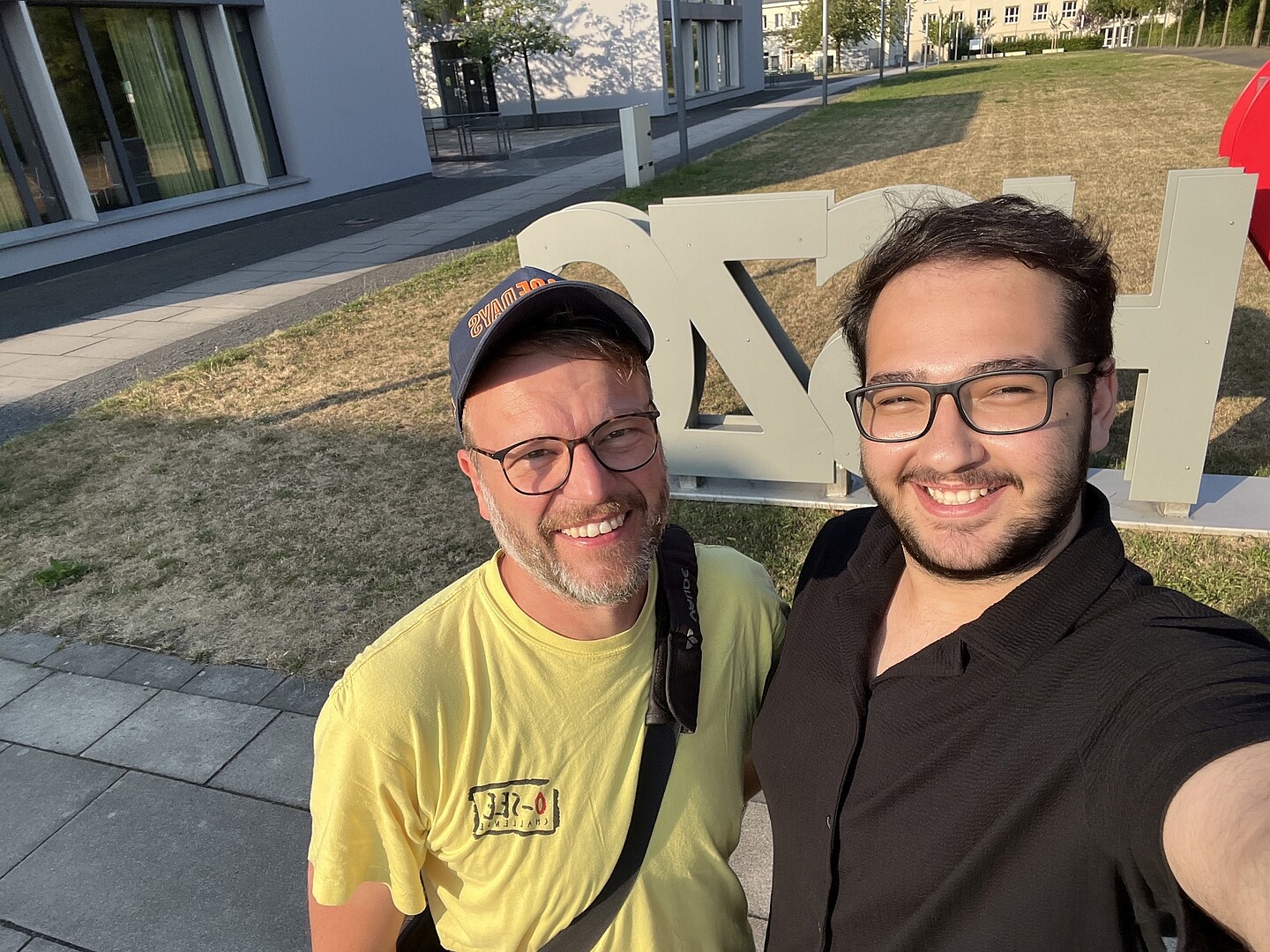
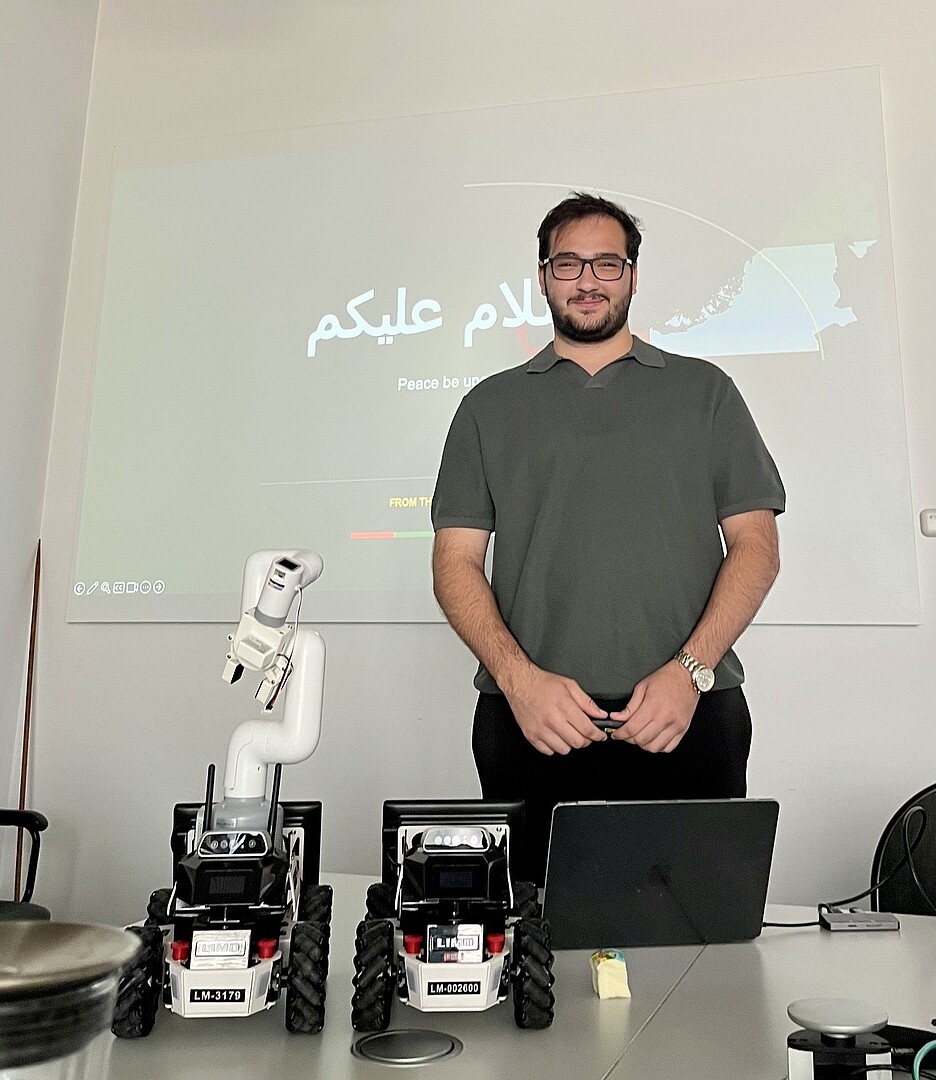
Cooperative robotics: Two LIMO robots complete a task together
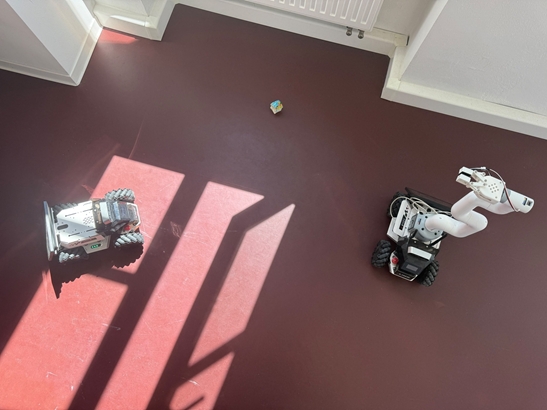
During his 320-hour internship, Hussein Aldalou, a mechanical engineering student at the University of Sharjah, developed a cooperative workflow for autonomous object search and retrieval using two AgileX LIMO robots. One robot acted as an external observer: using an RGB-D camera, it detected the second robot and the target object, searched for both autonomously and determined their relative positions. The second robot used this information to align itself, approach the object in a controlled manner and pick it up with a MyCobot 280 robotic arm.
For the implementation, Hussein combined ROS 2, AI-based object detection with YOLO, depth-image processing, LiDAR and IMU data, and methods for markerless pose estimation. Under controlled laboratory conditions, he integrated the individual functions into a staged end-to-end workflow and tested it in practice. He placed particular emphasis on safety checks, traceable test data and detailed technical handover documentation. This will enable future students and researchers to restart the system safely and develop it further in a targeted way.
Autonomous speed control on a small scale
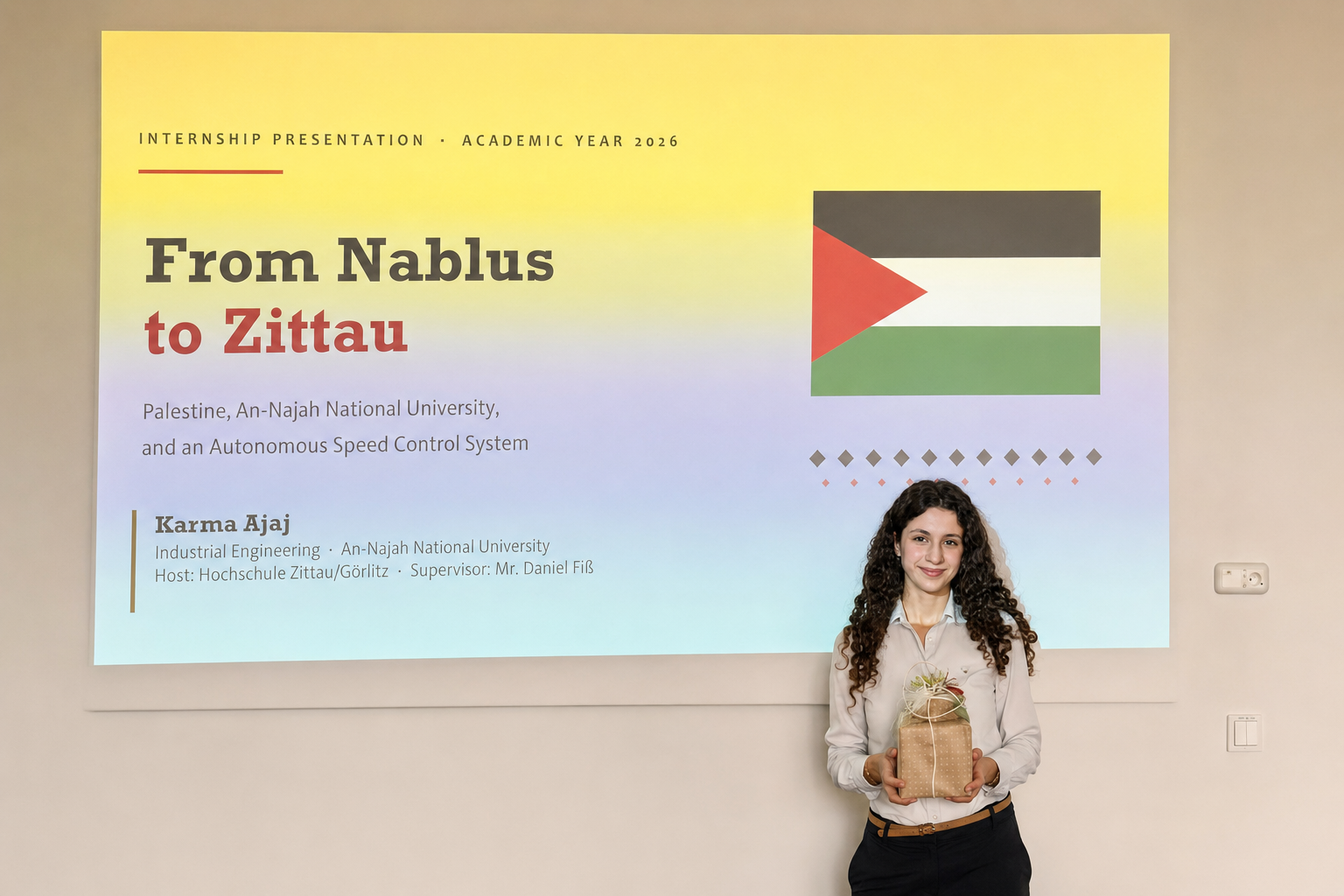
Karma Ajaj from the Department of Industrial Engineering at An-Najah National University worked on the automatic speed control of a vehicle on a Carrera Digital 132 racetrack. The goal was to replace continuous manual operation of the hand controller with sensor-based control while retaining the existing Carrera infrastructure.
To achieve this, Karma mounted a compact sensor unit consisting of an ESP32-C3 microcontroller and an MPU6050 inertial measurement unit directly on the vehicle. Acceleration and angular-rate data were recorded in real time and transmitted wirelessly via ESP-NOW to a second ESP32. Based on these measurements, the controller distinguished between straight sections, normal curves and tight curves and derived appropriate speed commands. A 12-bit digital-to-analogue converter then generated the analogue signal for the Carrera control system.
The demonstrator therefore covered the entire chain from motion sensing and data transmission to state classification and automatic adjustment of the driving command. It showed how fundamental principles of autonomous systems can be investigated using compact, low-cost hardware and created a basis for further work - for example on adaptive control algorithms, track learning or quantitative comparisons with manual driving.

Making research visible: The AQVA-HEAT system as a 3D model
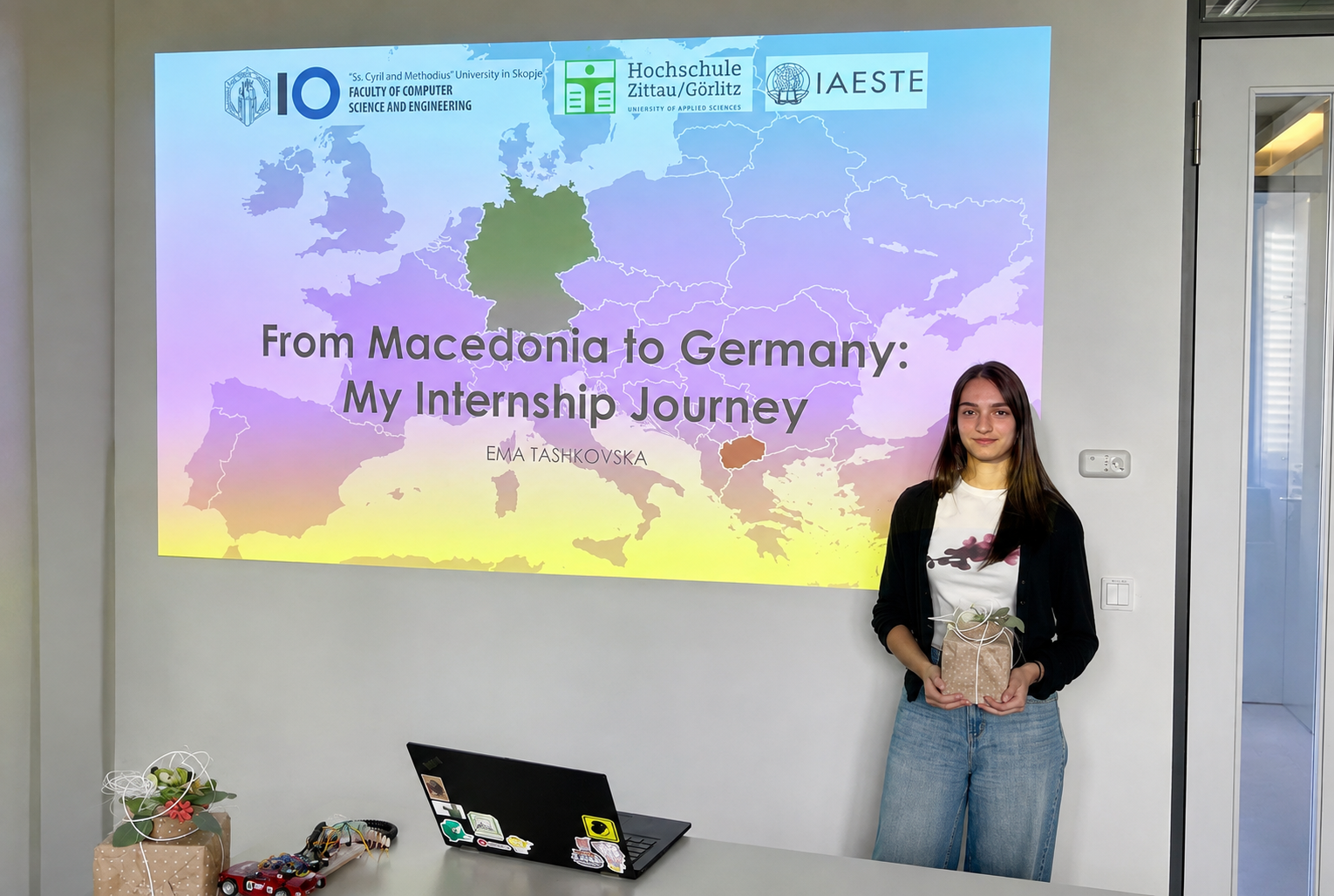
Ema Tashkovska is a Software Engineering and Information Systems student at the Faculty of Computer Science and Engineering at Ss. Cyril and Methodius University in Skopje, North Macedonia. From 1 July to 26 August 2026, she worked on a 3D model of the direct evaporator in the AQVA-HEAT vacuum ice-slurry plant. The process is intended to make water from rivers and lakes usable as a heat source for heat pumps even at low temperatures. Because the processes inside the plant are difficult to observe from the outside, the aim was to create an illustrative digital model that communicates its structure and operating principle more clearly.
Using Blender, Ema modelled central components such as the impeller of the water-vapour turbo-compressor, the agitator in the evaporator, the spray nozzles of the direct condenser, the condensate collection area and the surrounding vessel. She then assembled the components into a complete scene and added materials as well as process and motion effects. In addition to a stainless-steel version with visible steam, she created a transparent housing version through which the compressor, condensation process and liquid regions inside the unit can be observed.
The resulting renderings and animations provide a valuable basis for communicating the complex plant technology in research, teaching and science communication. Ema also documented possible extensions - from additional pipes and valves to a more realistic representation of the ice slurry and more advanced process animations.

International perspectives for research and teaching
The three internships demonstrate how IAESTE combines course-related professional experience with international cooperation and intercultural exchange. Hussein integrated a complex robotic system and documented it for continued development, Karma created a demonstrator for autonomous control, and Ema made a technically demanding energy process visible in a three-dimensional model.
We would like to thank Hussein, Karma and Ema for their commitment, ideas and excellent work, and we wish them every success in the future. We also thank Daniel Fiß and Johann Meyer-Scheffel for their technical supervision and Simone Kunze for her invaluable administrative support.
Connecting Across Borders
Alongside their intensive work in the laboratory, the students also had plenty of opportunities to experience the region. Together with Simone Kunze, they explored the Zittau Mountains on hiking trips and spent weekends visiting European cities such as Dresden, Berlin, Prague and Munich. These shared experiences fostered close bonds, and the international guests quickly formed lasting friendships with German students that will extend well beyond the internship period.
Interested in Getting Involved?
- For students: Would you also like to complete a paid internship abroad? Find out more and register via the IAESTE Exchange Platform.
- For companies and research institutes: Would you like to attract international talent? Contact the IAESTE national committee to find out how you can offer internship placements.
Upper floor
First floor
1st floor