
03. March 2015
Civil society as a local transformation actor
The documentation of the 8th November conference under the direction of Prof. Dr. Kollmorgen is now online.
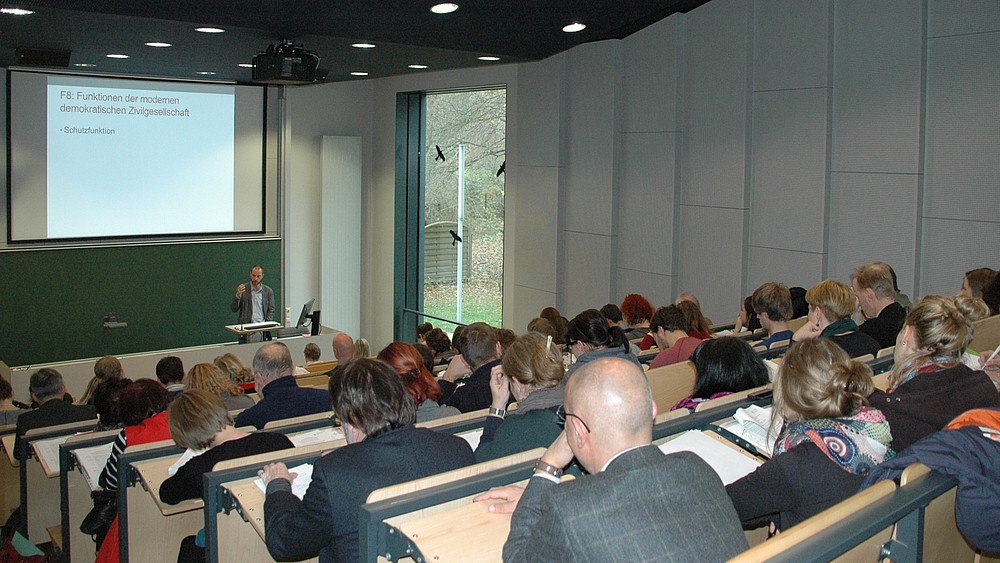
The opportunities and limitations of civic engagement in local transformation processes were the focus of the 8th November Conference in 2014, chaired by Prof. Dr. Raj Kollmorgen of the Faculty of Social Sciences. More than 70 guests from Dresden, Berlin, Vienna, and the surrounding region discussed how civil society can serve as a catalyst for local change processes in rural areas and small- to medium-sized towns; what motivates the key players; what opportunities for action and impacts they achieve; what structures civic engagement requires, and what this means for the relationship with market and state actors.
Three expert presentations framed the thematic field from various academic perspectives. European ethnologist Anna Eckert (University of Vienna) described the effects of the economization of municipal governments on civic engagement. Prof. Dr. Raj Kollmorgen (Management of Social Change, Zittau/Görlitz University of Applied Sciences) outlined the limits of civil society, while sociologist Michael Thomas (BISS e.V.) addressed the constraints on the scope of action for civil society actors in the process of social transformation in rural areas.
During roundtable discussions, various stakeholders shared practical insights and discussed the motivations, framework conditions, and obstacles faced by regional citizens’ initiatives, networks, and associations in the areas of regional development, car-sharing in the “Dreiländereck” region, cross-border volunteer services, energy cooperatives in Saxony, political citizen participation processes in municipalities, and new sharing economies.
CONCLUSION: In order to harness the diverse potential of civil society actors at the local level to shape the ongoing transformation processes—as a force for action alongside the market and politics—these actors need an empathetic culture of cooperation, shared motivations to improve the status quo in the interest of future well-being, unifying and reliable structures, as well as the time and financial resources needed to actually implement their own ideas for “doing things differently.”
Ihre Ansprechpartnerin
Diplom in Business Administration (FH)
Katrin Treffkorn
Institute for Transformation, Housing and Social Spatial Development
02826 Görlitz
Parkstrasse 2
Building G VII,
Room 315
2nd upper floor
2nd upper floor
+49 3581 3744349