High technologies from space research
HSZG is participating in the ERIS project. The aim of the project is to develop innovative solutions for technologies for future life on other planets and resource conservation on Earth.
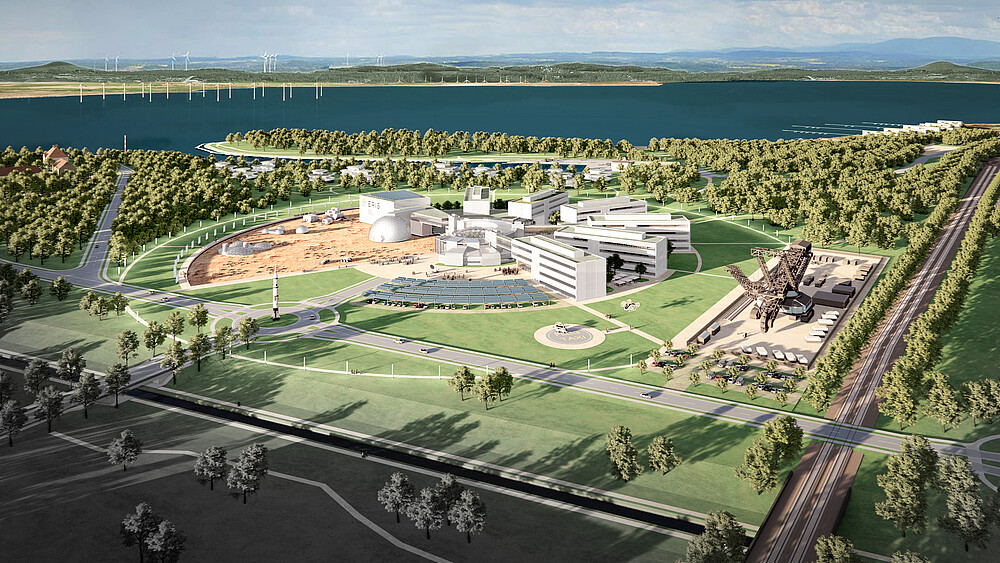
Through the initiative “Knowledge Creates Opportunities for the Region!”, the Federal Government and the Free State of Saxony aim to support structural change in Saxony’s coal-mining regions by establishing two new large-scale research facilities.
The space technology project “European Research Institute for Space Resources—ERIS” proposes a concept for such an institution that builds on the coal region’s existing expertise and further develops it to ensure its future viability and competitiveness in international growth markets.
In addition to many regional institutions, the Zittau/Görlitz University of Applied Sciences is also a partner in this project.
In this interview,Prof. Dr.-Ing. Stefan Kornhuber discusses the background and the HSZG’s research initiative within the ERIS project:
Prof. Kornhuber, what is the ERIS project all about?
The idea behind ERIS—as well as the Mars and Moon expeditions— is not to be constantly dependent on supply modules from Earth, as is the case with the ISS, but rather to set up the first station with only the bare essentials and then, piece by piece, literally build “everything” on site using available materials and produce food.
What contribution is the Zittau/Görlitz University of Applied Sciences making to this?
Energy is the foundation of life in self-sufficient systems. Researchers at Zittau/Görlitz University of Applied Sciences are focusing on the electrical power supply, with a particular emphasis on the necessary safety and resilience of the systems. In addition, they are developing the necessary components from available raw materials under the specific conditions at hand, as well as conducting economic evaluations of the proposed solutions.
Could you elaborate on that a bit more?
To enable self-sufficient life on other planets, energy is particularly essential. Without oxygen, conventional combustion is not an option here. Nor is wind power. That leaves electrical energy generated by photovoltaics. Our colleague Dr. Hartmut Stöcker from the TU Bergakademie Freiberg is contributing to this area of research.
To ensure a direct current (DC) power grid on which all life—including life support systems—depends, stable, self-sufficient, and cell-autonomous energy networks are required, along with redundant and resilient systems that account for both generation and load demands. The novelty compared to the ISS lies in the increased energy requirements for food production and the supply of water and energy needed for production. Prof. Dr.-Ing. Uwe Schmidt from our Faculty of Electrical Engineering and Computer Science is working on the prerequisites and ensuring the necessary electrical grid.
In order to manufacture, install, and operate the corresponding energy systems on site while taking environmental conditions—particularly pressure and cosmic radiation—into account, suitable materials must be identified and qualified using available raw materials so that the systems can be built with the appropriate energy density. This applies in particular to switchgear and cabling systems, but also to components such as those found in “residential electrical installations.” I am responsible for this area of electrical components within the team.
In addition, as was already implemented at NASA decades ago, potential solutions must undergo an economic evaluation before they are implemented. The goal is to find the optimal balance between technical feasibility and cost. Prof. Dr. Tino Schütte from the Faculty of Business Administration and Engineering Management is working on this.
What added value does the project offer beyond the prospective use of innovative technologies on other planets?
By using the insights gained from available constraints to create a self-sustaining system, corresponding novel approaches can also be developed on Earth to minimize the use of raw materials and become less dependent on resources that have been scarce and critical up to now.
The TU Bergakademie Freiberg recently published the following press release on ERIS:
Whether satellite systems, precise positioning technology or the finest sensors - high technologies from space research are already shaping our everyday lives today. But they can do much more for a sustainable and resource-conserving life on Earth. In the ERIS project, scientists at TU Bergakademie Freiberg, together with partners from space research and technology as well as from raw materials, energy, materials and production research, want to develop technologies that not only meet the conditions on other planets, but also offer innovative solutions for current challenges on Earth.
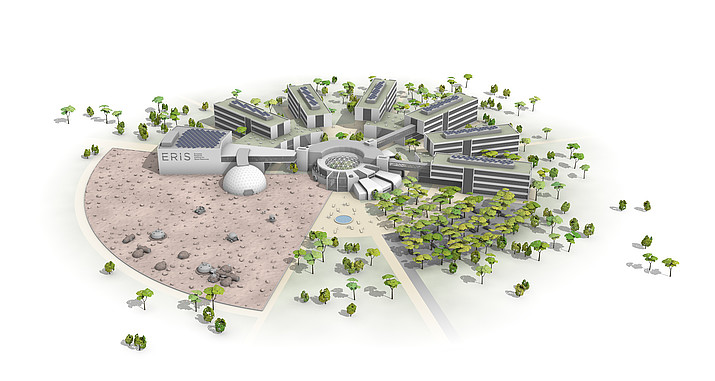
ERIS Enables Cutting-Edge Space Research in Saxony
If approved by the Federal Ministry of Education and Research (BMBF) and the Free State of Saxony, ERIS could become one of two new major research centers in Saxony’s coal-mining regions. This would open up new economic opportunities and create high-tech industrial hubs that generate numerous jobs.
At the technology center—equipped with state-of-the-art simulators for planetary surfaces and habitat technologies, as well as robotic and autonomous systems—scientists will then work to develop, among other things, processes and methods for building self-sustaining space stations. These include, for example, new 3D printing processes, artificial intelligence-based production systems, and self-sufficient supply and energy systems that produce no emissions or waste. “This will make it possible to construct space stations directly on the Moon using locally available materials and to sustain them self-sufficiently under extreme conditions,” explains Prof. Drebenstedt, TUBAF spokesperson for ERIS. Initial construction and testing missions could become a reality in the not-too-distant future. After all, new lunar and Martian missions by NASA, the ESA, and other private companies are already planned for 2025.
New Research and Academic Opportunities for Doctoral Candidates and Students
However, the successful implementation of the project opens up new opportunities not only in Lausitz but also for students and doctoral candidates at TU Bergakademie Freiberg. This is because the development of space technologies requires not only knowledge from the aerospace industry, but above all from the fields of natural and engineering sciences, mathematics, computer science and robotics, Mechanical Engineering, energy and process engineering, as well as materials science and economics. New degree programs and teaching concepts are also planned that will integrate all of these necessary fields.
The best two concepts in the "Knowledge creates prospects for the region!" competition are expected to be selected at the end of September 2022. Further information can be found on the ERIS website.