
Overall strategy for regional energy and grid expansion handed over
The HSZG was also actively involved in the development of the groundbreaking recommendations for energy and grid expansion in the district of Görlitz.
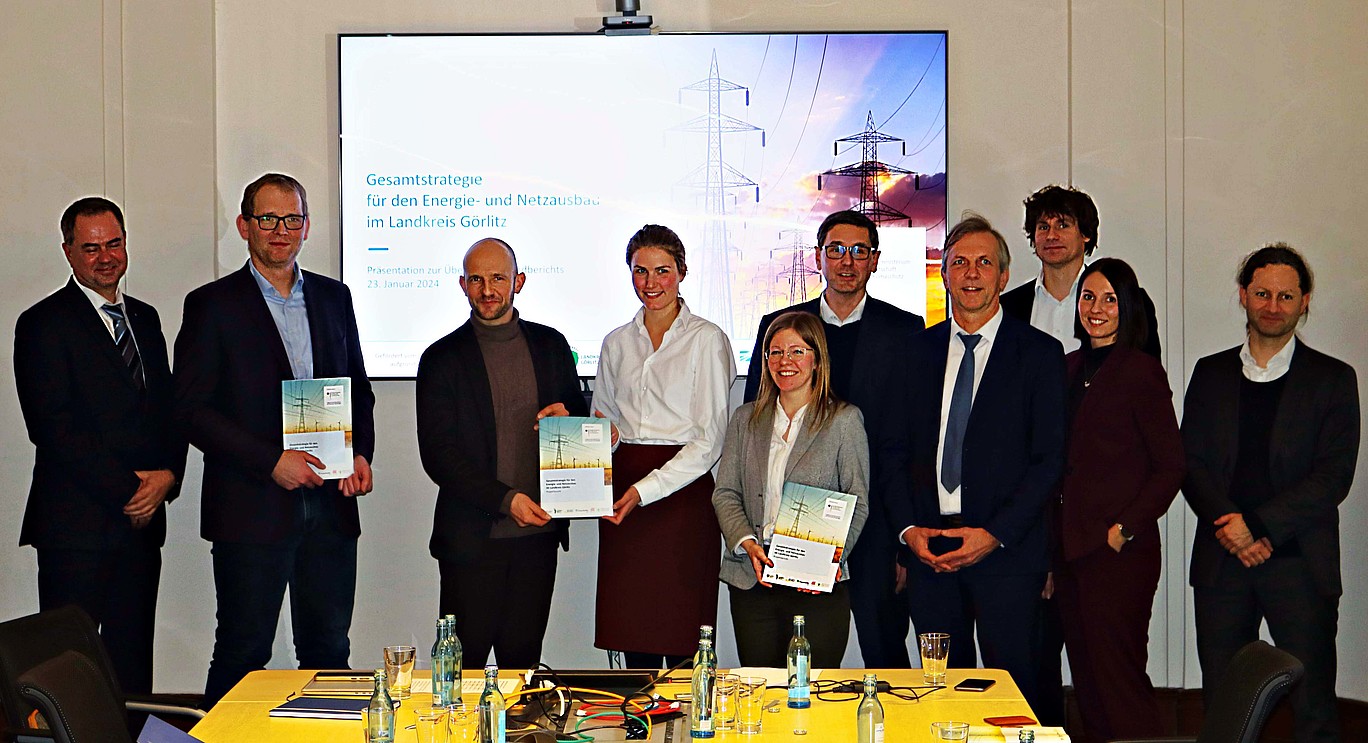
On January 23, 2024, District Administrator Dr. Stephan Meyer and Sven Mimus, Managing Director of Entwicklungsgesellschaft Niederschlesische Oberlausitz mbH (ENO), in the presence of Prof. Mario Ragwitz, Director of the Fraunhofer Institute for Energy Infrastructures and Geothermal Energy (IEG), Dr. Ella Middelhoff, Senior Consultant at Becker Büttner Held (BBH) Consulting AG, and Thomas Gubsch, a research associate at the Zittau/Görlitz University of Applied Sciences, officially presented the comprehensive strategic concept for energy and grid expansion in the Görlitz district at the Görlitz District Office.
Also present at the presentation were representatives from SachsenNetze GmbH, the Upper Lusatia-Lower Silesia Regional Planning Association, the Zittau and Görlitz municipal utilities, and LEAG.
The topics of sustainable energy generation, security of supply, price stability, and the choice between centralized and decentralized systems are key areas that are inextricably linked to the energy transition and will continue to play a decisive role in the future. The pressure for change on the energy system is immense and fundamentally challenges traditional structures. New players are entering the market and raising questions about the technical, economic, and social integration of renewable energy into the electricity grid.
Why is this study so important? The county is an energy region and should remain so in the future. The primary goal of this concept development is to formulate forward-looking recommendations for the expansion of the power grid, the integration of renewable energy, heat supply, and alternative solutions such as hydrogen use and production. These recommendations will enable us to position the district for the future and identify ways to support the regional economy.
Despite the good progress already made in the field of renewable energy—which includes the expansion of wind power and solar PV systems as well as the repowering of older facilities in nearly all municipalities in the county—the county still faces challenges. Planning and implementation depend on existing grid conditions, which often require traveling long distances to the nearest feed-in point or, in some cases, make feed-in impossible due to grid overload. However, the use of renewable energy sources is essential to keeping the district competitive in the long term.
At the same time, the district aims to generate added value for the municipalities. According to Section 6 of the Renewable Energy Sources Act (EEG), cities and municipalities in the district can generate up to 6 million euros in annual revenue from known renewable energy projects alone. In addition, there are funding opportunities and compensation payments. Last but not least, citizens benefit from a secure supply of electricity, heat, and energy.
District Administrator Dr. Stephan Meyer: “I hope that the comprehensive energy plan will lay an important foundation and bring about positive changes for our district. A forward-looking energy policy and sustainable value creation mean quality of life for current and future generations. That is our shared goal. Our thanks go to the representatives from Fraunhofer IEG, BBH Consulting, and the Zittau/Görlitz University of Applied Sciences for preparing the study. The energy transition is a collective effort that we can only tackle together and for which we need strong partners.”
Text and image: Görlitz District, courtesy of
The overall strategy for energy and grid expansion in the district of Görlitz is published at https://www.sichtwechsel-zukunft.de/projekte.
Contact person

1st floor
Upper floor