


27. April 2018
Flipped manufacturing economy
Students and professors swap roles: teaching is "turned on its head" in flipped lessons.
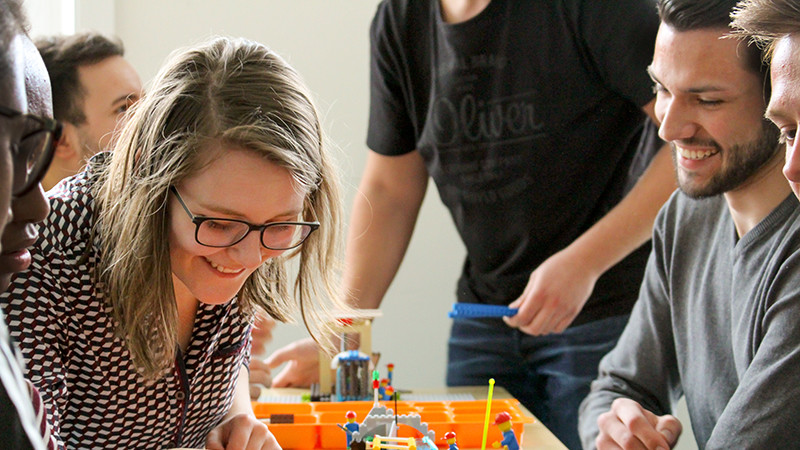
In Professor Sophia Keil’s class / course on Manufacturing Management, offered by the Faculty of Business Administration and Engineering Management, teaching is being “turned upside down.” Since the beginning of the 2018 summer semester, the class / course has been experimenting with an innovative approach by applying the “flipped classroom” method. Students work through the course material independently at home and then apply what they’ve learned at the University. In addition to acquiring subject-specific knowledge, this approach is designed to help them further develop their social and communicative skills (particularly communication skills, the ability to cooperate, the ability to integrate, teamwork skills, the ability to experiment, and verbal fluency). In this article, you’ll learn how this currently works and what trends are emerging.
To ensure that students’ learning is goal-oriented, practitioners and faculty members at our University provide ongoing guidance and practical examples on current topics such as Failure Mode and Effects Analysis (FMEA), time management, decision-making using dashboards, and design thinking as part of subject-specific sessions in the form of coaching. Students then work in groups to develop content on specified methods of production optimization to learn how to improve the strategic metrics of cost, time, and quality in manufacturing.
The goal is for students to present their results in the form of a presentation and a self-designed exercise to their fellow students and the module coordinator during a colloquium. After a review by a jury, the results are revised as part of a learning loop. Subsequently, these topics are visualized in the form of explanatory videos following a video production workshop. Students are empowered to independently and autonomously familiarize themselves with topics using a scientific approach, learn them, and subsequently teach them to others.
After the class / course concludes this summer, you’ll learn in the next article how the students responded to the method and what conclusions the module coordinators have drawn.
The “Manufacturing Management” class / course is organized by the “Learning to Learn” project of the Career Services and the Public Relations Office at Zittau/Görlitz University of Applied Sciences.
Faculty of Business Administration and Engineering Management
02763 Zittau
Schliebenstrasse 21
Building Z II,
Room 16.3
+49 3583 612-4632
University Executive Board
02763 Zittau
Theodor-Körner-Allee 16
Building Z I,
Room 1.51.3
1st floor
1st floor
+49 3583 612-3010
University Executive Board/Education Division
02763 Zittau
Schwenninger Weg 1
Building Z VII,
Room 4010
4th upper floor
4th upper floor
+49 3583 612-4595
Faculty of Business Administration and Engineering Management
02763 Zittau
Schliebenstr. 21
Building Z II,
Room 018.4
First floor
First floor
+49 3583 612-4595