

28. October 2020
First virtual BASA network meeting
Different perspectives and professional arguments were at the heart of the further development of the screening procedure, which is used to question employees about their working conditions.
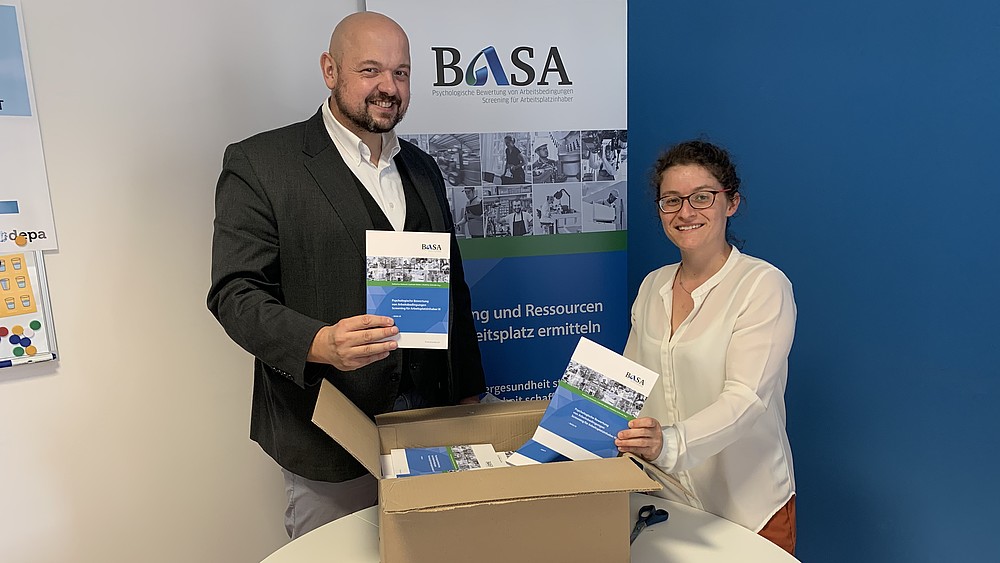
BASA is the abbreviation for a screening procedure used to survey employees about their working conditions. BASA stands for “Psychological AssessmentofWorking Conditions—Screeningfor Employees”and was first published in 2001 as a procedure by the Federal Institute for Occupational Safety and Health (BAUA). Since 2016, responsibility for the procedure has rested with Prof. Dr. rer. nat. Matthias Schmidt, who, together with Katharina Roitzsch and Gabriele Walter, completely revised the procedure and adapted it to the current requirements of the Occupational Safety and Health Act ( risk assessment of psychological stress, § 5 ArbSchG, Item 6), the Joint German Occupational Safety and Health Strategy (GDA), and ISO standards.
BASA III assesses psychological stress and resources in the workplace. The goal is to identify conditions at work that are either supportive or detrimental. This enables the development of occupational safety and health measures.
The BASA Network connects users with the development team. Through the network, you’ll be the first to learn about current developments and have the opportunity to share your specific needs with the development team. The BASA network has been active at Zittau/Görlitz University of Applied Sciences since the beginning of this year. Here, the development team and users meet to exchange news about BASA and reflect on practical experiences and requirements.
On October 8, 2020, the first virtual BASA network meeting took place, featuring a lively exchange of ideas and input from all participants. A presentation on current developments related to BASA and a field report were followed by a digital Open Space session, during which participants from Germany and Austria engaged in lively and, at times, heated discussions based on their own experiences. The discussion centered on further necessary validation steps, experiences with using BASA in practice, and the question of how future collaboration within the network should proceed. This is precisely the purpose of the network: bringing together different perspectives and exchanging expert arguments as the foundation for BASA’s ongoing development.
A new development was well received. As a sort of spin-off, the BASA team is currently working on a modified version of the procedure for self-employed individuals. To this end, the BASA content has been adapted to the circumstances of self-employed individuals. The goal is to use the structured results to create a targeted advisory service for this target group. During the current winter semester, the procedure is being tested on a pilot sample as part of a final dissertation project.
You can find more information about the BASA network here.
Faculty of Social Sciences
02826 Görlitz
Brückenstraße 1
Building II,
Room 156
First floor
First floor
+49 3581 374-4315