E-car meets Zittau
A presentation on electromobility provides insights into the history of its development, everyday life with e-cars and market opportunities.
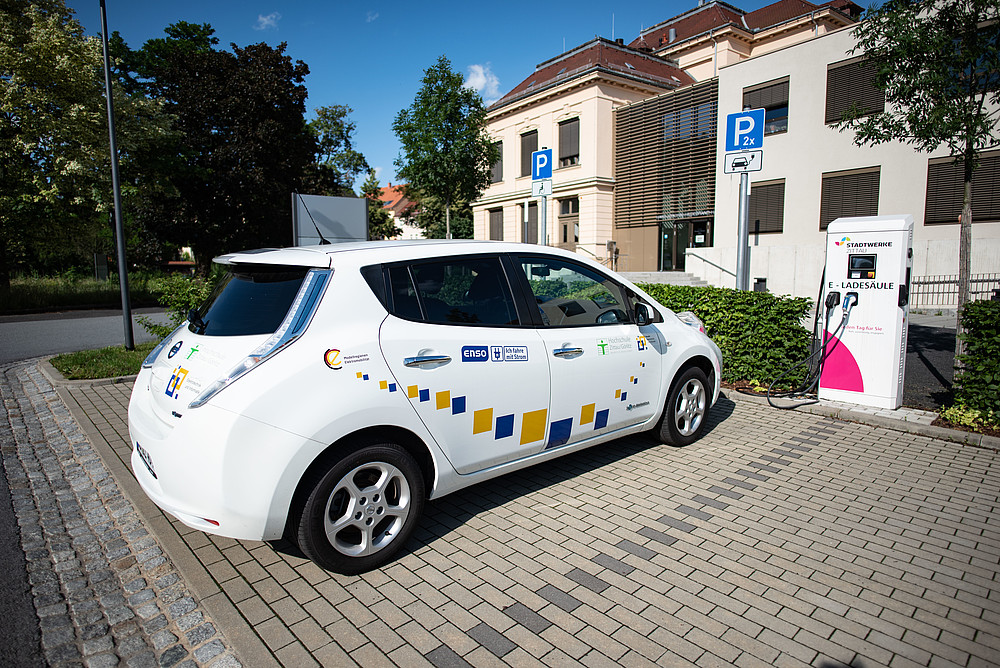
Structural change, climate change, technological change… our habits are slowly changing. As a result, the topic of electric mobility is gaining more and more attention, and more than 10 percent of newly registered cars in Germany are already fully electric. But how does this work in our rural region, and what experiences have we seen so far?
Markus Weiland spoke about this in a thought-provoking presentation to an audience of about 20 people on the evening of July 8. He provided an in-depth look at electric mobility, covering its history and market development, as well as everyday use, charging and payment options, the unique characteristics of the “Dreiländereck” region, and new market opportunities.
Originally from Bavaria, trained as a media computer scientist at TU Dresden, and with professional experience in North America, Markus Weiland returned to Germany in 2015 to found a startup and then moved to Zittau. As a software developer with a wide range of skills, he brings a pragmatic “get things done and don’t talk too much” approach to the table.
On a holiday in 2018, on a highway somewhere between Zittau and Bavaria…
…after his diesel car broke down twice, he began looking into electric cars and decided to switch. The beginnings of electric mobility date back to 1895. At that time, electric cars accounted for around 50 percent of total traffic in some places. However, it was the invention of the electric starter that led to the rise of internal combustion engines.
But now, electric mobility is becoming increasingly widespread. As a result, the end of internal combustion engines is predicted for 2030. Automakers such as Volvo, Jaguar, and others plan to sell only electric models by then. The VW Group also aims to increase the share of electric powertrains to 70% by 2030. As of the end of December 2020, 14% of new passenger car registrations in Germany were powered exclusively by electricity.
Everyday Life with Electric Cars…
… is characterized by many advantages in driving performance as well as a high level of comfort. The presentation covered electric cars in detail from various perspectives, including energy consumption, charging technologies, costs, battery life, vehicle prices, safety, and practical information.
Critical issues and areas in need of improvement—such as charging stations blocked by parked cars and incorrect or insufficient signage—were also addressed. A comparison with a “normal” gas station was also made. Furthermore, maps and coverage of charging stations in the Czech Republic, Poland, and Germany were examined. New business opportunities were also highlighted using existing examples, rounding out the engaging presentation.
In the course of the discussion, the idea arose to set up a regulars' table for drivers of e-cars and other interested parties. We are looking forward to it and invite you to join us! So if you would like to join us, please contact us via saxony5(at)hszg.de .
If you are interested, we can provide the presentation.
A heartfelt thank you goes to Markus Weiland, as well as to all contributors and participants, for their interest and for the lively discussion. The event was organized by Saxony5 and the Dreiländereck Adult Education Center.