
Competence requirements for AI assistance systems in production
The introduction of AI assistance systems in production is revolutionizing industrial processes and presenting companies with new challenges. In addition to technological adjustments, this development primarily requires a reorientation of employees' skills. This article examines the general and specific skills requirements that are necessary for the successful use of AI systems in production and summarizes scientific findings on the changes in these requirements.
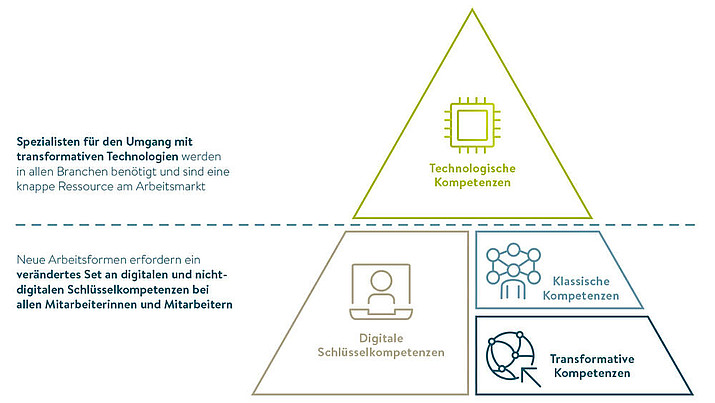
General Competency Requirements
The introduction of AI assistance systems in production requires far-reaching adjustments that go beyond technical knowledge and necessitate comprehensive skills development. The Future Skills Framework clearly shows that technological and digital competencies, in combination with transformative skills, are crucial for successfully implementing AI systems. Employees should therefore not only be equipped with specific expertise in human-machine interaction and data processing, but also develop competencies such as a willingness to embrace change, systemic thinking, and interdisciplinary collaboration. Companies are called upon to promote a culture of lifelong learning and offer targeted training programs that strengthen both technological and transformative skills. Only in this way can the potential of AI assistance systems be fully realized and employees be optimally prepared for the challenges of an increasingly digitized manufacturing world.
Future skills are versatile abilities, competencies, and traits that will gain importance in all areas of professional and personal life over the next five years. ⁹:
The skills required to work with AI systems in production can be divided into three main categories ¹:
1. Technical and basic knowledge:
- Subject-specific competence: Employees possess the necessary subject-specific knowledge and skills to perform their day-to-day tasks in accordance with their job roles. Depending on the employee’s position, this may also include manual skills, for example.
- Basic digital skills: Employees use conventional digital media and technology confidently and competently and can work seamlessly with common office programs as well as digital collaboration technologies. In particular, they have sufficient awareness of digital security issues.
- AI Awareness: Employees are familiar with the AI systems used in the company and their basic capabilities; this specifically includes an understanding of what AI systems are currently unable to do. They are aware of the data processed by the AI system, including any personal data.
2. Development of AI Systems and Working with AI Systems:
- HMI Skills: Employees possess the skills to engage in purposeful human-machine interaction using state-of-the-art technology.
- Basic Knowledge of Machine Learning: Employees know and understand the fundamentals of machine learning, including deep learning and neural networks, and can apply this knowledge in human-machine interaction.
- Skills in Programming Languages, Platforms, Frameworks, and Libraries: Employees are proficient in relevant programming languages such as Python as a foundation for machine learning. They are proficient in using common platforms such as Amazon Web Services (AWS) and frameworks/libraries such as Spark or Hadoop (Büchel & Mertens 2021).
- Big Data, Data Science, and Data Analytics: Employees possess skills in managing, collecting, compiling, processing, and modeling data, as well as analyzing large volumes of structured or unstructured data. Key areas of expertise include advanced mathematics, cryptography, data ethics and data privacy, and data mining (Gesellschaft für Computer science 2019).
- Process and System Competence: Employees can identify processes and workflows within the company, think in terms of these processes and workflows, and structure their own work behavior within them. They are also able to describe, reconstruct, and model these processes and other complex issues as systems, and on this basis, make predictions and devise courses of action. Specifically, employees understand the specific ways in which AI influences business processes: They comprehend the changes brought about by AI and can optimize their own work processes in relation to collaboration with AI.
- Problem-solving skills, resilience: Employees can quickly identify unexpected situations and difficulties, deal with them, and develop appropriate solution strategies. This includes, in particular, the knowledge and, where necessary, the practical ability to intervene in AI-driven processes.
- Reflective competence: Employees are able to critically interpret and evaluate the information and results generated by AI systems. They can independently and competently assess when trust in AI systems and the data generated by them is justified.
3. Shaping the Context of AI:
- Personal Competencies: Employees possess a sufficient degree of personal responsibility and self-organization. They demonstrate the curiosity and willingness to learn how to use machine learning and AI technologies and to work with them.
- Social and Communication Skills: Employees can contribute effectively to teams with diverse compositions. They are able to collaborate with colleagues from various professional backgrounds and with differing levels of experience and expertise. When interacting with customers and users of AI systems, employees can appropriately explain the specifics of how AI systems are used within their respective areas of responsibility.
- (Human Resources) Management, Leadership Skills, Change Management: Employees with leadership responsibilities can organize a team, coordinate and delegate tasks (or groups of tasks). They can communicate the potential and limitations of AI, alleviate fears, and foster opportunities for professional development. When integrating AI systems into business processes, they can formulate reasonable goals and thus help shape the change process.
- Decision-making competence: Employees understand their responsibilities and are able to make reliable, well-considered decisions within the scope of their duties.
- Adaptability and Transferability: Employees are able to adapt to the opportunities and challenges presented by AI and adjust their work methods accordingly.
IT skills and domain-specific expertise are equally important. However, employees who master both areas of expertise are rarely available ². Therefore, social and communication skills and ethical values are becoming increasingly important.
Specific Competency Requirements
The implementation of AI applications in production requires various roles with specific skills ³:
- Corporate leadership, project sponsorship:
- Strategic focus, company-wide perspective, trust in AI technologies, decisiveness, and foresight.
- Project Management / Project Expertise:
- Project and personnel management, leadership skills, ability to coordinate interdisciplinary teams.
- Technology experts, automation specialists:
- Problem-solving skills, resilience, reflective thinking, knowledge of signal processing and automation technologies.
- Data scientists, data engineers:
- Data selection, preparation, analysis, and interpretation; teamwork and communication skills.
- AI Experts / ML Experts:
- In-depth knowledge of mathematics, statistics, machine learning, and data management.
- MLOpsEngineers, IT Security Experts:
- Fundamentals of software engineering, process and system expertise, and knowledge of IT security.
- Process managers, maintenance technicians:
- Subject-specific competence, in-depth process knowledge, domain and operational expertise, and self-directed competence in plant engineering.
- Quality managers:
- Knowledge of operational quality specifications and QM systems, ISO standards, and tolerance management.
- Safety Officers, Occupational Safety Experts:
- Expertise in ethical, legal, and social implications (ELSI), as well as process and system competence.
- Plant/process operators:
- Domain knowledge, practical experience, ability to interact with AI systems.
- Works Council:
- Mediation skills, acting as a liaison between the workforce and management, understanding of ELSI issues.
- Interaction designers:
- MMI expertise, design skills, focus on usability and user experience.
- Human Resources Developers / Change Managers:
- Communication management, competency development, promoting transparency, open communication.
- System developers:
- Programming skills, understanding of corporate IT architecture.
All participants should possess basic digital literacy, be communicative, demonstrate adaptability, be creative, and be open to new ideas ³.

Certain skills are particularly relevant for skilled workers in production 4These include a basic knowledge of machine learning and knowledge of human-machine interaction. They should be able to demonstrate work steps for robot tools and train them. Critically examining the learning progress of AI systems is just as important as carrying out recalibrations when errors occur. In addition, the ability to collaborate with robotic tools, increased adaptability and communication skills as well as increased decision-making and reflection skills are crucial skills in this context.
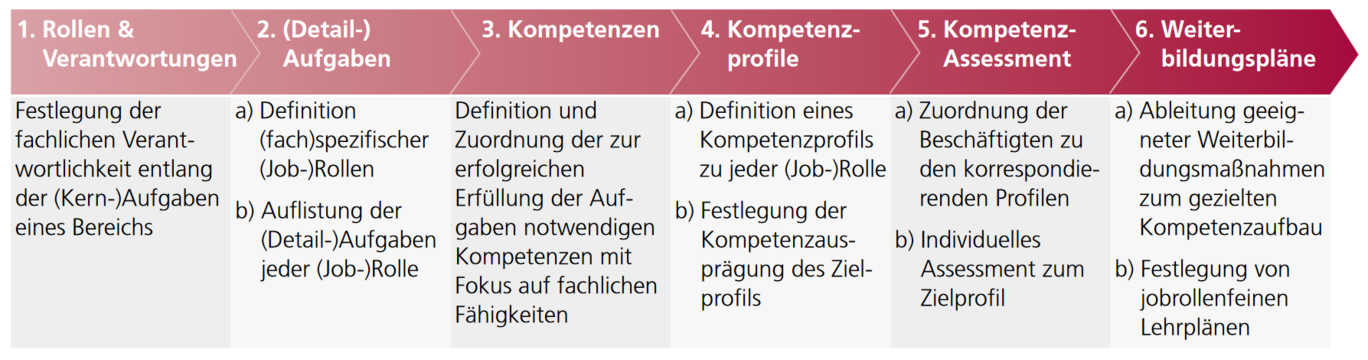
Task-oriented competence management process
The task-oriented competence management process for the implementation of AI assistance systems in production comprises six successive steps that specifically address the requirements of modern working environments:
- Defining (Job) Roles and Responsibilities in the Context of AI: The first step is to define in detail the responsibilities of each (job) role and their interfaces with other areas. This is done based on core tasks using appropriate methods, such as the RACI method. It is essential not only to define the areas of responsibility but also to specify the activities that fall outside a role’s scope of responsibility, in order to prevent competency profiles from being unnecessarily expanded. This process requires a deep understanding of the company’s structures and processes.
- Assignment of Tasks in the Revised Division of Labor Between Humans and AI: Based on the defined roles, core and detailed tasks are assigned to the respective roles. This is only possible through close collaboration with the affected departments, as the day-to-day practices and subject matter expertise of employees must be taken into account. The result is a tabular overview of (job) roles with associated tasks, which serves as the basis for assigning specific AI competencies.
- Derivation and Definition of Specific AI Competencies for Task Completion: The competencies required to complete the tasks are divided into professional, methodological, social, and personal competencies. A competency profile encompasses the knowledge and skills (“can”), the authority (“may”), and the motivation (“will”) to perform a task. These components must be taken into account in competency management in order to create realistic competency profiles. Competencies are mapped based on the tasks of a (job) role.
- Defining competency profiles and establishing target profiles: Based on the tasks of the (job) roles, competency profiles are created that define the necessary competencies and their levels. This step requires critical analysis to ensure that only the relevant competencies are considered. The target profile, often presented as a network profile, shows the competency levels required for a role.
- Competency Needs Analysis and Individual Assessment: In this step, employees are matched to the established competency profiles, and their current competency levels are evaluated. This can be done through observation by supervisors or through a collaborative method in which supervisors and employees jointly develop and discuss the current profile. This method fosters motivation and personal responsibility. The analysis provides the basis for planning professional development initiatives.
- Defining Appropriate Training Measures for Building AI Competencies: Based on the competency needs analysis, specific training measures are defined to close the identified gaps. Learning opportunities that combine formal and informal learning are particularly effective in this regard. Digital learning technologies increase flexibility and enable the practical application of what has been learned. Competency development is evaluated and adjusted during performance reviews to ensure sustainable learning success.
This structured competency management process ensures that employees are able to meet the new demands posed by AI-assisted systems and to continuously develop their skills.
Changes in Competency Requirements
The use of AI-assisted systems leads to significant changes in competency requirements:
- Increased job complexity and diversity of skills: Particularly in information-processing roles, the complexity of tasks is increasing, requiring expanded skills ⁵.
- Potential reduction in autonomy: In low- and medium-skilled roles, employees’ autonomy may be limited by AI systems ⁵.
- Shift in task focus: In assembly work, the focus is shifting from cognitive tasks to manual, non-routine tasks ⁵.
Skill Development
Targeted competency development is crucial for the successful implementation of AI assistance systems ⁶ ³:
- Strategic integration: Skills development should be an integral part of the corporate strategy ⁴.
- Practical Training: “On-the-job training” and “in-house seminars” promote direct relevance to real-world applications and facilitate implementation in everyday work ³ ⁸.
- Combination of Formats: Digital learning offerings should be supplemented by experience-based in-person sessions to address diverse learning needs ³ ⁸.
- Inclusion of all employee groups: Low-skilled workers, in particular, should be included in competency development measures to prepare all employees for change ³ ⁸.
The successful introduction of AI-assisted systems in production therefore requires comprehensive competency management that takes into account technical, subject-specific, and cross-disciplinary competencies and involves all employee groups ⁷ ³.
Conclusion
The introduction of AI-assisted systems in production requires more than just technological adjustments. It requires comprehensive competency management that takes into account technical, subject-specific, and cross-disciplinary competencies. The ability to link domain-specific knowledge with AI expertise and to respond flexibly to new requirements is of central importance ⁷ ³. Companies should therefore invest in the continuous professional development of their employees and promote a culture of lifelong learning in order to fully realize the potential of AI in manufacturing.
Sources/Footnotes
- Learning Systems Platform. Competency Development for AI – Needs and Solutions for Education and Training. Retrieved from https://www.plattform-lernende-systeme.de/files/Downloads/Publikationen/AG2_WP_Kompetenzentwicklung_KI.pdf
- Learning Systems Platform. AI and Work – Competencies. Retrieved from https://www.plattform-lernende-systeme.de/schwerpunktthemen/ki-und-arbeit/kompetenzen.html
- Fraunhofer IAO. Human-Centered AI Applications in Production. Retrieved from https://www.ki-fortschrittszentrum.de/content/dam/iao/ki-fortschrittszentrum/documents/studien/Menschzentrierte-KI-Anwendungen-in-der-Produktion.pdf
- Learning Systems Platform. AI Competence Development in Office and Production Work. Retrieved from https://www.plattform-lernende-systeme.de/files/Downloads/Publikationen_EN/AG2_WP_AI_competence_GB.pdf
- Dombrowski, U., & Wagner, T. Impact of Artificial Intelligence on Work in Assembly Systems. Journal of Intelligent Manufacturing, 2023. Retrieved from https://link.springer.com/article/10.1007/s10845-023-02086-4
- Rossi, A., et al. Artificial Intelligence in Industry: A Review on Uptake and Competencies. 2022. Retrieved from https://re.public.polimi.it/retrieve/e0c31c12-685b-4599-e053-1705fe0aef77/SSRN-id4072671.pdf
- Handelsblatt Live. AI in the Workplace: What Skills Are in Demand Now. Retrieved from https://live.handelsblatt.com/ki-am-arbeitsplatz-welche-kompetenzen-jetzt-gefragt-sind/
- Learning Systems Platform. Competency Development for AI – Needs and Solutions for Education and Training. Retrieved from https://www.plattform-lernende-systeme.de/files/Downloads/Publikationen/AG2_WP_Projektbericht_Kompetenzentwicklung_KI.pdf
- Stifterverband and McKinsey: Future Skills Framework, 2021. Retrieved from https://future-skills.net/framework
Author: David Sauer
Co-author: Tino Schmidt, Prof. Matthias Schmidt

2nd upper floor
4th upper floor
1st floor