
HSZG develops new semiconductor degree programs with and for industry
The courses were subsequently also presented to TSMC and ESMC, where they met with great interest as a contribution to securing skilled workers in the European semiconductor industry.
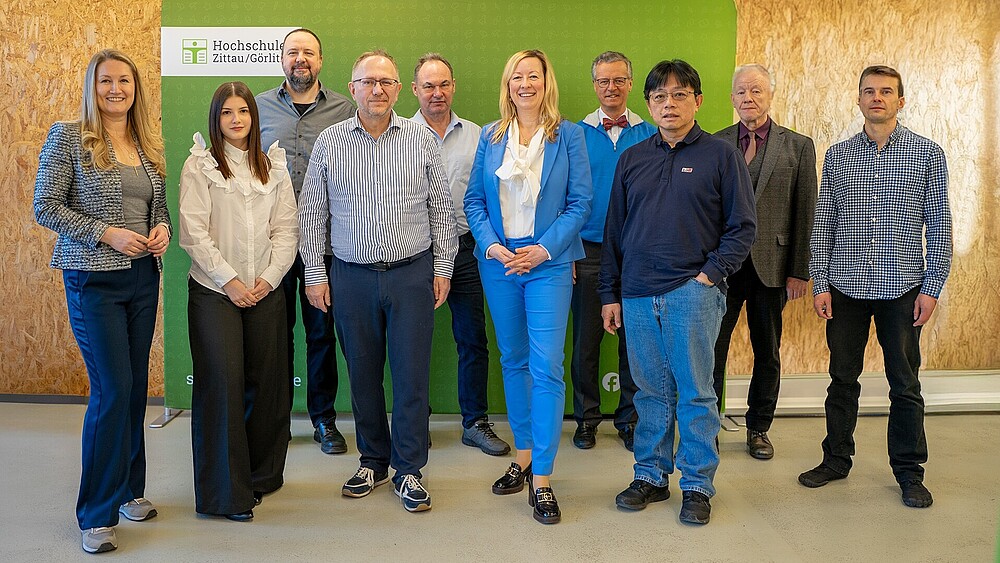
In the fall of 2026, the Zittau/Görlitz University of Applied Sciences (HSZG) will launch the new degree programs “Mechatronics for Manufacturing” and „Semiconductor Processes and Materials Chemistry“will launch at Zittau/Görlitz University of Applied Sciences (HSZG). In February 2026, HSZG presented these degree programs to global player TSMC and its subsidiary ESMC.
“The Free State of Saxony is Europe’s largest hub for information and communication technologies and microelectronics. One out of every three chips produced in Europe bears the ‘Made in Saxony’ label,” reports the Saxony Economic Development Agency. Robert Bosch GmbH, GlobalFoundries Inc., Infineon Technologies AG, and—starting in 2025 and 2027, respectively—Jenoptik AG and TSMC (Taiwan Semiconductor Manufacturing Company) operate some of the most modern production facilities for microchips and semiconductors in Dresden. The Dresden-Rähnitz site is also currently Saxony’s largest construction site. The joint venture ESMC—European Semiconductor Manufacturing Company— (with TSMC, Bosch, Infineon, and NXP Semiconductors as partners) plans to create 5,000 jobs there and, starting in 2027, to more closely integrate its European and Asian sites—to advance groundbreaking future technologies, innovation, and regional and international competitiveness.


Zittau/Görlitz University of Applied Sciences Introduces Two New Degree Programs in Semiconductor Engineering
The semiconductor industry is a “pull factor” for companies, municipalities, and academic institutions alike. Eastern Germany and the Free State of Saxony have evidently taken to heart the quote often attributed to Mikhail Gorbachev: “Life punishes those who are late.” And Zittau/Görlitz University of Applied Sciences (HSZG) has responded promptly and proactively by establishing new degree programs in the field of the semiconductor industry, positioning itself in a good way to provide tailored training for future national and international specialists in the semiconductor sector.
For example, in collaboration with the Görlitz district, international exchange initiatives such as Taiwan Day 2024 and the International Economic Conference 2025 were launched in the past. In September 2025 and January 2026, delegation trips to Asia—specifically to Taiwan and other Asian countries—were organized in collaboration with Saxony’s business, academic, and political communities. Another asset: As part of its high-tech strategy, the university is currently developing two new, practice-oriented bachelor’s degree programs: “Semiconductor Processesand Materials Chemistry” and “Mechatronics for Manufacturing.” The programs will begin in the fall of 2026—making February 2026 an ideal time to present these programs to the ESMC joint venture and its parent company, the Taiwanese semiconductor giant TSMC.
Degree Programs Developed in Collaboration with Industry
A key factor in the success of the new degree programs is their close alignment with the semiconductor industry. The degree programs were not designed in isolation but were developed through intensive dialogue with leading companies in the industry. Key issues for the future were already discussed as part of a university-wide expert dialogue involving around 30 representatives from leading Saxon semiconductor companies—including Applied Materials GmbH, Infineon Technologies Dresden GmbH & Co. KG, Robert Bosch Semiconductor Manufacturing Dresden GmbH, Silicon Saxony e.V., and the Fraunhofer Microelectronics Group/Research Factory for Microelectronics Germany (FMD)—key questions about the future were discussed. The focus was on determining which technical, interdisciplinary, and practical skills future professionals in the semiconductor industry will need. The results of this process have been directly incorporated into the development of the two new degree programs. This ensures that course content, practical components, and competency profiles are closely aligned with the requirements of a highly dynamic industry. More information is available here.

Our partnerships with leading companies such as TSMC and ESMC enhance the international visibility of the Zittau/Görlitz University of Applied Sciences and provide valuable impetus for our teaching and research. With the new degree programs in Mechatronics for Manufacturing and Semiconductor Processes and Materials Chemistry, we are making a concrete contribution to securing a skilled workforce in a key industry and positioning the HSZG for a strong future in teaching, research, and technology transfer—for the region and beyond.
”"Mechatronics for Manufacturing" Degree Programme
The “Mechatronics for Manufacturing” degree programme focuses on the networked and digital manufacturing of the future.
Additional key aspects: a) training the next generation of engineers in the fields of robotics, mechatronics, and digital manufacturing in semiconductor production, b) developing professionals who combine technical expertise, practical experience, and an international perspective, c) equipping students to develop innovative mechatronics systems and robotic solutions, d) building an international network of expertise through the close integration of academic education and practical experience; and—last but not least— e) providing companies with access to highly qualified young professionals and innovative ideas.
A distinctive feature of “Mechatronics for Manufacturing” is its binational structure and the partnership with the Technical University of Liberec (TUL) in the Czech Republic. Students can earn a dual degree from both universities. The first three semesters are spent on the Zittau campus, where the language of instruction is German. In the fourth and fifth semesters, students change locations and study in English. This international focus strengthens language skills and prepares prospective graduates for careers in globally active companies.
“The semiconductor industry is considered a key sector of the digital transformation and is represented in so-called Silicon Saxony by numerous semiconductor companies and their suppliers. For HSZG, the collaboration with leading semiconductor companies at the launch of the ‘Mechatronics for Manufacturing’ degree programme opens access to state-of-the-art technology and establishes the university as a relevant partner in a global market of the future. “The exchange of information enables HSZG to refine the semiconductor-specific course content and adapt it to the technical needs of the semiconductor industry,” says Prof. Dr.-Ing. Wolfgang Kästner, professor and program director in the Faculty of Electrical Engineering and Computer Science at HSZG, summarizing the characteristics of the degree programme.


"Semiconductor Processes and Materials Chemistry" degree programme
The “Semiconductor Processes and Materials Chemistry” degree programme combines fundamental scientific knowledge and skills with specific competencies required in the semiconductor industry. In addition to the fundamentals, modules provide specific knowledge of semiconductor processes, covering both the chemical and physical processes of semiconductor manufacturing and logistical control processes. The degree programme is designed for anyone who combines an interest in the natural sciences with a desire to innovate in a technical field. Students actively contribute to the development of energy-efficient technologies and help shape the digital transformation. The close integration of theory and practice creates a solid foundation for challenging roles in a dynamic environment. The program combines three core areas of expertise: a) Materials chemistry and materials: structure, bonding, and surface properties of materials; b) Semiconductor process engineering: coating, patterning, etching processes, and characterization methods; and c) Production and Quality management: process control, sensor technology, data science, and lean approaches.
“The goal of the degree programme is to provide highly specialized training for professionals in the chemical/physical process landscape as well as in the logistical control processes of semiconductor production. The foundational studies during the first three semesters take place at Zittau/Görlitz University of Applied Sciences and impart the relevant technical fundamentals. The program is designed so that future graduates can write their final dissertation in either German or English. Prior to this, starting in the fourth semester, students have the opportunity to gain important, hands-on insights into semiconductor production directly within a company,” says Prof. Dr. Gerd Fischer of the Faculty of Natural and Environmental Sciences at HSZG and program director for the upcoming degree program in “Semiconductor Processes and Materials Chemistry.”
Degree programmes highly aligned with the strategic goals of TSMC/ESMC
“Both degree programmes—Mechatronics for Manufacturing and Semiconductor Processes, and Materials Chemistry—align very well with the strategic goals of TSMC/ESMC. They focus on key areas of expertise that are essential for developing and retaining a highly qualified semiconductor workforce in Europe. We see great potential for collaboration with HSZG in developing practice-oriented talent pipelines tailored to the needs of the industry,” says Constantin Diederichs, Human Resources Project Manager for Talent Acquisition and University Relations at TSMC.
And in the future?! – “Another dialogue meeting between HSZG and TSMC/ESMC is planned for the near future. Furthermore, an information session specifically featuring TSMC and ESMC will be held in the coming months for students and high school students to highlight career opportunities in the semiconductor industry. TSMC/ESMC will also participate in university events such as the University Information Day and the ‘University Open House’ to introduce themselves. In the long term, HSZG and TSMC/ESMC intend to explore the potential of Master's degree programmes to be offered to students as an additional qualification option,” says Prof. Dr.-Ing. Wolfgang Kästner.
The semiconductor industry is the backbone of the digital future. For more information on how Zittau/Görlitz University of Applied Sciences is addressing this future-oriented topic, please visit the corresponding website.
Text: Frank Leberecht
Photos: HSZG



1st floor