
Message details
"Our students don't have to worry about their future"
New appointment: Prof. Dr.-Ing. Matthias Kunick has been Professor of Energy System Technology at the HSZG since the beginning of the summer semester. A return and a new beginning.
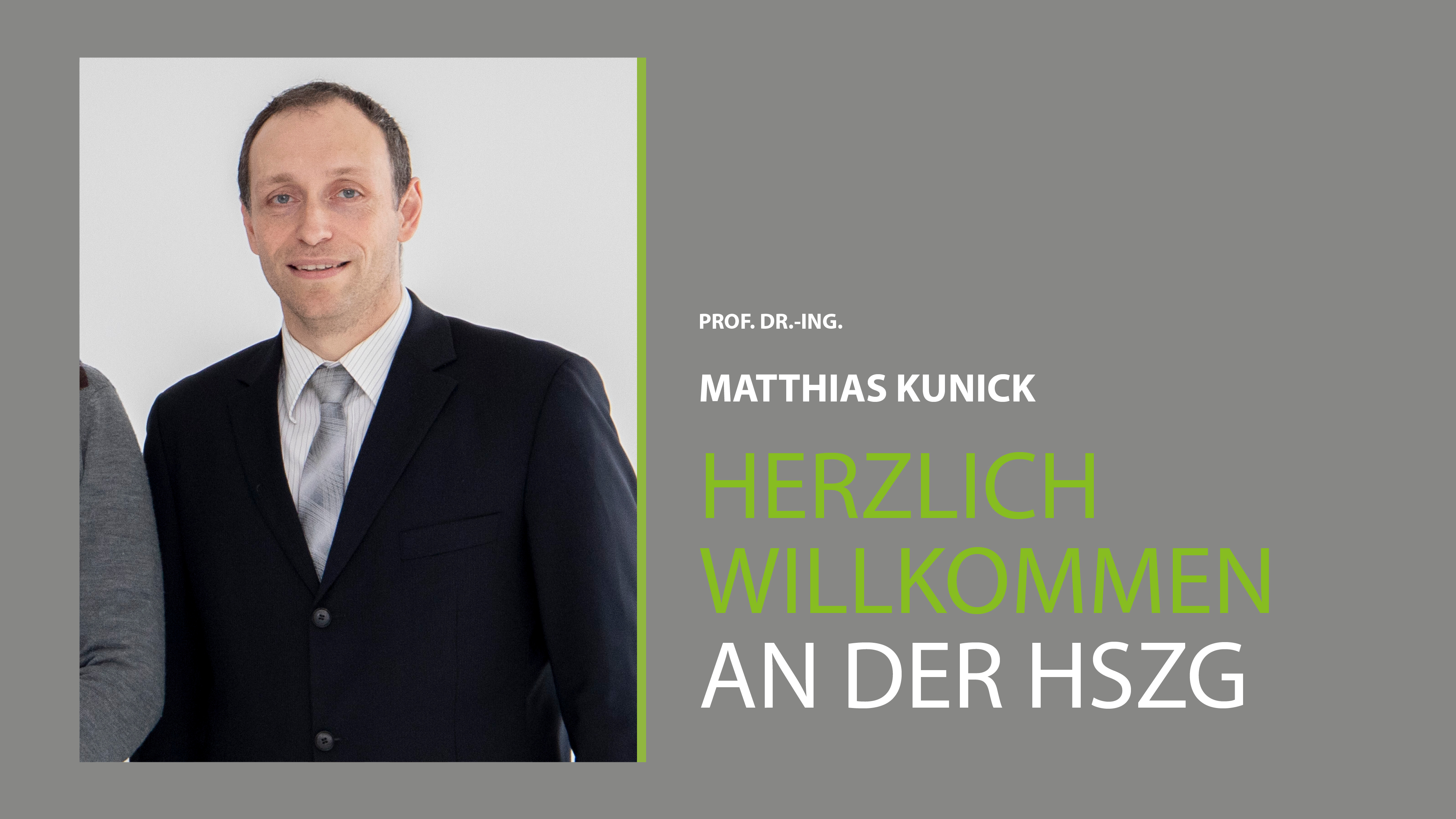
“Like the Rector,” says Prof. Dr.-Ing. Matthias Kunick with a laugh, “I’m a product of Zittau/Görlitz University of Applied Sciences.” In 2001, Kunick enrolled as a student in Mechanical Engineering and majored in design engineering. He shares an anecdote from that time: “I had a classmate sitting next to me in the thermodynamics lab who was struggling financially. He asked the professor if he needed a student assistant so he could earn a little extra money. ‘There are always projects,’ the professor said, and asked if I might be interested as well.” Kunick agreed out of sheer politeness, so as not to offend the professor. His classmate dropped out of the project shortly thereafter. But Kunick stayed. And that was a good thing. “I later worked as a research assistant in the Department of Technical Thermodynamics under Prof. Dr.-Ing. habil. Hans-Joachim Kretzschmar, and even during periods when I wasn’t employed at HSZG, I always maintained close contact with the university. Prof. Kretzschmar ultimately gave me the opportunity to earn my doctorate through a collaborative program at TU Dresden under Prof. Dr.-Ing. Uwe Gampe.”
71 nights, 10 weeks
The HSZG runs like a common thread through Kunick’s life, enabling him to pursue exciting projects and build a professional future. After completing his doctorate, his work at the HSZG also took him to the U.S., specifically to Idaho. “You have to seize the opportunity to work at a major institute like the Idaho National Laboratory,” says Kunick. So he moved with his wife and their two daughters—now seven and three years old—to Idaho Falls, a city of 60,000 residents. For the first 71 nights—about 10 weeks—they slept in a hotel. And you can get a better sense of what makes Kunick tick when you realize that he actually counted those nights. “It was a challenge at first to get everything organized there,” he says. “But we managed it well.” Then the shipping container with their belongings arrived from Germany. They found a townhouse to rent and a daycare center for the children. “Things were going really good for me at work; I was lucky with the projects and had great coworkers,” Matthias Kunick could imagine staying in the U.S. forever.
When his wife fell ill and had to undergo surgery, both were starkly reminded of how valuable a well-functioning healthcare system is. “It was interesting to get to know the American healthcare system,” he says. “We’re extremely spoiled by the healthcare system in Germany.” Kunick’s wife needed her familiar family environment to recover. “In the U.S., my wife wouldn’t have recovered from her illness anytime soon. So, with a heavy heart, we said goodbye to our friends, neighbors, and colleagues there. Of course, we’ve now returned home and are happy to be reunited with our friends, family, and colleagues, who were always there for us.”
"The opportunity to work at a large institute like the Idaho National Laboratory is something you have to take advantage of."
”A Focus on Teaching
Since the start of the summer semester, Kunick has been a professor of energy system technology at HSZG. “It was a stroke of luck for me that I was able to return to HSZG.” There are comparatively few positions for university faculty members at colleges and universities, so the opportunities get scarcer the higher up you go. “Energy system technology as a field of study is good for my career path. For me, teaching is now the top priority,” says Matthias Kunick. Every university instructor must first and foremost focus on that. Aside from that, of course, one can still pursue one’s own research interests. “In research, you have freedom; you can develop your ideas freely. In contrast to large research institutes, however, you also have to take care of staffing and research funding yourself.”
On March 1, Kunick began his position at HSZG; a week later, he gave his first lectures. Then came the COVID-19 lockdown and with it the requirement to offer courses digitally. “That’s naturally a bit challenging when you’re just getting back into teaching.” Especially when the whole family is at home because of the pandemic. Kunick’s wife works in the purchasing department at Siemens. “She’s constantly on the phone, wearing her headset and talking to people in China,” Kunick laughs as he tells the story. “I take care of the girls when they’re cranky. Luckily, they’re back in school and daycare now. So things are settling down again; I can focus on my video lectures and travel to Zittau once more.”
The Modern World
These video lectures require an enormous amount of effort on Kunick’s part. He records them and then posts them online. “I offer students the option to email me their questions. That is good. Another advantage of the video is that you can watch it as many times as you need until you’ve understood a more complicated concept.”
Matthias Kunick has a few projects in the pipeline that he’d like to work on. One of them—and this much can be revealed—involves the development of a thermonuclear rocket engine for manned Mars missions at the Idaho National Laboratory, funded by NASA. But at the moment, it’s difficult to find staff. “Good graduates in energy engineering and Mechanical Engineering don’t have to worry about their future,” says Kunick. There are many interesting opportunities in both industry and research. Perhaps one day it will be Kunick’s students who help shorten the travel time to Mars and thereby move humanity forward a little bit.
- Idaho National Laboratory (INL), Idaho Falls, ID, USA Nuclear Science & Technology,
Modeling and Simulation,
RELAP-7 Postdoctoral Research Associate - Zittau/Görlitz University of Applied Sciences,
Faculty of Mechanical Engineering,
Department of Technical Thermodynamics, Research Assistant - Siemens AG, Power Generation, Görlitz
Research and Development Department,
Projects: Software for the design of industrial steam turbines, Development Engineer - Zittau/Görlitz University of Applied Sciences,
Faculty of Mechanical Engineering,
Department of Technical Thermodynamics, External Research Assistant - Bombardier Transportation, Görlitz,
, Design Mechanic
- 2008–2017 Zittau/Görlitz University of Applied Sciences, Faculty of Mechanical Engineering, and Dresden University of Technology, Faculty of Mechanical Engineering, Cooperative Doctoral Program,
Title: “Fast Calculation of Thermophysical Properties in Extensive Process Simulations with the Spline-Based Table Look-Up Method (SBTL),” Advisors: Prof. Dr.-Ing. habil. H.-J. Kretzschmar, Prof. Dr.-Ing. U. Gampe
Additional Classes / Courses:
Fundamentals of Turbomachinery, Grade: 1.3 Refrigeration Technology, Grade: 1.7
Gas and Steam Turbines, Grade: 1.0
Dr.-Ing., Overall Grade: “summa cum laude” - 2005 Siemens AG, Power Generation, Görlitz
Diplom thesis,
Title: “Calculation of the Thermodynamic Properties of Ammonia-Water Mixtures, Water and Water Vapor, and Helium in Energy Technology Process Modeling,” Grade: 1 - 2001–2005 Zittau/Görlitz University of Applied Sciences,
Degree programme: Mechanical Engineering, Specialization: Design, Diplom-Ingenieur (FH), (overall) grade: 1.4 - 2000–2001 Zittau Vocational School Center,
university of applied sciences entrance qualification, overall average 1.0 - 1995–1998 Bombardier Transportation, Görlitz,
: Skilled worker training as a design mechanic
- 2014 – National Institute of Standards and Technology, Boulder, USA, Thermophysical Properties Division, Visiting Researcher, Project: “Development of Fast and Accurate Algorithms for Property Calculations in Extensive Process Simulations,” Advisor: Dr. Eric Lemmon
- 2011 – National Institute of Standards and Technology, Boulder, USA, Thermophysical Properties Division, Visiting Researcher, Project: “Fast and Accurate Algorithms for Fluid Property Calculations in Extensive Process Simulations,”
, Advisor: Dr. Eric Lemmon - 2003–2005 – Zittau/Görlitz University of Applied Sciences,
Faculty of Mechanical Engineering, Department of Technical Thermodynamics, Student Assistant,
Advisor: Prof. Dr.-Ing. habil. H.-J. Kretzschmar - 2004 – Alstom Power, Baden, Switzerland,
Department of Aero- and Thermodynamics, work placement semester,
Title: “Multi-section Analysis for Flow in Low-Pressure Turbines in a Cycle Simulation Program,” Grade: 1
- Prof. Hans-Joachim Hildebrand Award from Zittau/Görlitz University of Applied Sciences,
, awarded for the PhD thesis titled:
“Fast Calculation of Thermophysical Properties in Extensive Process Simulations with the Spline-Based Table Look-Up Method (SBTL),” Zittau, 2017
- First place at the ASME Turbo Expo Student Poster Session,
, awarded for the presentation titled:
“The New Spline-Based Table Look-Up Method (SBTL) for the Fast Calculation of Real Fluid Properties in CFD Simulations of Steam Turbines,”
Seoul, South Korea, 2016 - Special Prize from the Friends of Zittau/Görlitz University of Applied Sciences,
, awarded for the Diplom thesis titled:
“Calculation of the Thermodynamic Properties of Ammonia-Water Mixtures, Water, Water Vapor, and Helium in Energy Process Modeling,”
Zittau, 2006 - Award from the Saxon State Ministry of Culture for earning the general university of applied sciences entrance qualification with a grade point average of 1.0,
Dresden, 2001
1st floor