Message details
Silicone, recycle yourself!
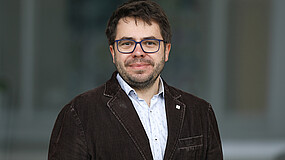
How the HSZG is researching the circular economy of tomorrow. An interview with Prof. Jens Weber.
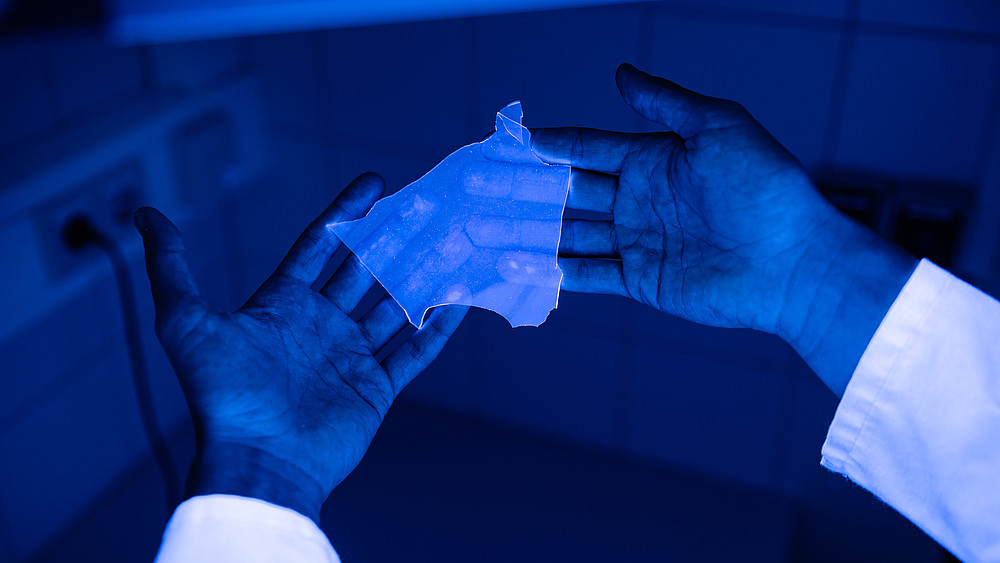
The recently launched ERDF project “Evaluation of Recyclable Materials for Electrical Engineering” is not Prof. Jens Weber’s first interdisciplinary project on the topic of silicones in high-voltage insulators. His newly funded ERDF project focuses on improving this successful plastic, which will soon celebrate its 100th anniversary.
In this interview, the professor of physical chemistry at the Faculty of Natural and Environmental Sciences discusses the potential applications of so-called vitrimers, their connections to high-voltage technology, and which books he would recommend to people with no background in chemistry.
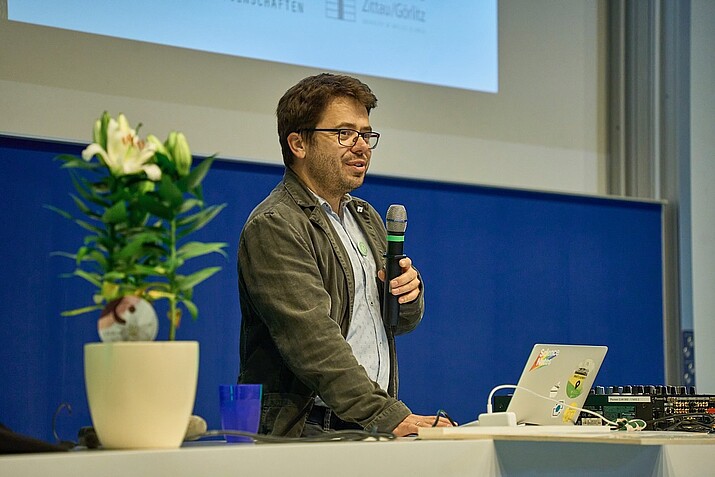
Professor Weber, so-called vitrimers have caused quite a stir in the world of chemistry. Could you briefly explain what they are and how they relate to your research?
Yes, of course. While thermoplastics, such as polyethylene (PE) or polyethylene terephthalate (PET), can be melted down and thus reshaped into new forms—and are therefore, in principle, good candidates for recycling—this is not possible for elastomers (e.g., silicones) or duromers (e.g., epoxy resins). Once molded, these materials simply cannot be reshaped, which makes their material recycling extremely difficult. “Vitrimers” can be understood as an umbrella term for a class of plastics that solves precisely this problem through “novel” chemistry—remolding cross-linked plastics is now possible.
If vitrimers are such all-rounders, why aren’t we already using them in products?
The concept is still quite new; it was first proposed and presented by French researchers around 2011. Initially, it was limited to only a few—and, moreover, new—classes of materials, but now that the principles are largely understood, a multitude of new vitrimer systems have been developed in laboratories worldwide in recent years, including silicone elastomers. However, the path from the lab to application and production is not easy—in addition to upscaling, which isn’t always straightforward because new chemicals are needed in larger quantities, the materials must also meet technical requirements—otherwise, they won’t make it to market. Here, we want to focus on the example of silicone elastomers and examine whether and how these new materials meet the high demands of high-voltage engineering.
Your research group is focusing in particular on insulators in high-voltage technology; there is a successful interdisciplinary collaboration within our university with Prof. Stefan Kornhuber from the Faculty of Electrical Engineering and Computer Science. If you succeed in making silicone elastomers based on vitrimers usable as a material in “real-world” applications, what impacts do you hope to see?
First of all, it would be wonderful if, thanks to this new chemistry, “production waste,” for example, didn’t have to be disposed of but could instead be quite easily reprocessed and actually put to use. Whether and how insulators can be reused after many years of service is not yet clear, but it would be great if that were possible. In any case, given the wide range of applications for silicones, we can make a real contribution here to the transition to a circular economy.
For many people, chemistry is synonymous with artificial, unnatural, and sometimes even dangerous to us and our environment. Do you have any advice for people who would like to start understanding today’s developments?
Well, the image of modern chemistry is, in part, of course, self-inflicted, but we should always keep in mind that chemistry is, first and foremost, simply the study of material transformations (in nature, too, of course!) and isn’t bad in and of itself. As a book lover, I’d probably point to some wonderful books here—for example, Jens Soentgen’s somewhat unorthodox introduction: *How to Philosophize with Fire: Chemistry and Alchemy for the Fearless* or “The Elements: The Discovery and History of the Basic Substances” by Philipp Ball. Modern developments are covered only briefly in these books. For more on this, it might be helpful to take a look at a portal by the German Chemical Society (GDCh) on the fascination of chemistry.
The interview was conducted by Kristin Sprechert.