
Message details
Patent granted for innovative condition assessment of transformers
The HSZG lives up to its reputation as an “energy university.”
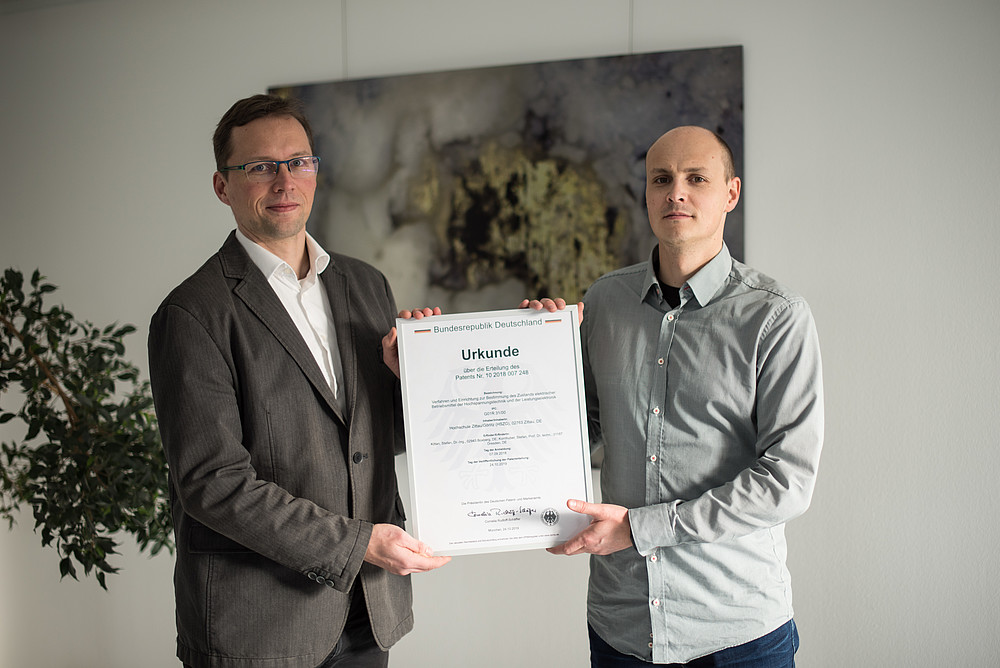
Prof. Dr. techn. Stefan Kornhuber and Dr.-Ing. Stefan Kittan, in collaboration with HSZG, have patented an innovative method for assessing the condition of transformers that combines the traditional Health Index (HI) method with entropy-based methods.
Assessing the condition of transformers plays an essential role in the era of climate change. This is because, in order to achieve the climate goals set by the federal government, our energy supply system is being restructured—moving away from a few central, base-load-capable large power plants toward many decentralized, volatile energy sources. This shift is placing increased strain on the transmission grid and its components. Renewable energy sources are causing occasional load reversal, resulting in previously unanticipated stresses on grid components. The slow pace of transmission grid expansion further exacerbates this situation. As a result, the expected service life and operational reliability of individual components are declining.
Transformers are essential components of transmission grids. Therefore, assessing their reliability is of particular importance. To ensure safe grid operation even in the current energy policy landscape, Dr.-Ing. Stefan Kittan and Prof. Dr. techn. Stefan Kornhuber have developed novel assessment methods for distribution and power transformers as part of the Smart-TR project “Condition Assessment of Power and Distribution Transformers in power engineering.”
Health Index (HI) methods are an important tool for assessing the condition of transformers. In this process, a large number of measured values are weighted and summarized into a single index. This index can be used to draw conclusions about the aging of the transformer. There are several HI methods, which differ in the number and type of measured values they consider. Furthermore, the focus of each method is determined by the weighting applied to the measured values. A disadvantage of HI methods is that they are only applicable when all necessary measurement data are available. This disadvantage is all the more significant given that certain measurements can only be performed with considerable effort.
A newer, entropy-based HI method compensates for this disadvantage by determining the necessary weighting factors directly from the measurement data. However, this has so far entailed a new drawback: entropy-based HI values are not comparable with one another. As a result, it is no longer possible to draw absolute conclusions about the state of aging. It is only possible to detect when the condition is deteriorating.
As part of their scientific work, Prof. Kornhuber and Dr. Stefan Kittan have found a way to compensate for this drawback by combining elements of the classical HI method with the entropy-based method. The scientists have successfully patented this innovative approach in collaboration with the Zittau/Görlitz University of Applied Sciences.
The project “Condition Assessment of Power and Distribution Transformers in Power Engineering (Smart Grid – Smart Monitoring)” is funded by the Federal Ministry of Education and Research as part of the “Research at Universities of Applied Sciences in Collaboration with Companies” (FHprofUnt) funding program (SC03FH026PB5).

The patenting of the invention was supported by:



1st floor