
Message details
06. July 2016
Newly developed process becomes international standard
No hot air! A new method developed by DLR, TUD and HSZG simulates water vapor flows in turbomachinery.
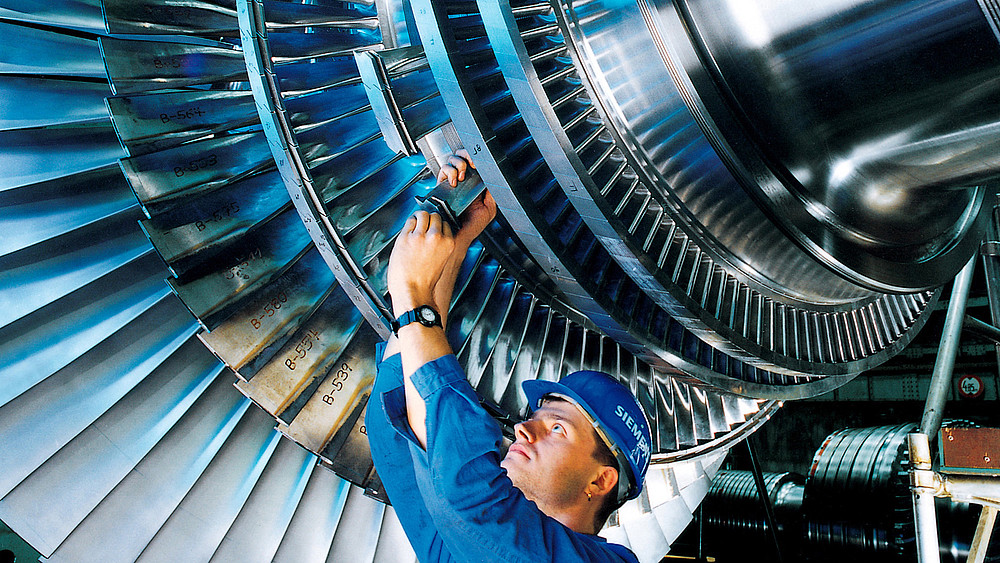
The German Aerospace Center (DLR), in collaboration with Zittau/Görlitz University of Applied Sciences and the Technical University of Dresden, has developed a method that simulates the flow of water vapor in turbomachinery with high precision and 10 times faster than before. This enables scientists to predict the processes occurring in a turbine with significantly greater precision, and provides manufacturers with reliable data for the further development of their systems. Space researchers also use these computational methods; they enable them to better understand and simulate processes on comets, moons, and exoplanets. The method has been declared the new international standard by the IAPWS (The International Association for the Properties of Water and Steam).
Water exhibits very different properties depending on temperature and pressure. To numerically predict the processes in the three-dimensional environment of a turbine, the behavior must be calculated for millions of points in space at every moment in time. Over the past six years, scientists at the DLR Institute of Propulsion Technology, in cooperation with Zittau/Görlitz University of Applied Sciences and TU Dresden, have developed a highly accurate calculation method that is 300 times faster than previous models. This makes it possible for the first time to simulate the properties of water vapor in complex processes.
"To develop this new, highly accurate, and at the same time very fast algorithm, we started with the IAPWS calculation equations and solved them using efficient interpolation methods and special variable transformations. This has resulted in interpolation tables that very accurately represent the properties of water vapor,” says Prof. Hans-Joachim Kretzschmar of Zittau/Görlitz University of Applied Sciences, who, together with Matthias Kunick, designed the new interpolation method (spline-based table look-up, SBTL). Such precise simulations are a crucial foundation for the further development of turbines. Manufacturers can use them to test the properties and behavior of prototypes in computer simulations, which shortens development time and significantly reduces development costs.
Computational Fluid Dynamics
A new feature of the method is its integration with a CFD (Computational Fluid Dynamics) database. Before the calculation, the possible states of water or steam are narrowed down using this database—for example, for parameters such as pressure and temperature. This means that not all possible states of matter need to be calculated, but only those that are relevant in each case.
“Water and water vapor are highly versatile media; simulations in the complex three-dimensional environment of a turbine are therefore extremely difficult and time-consuming,” says project leader Prof. Francesca di Mare of the DLR Institute of Propulsion Technology. With the help of computational fluid dynamics, very accurate, realistic information can be obtained about the three-dimensional and highly transient processes within a turbine.
The method is already being successfully used in Siemens’ “Power and Gas” division. This drastically accelerates dynamic and steady-state simulations of power plant processes without compromising computational quality.
“In steady-state simulations, we were able to more than double the calculation speed in some cases,” says Ingo Weber, head of tool development for steady-state power plant simulations in the “Energy Solutions” division of Siemens “Power and Gas.” Computational methods are also used in space research. It is not only industry that needs highly accurate computational methods for modeling the behavior of water vapor. Water—in the form of vapor, liquid water, or ice—is one of the most important substances on Earth and in our solar system. Using this computational method, planetary researchers can, among other things, better understand the processes on the icy moons Titan or Europa, as well as the vapor atmospheres of hot planets such as early Venus or certain exoplanets.
“Water occurs in many different forms throughout our solar system. If you want to model these processes, it’s not sufficient to simply assume that water vapor behaves like an ideal gas. What’s important here are codes that can calculate these processes quickly and accurately,” says Dr. Jens Biele, deputy project manager for the Philae comet lander. From an idea to an international standard. “Six years ago, we started with the idea of combining highly accurate algorithms with a CFD database,” di Mare recalls. Due to the complexity of water, this combination was long considered a major challenge among experts. The method is so accurate and reliable that it was adopted by the “International Association for the Properties of Water and Steam (IAPWS),” declared the new international standard for calculating the properties of water vapor and water in computational fluid dynamics and complex transient process simulations. The IAPWS is an international association of twelve national organizations that research the properties of water in all possible states of matter. “Through the development of this innovative method, DLR has further established itself as a pioneer in virtual product technology,” says Reinhard Mönig, head of the Institute of Propulsion Technology. “In this way, DLR supports industry in solving general technical problems and lays the foundation for efficient product development.” The new simulation method is the result of collaboration among scientists from three institutions. The highly accurate thermodynamic algorithms were developed by Kretzschmar and Kunick in the Department of Technical Thermodynamics at the Zittau/Görlitz University of Applied Sciences in collaboration with Prof. Uwe Gampe from the Technical University of Dresden. The algorithms were optimized for the highly complex application of 3D numerical simulation of turbomachinery in close collaboration with the DLR, where a group led by Prof. di Mare implemented them in the TRACE software system.
Text: German Aerospace Center (DLR) (Original text: here)
Your contact person
Prof. Dr.-Ing. habil. H.-J. Kretzschmar
Dean of the Faculty of Mechanical Engineering
Mail: hj.kretzschmar@hszg.de
Phone: 035836124814
Your Contact Person
Dorothee Bürkle
German Aerospace Center (DLR)
Communication, Team Leader Media Relation
Phone: 022036013492
Your Contact Person
Prof. Dr. Francesca di Mare
German Aerospace Center
Institute of Propulsion Technology - Combustion Chamber Simulation
Phone: 022036013245