
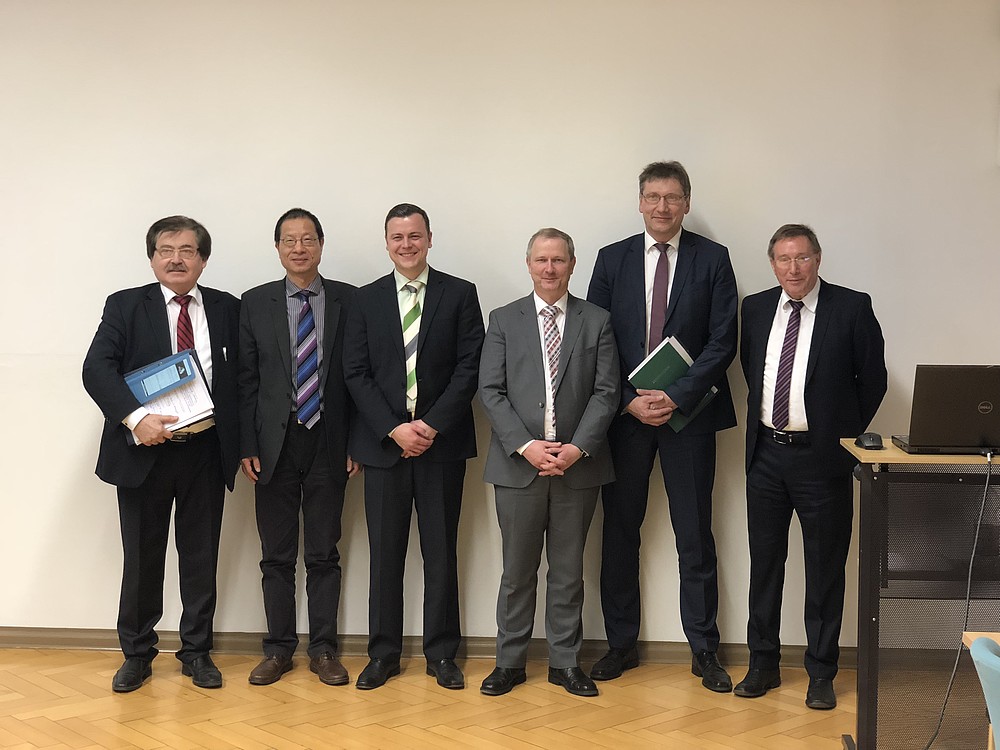
On February 14, 2018, Sebastian Schmidt from the Institute for Process Engineering, Process Automation, and Measurement Technology (IPM) successfully defended his dissertation at the Faculty of Mechanical Engineering at the Technical University of Dresden. The dissertation is titled “Development and Validation of a Method for Monitoring the Condition of the Reactor Pressure Vessel During Beyond-Design-Basis Accidents in Pressurized Water Reactors” and was awarded the distinction “magna cum laude” by the doctoral committee.
From July 1, 2012, to September 30, 2015, Mr. Schmidt worked as a research associate on the collaborative project funded by the Federal Ministry of Education and Research (BMBF) “Non-invasive Condition Monitoring of Nuclear Reactors for the Detection of Fuel Level Changes and Core Deformation (NIZUK).” The project partners were Zittau/Görlitz University of Applied Sciences (BMBF grant number: 02NUK018A) and Dresden University of Technology (BMBF grant number: 02NUK018B). The project was led and the doctoral thesis supervised by Prof. Dr.-Ing. Alexander Kratzsch (Director of IPM) and Prof. Dr.-Ing. habil. Uwe Hampel (AREVA Endowed Chair for Imaging Measurement Techniques for Energy and Process Engineering at the Institute for Energy Technology in the Faculty of Mechanical Engineering at Dresden University of Technology).
The project was based on the central question of whether it is possible to measure a core meltdown in the reactor pressure vessel of a pressurized water reactor nuclear power plant, such as the one that occurred in Fukushima in 2011. A key initial challenge was to establish a suitable database as the foundation for the investigations. This was achieved during the course of the project by researchers at the Technical University of Dresden through extensive Monte Carlo simulations of gamma radiation transport inside and outside a reactor pressure vessel for a generic pressurized water reactor.
Another major challenge of the collaborative project was the development of a measurement method for core state diagnosis, or a so-called core state monitoring method. Solving this challenge was the objective of Mr. Schmidt’s doctoral dissertation. Through the application of model-based structural health monitoring methods, the definition of core states during a core melt accident, and the development of suitable classification methods (including artificial neural networks of the multilayer perceptron type), the development of the core condition monitoring method was successfully completed. In addition, during his doctoral studies, Mr. Schmidt succeeded in experimentally validating the developed method using the NICOLE (Non-Invasive Condition Monitoring of Level and Core) test facility.
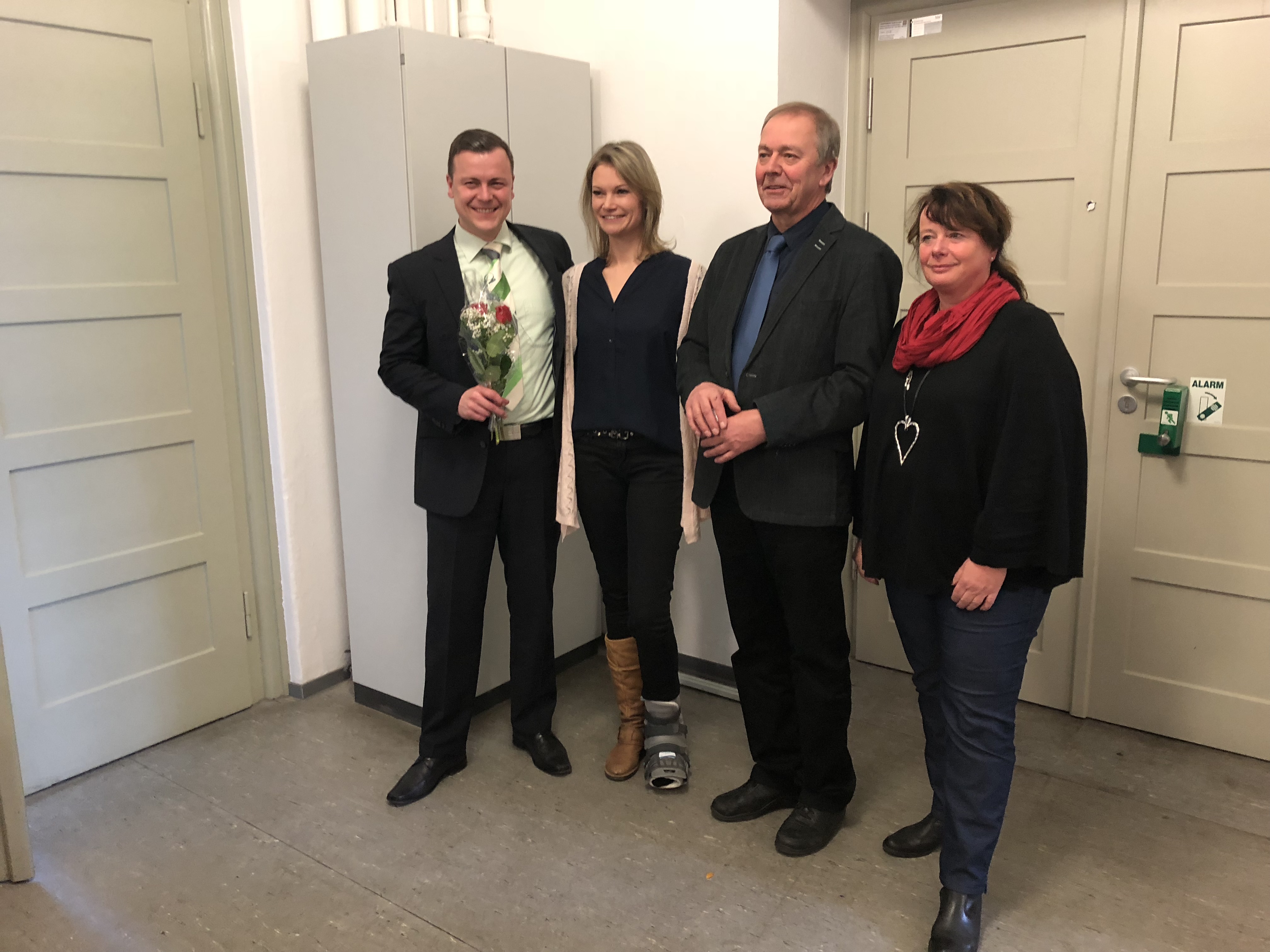
Later this year, Mr. Schmidt will face the most difficult challenge yet in completing his doctoral degree: the formal defense of his PhD thesis before his colleagues at the IPM.
Contact
Director, Institute for Process Engineering, Process Automation, and Measurement Technology (IPM)
Prof. Dr.-Ing. Alexander Kratzsch
Phone: 03583 612 4282
Email: a.kratzsch@hszg.de