
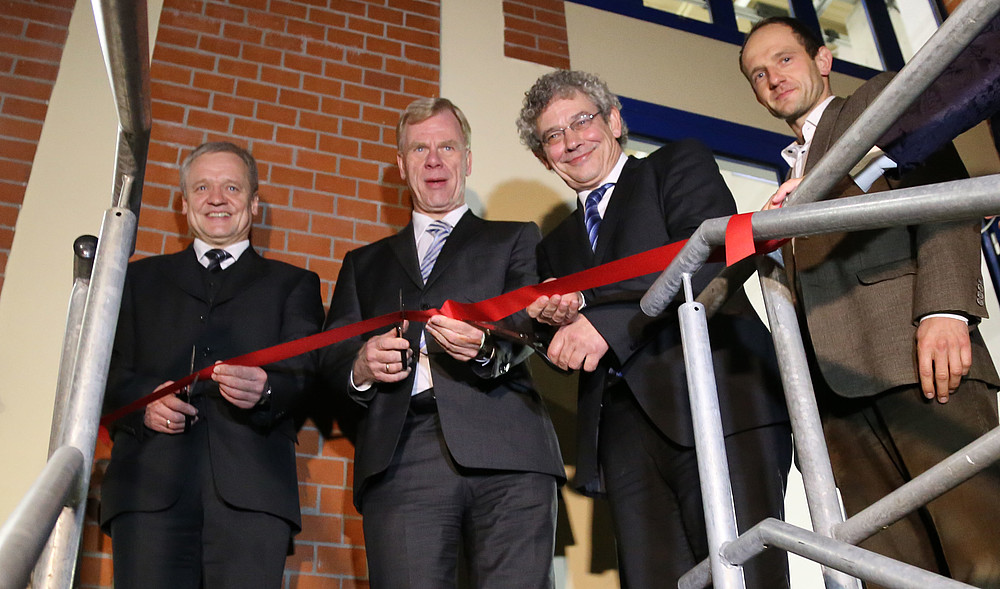
Yesterday, November 5, 2015, the Zittau Power Plant Laboratory (ZKWL) was officially inaugurated in the presence of Saxony’s Minister of State for Finance, Prof. Dr. Georg Unland. “He is very familiar with the Zittau/Görlitz University of Applied Sciences for its good teaching and research in the field of energy and environmental engineering,” the State Minister said in his speech. During the subsequent tour of the Zittau Power Plant Laboratory, he showed great interest in the test facilities and asked for detailed explanations of them.
Construction of the ZKWL began on September 5, 2011. Three large-scale test facilities were built and have already been successfully tested for operational functionality in recent months.
The large-scale test facilities consist of a magnetic bearing test rig (MFLP), a modern pressure vessel test facility, a thermal storage system (THERESA), and a thermochemical test field (TCV II).
The total cost for the three projects amounts to 7 million euros, of which 6.3 million euros come from ERDF funds. Zittau/Görlitz University of Applied Sciences is contributing 10% of the funding. In addition, there are approximately 1 million euros in construction costs for upgrading the facility. Furthermore, Stadtwerke Zittau GmbH is actively supporting this project. This makes it the largest research investment since the founding of the Zittau/Görlitz University of Applied Sciences in 1992.
“We are very pleased that we have now successfully completed this extensive project and can intensify our research in the field of ‘Energy and Environment,’” said Rector Prof. Friedrich Albrecht. “This research laboratory will further strengthen the traditional areas of teaching and research at the Zittau campus. On the one hand, this includes the energy-focused degree programmes offered by Zittau’s faculties, and on the other hand, it paves the way for the expansion of research and development in this field.”
the Institute for Process Engineering, Process Automation, and Measurement Technology
Energy and Environmental Engineering
Automation and Mechatronics
The major “Zittau Power Plant Laboratory” project is funded by the European Regional Development Fund (ERDF) and the Free State of Saxony.
Another highlight of the event was the presentation of the “Prof. Hans-Joachim Hildebrand Prize.” This year, the prize was awarded to the project teams at the Zittau Power Plant Laboratory for their outstanding work in establishing the laboratory.
The “Prof. Hans-Joachim Hildebrand Prize” recognizes and rewards scientific achievements in the fields of energy technology and energy economics that that demonstrate novel theoretical and practical insights, or in which the application of known or modified laws yields significant technical and/or economic effects, or that have led to the development of a scientific school of thought. The founding rector of the Zittau University of Applied Sciences, who would have celebrated his 100th birthday today, November 6, 2015, established this prize in 1988.
About the individual projects:
Project 1: Increasing the Energy Efficiency of Turbomachinery in Power Plants through Innovative Bearing Concepts (MFLP)
Project Leader: Prof. Dr.-Ing. Frank Worlitz
Overall Goal: To increase the energy efficiency of turbomachinery by improving efficiency through the use of innovative bearing concepts
Motivation: Conventional bearings cause energy losses due to friction and the necessary oil lubrication. In magnetic bearings, the rotor floats in an air gap without mechanical contact. In this way, losses can be reduced to as little as 5% of the bearing losses associated with sliding bearings.
In Germany and around the world, the use of magnetic bearings for rotors in steam turbines, compressors, and offshore wind turbines has long been under consideration. The solution for high temperatures and/or aggressive atmospheres in this field lies in the development of high-temperature magnetic bearings.
This project aims to establish the scientific and technical foundations.
In addition to the theoretical work, a test rig was developed and constructed for experimental investigations of magnetic and support bearings under realistic conditions.
The research results will make it possible to optimally tailor magnetic bearings to specific machines and the expected process conditions.
Project 2: Improving Energy Efficiency in Thermal Power Plants (THERESA)
Project Leaders: Prof. Dr.-Ing. Alexander Kratzsch, Prof. Dr.-Ing. Wolfgang Kästner
Overall Objective: The overarching goal of the project is to establish the scientific and technical foundations for the application of thermal energy storage systems with the aim of improving the energy efficiency of thermal processes (power plant processes).
Motivation: Current energy policy in Germany is placing new and rapidly changing demands on the existing power plant fleet and transmission grids. Due to the massive expansion of renewable energy sources, thermal power plants in particular must be able to respond with a high degree of flexibility to the highly volatile electricity supplied from renewable sources. The project “Improving Energy Efficiency in Thermal Power Plants” contributes to ensuring that thermal power plants can continue to operate cost- and energy-efficiently in the future while stabilizing the power grid. The use of thermal energy storage systems in thermal power plants—inspired by initial experiences with parabolic trough power plants—is favored as a solution. As part of the project, the large-scale test facility THERESA (Thermal Energy Storage Facility) was planned, constructed, and commissioned to achieve these objectives. The necessary experimental investigations are being conducted using this test facility. Characteristic load transients from power plants are simulated using thermodynamic simulation codes. From this, conclusions are drawn regarding the design and operation of the energy storage systems. Among other methods, soft computing techniques are applied to the modeling and simulation of thermal energy storage systems. An online condition assessment of the energy storage systems provides insights for condition-based maintenance.
In the Free State of Saxony, lignite-fired power plants are primarily responsible for covering the base load and providing the volatile residual load resulting from renewable energy feed-in. Increasing the flexibility of Saxony’s power plant fleet is of high importance for ensuring the energy supply to Saxony’s industry.
Project 3: Thermochemical Test Facility (TCV II)
Project Leader: Prof. Dr.-Ing. habil. Tobias Zschunke
Motivation: While centralized and large-scale energy supply systems will remain dominant in the German energy system, and decentralized, self-sufficient solutions are increasingly becoming attractive supplementary options, in many parts of the world decentralized solutions incorporating a mix of renewable primary energy sources are the only way to achieve improvements in living standards at an affordable cost. Renewable energy feedstocks, such as biomass, place high demands on thermochemical conversion technology.
Thermochemistry is a general term for processes in which chemical decompositions and transformations occur under temperatures far above 200 °C, up to 1,200 °C.
Furthermore, integrating energy generation with energy utilization requires methods for heat and cold storage and their control, which in turn are based on the fundamentals of physical chemistry. There are still some gaps in the engineering fundamentals for the widespread deployment of heat, cooling, and electricity supply in decentralized networks without fossil fuels; some of these gaps are to be addressed in the “Thermochemical Test Bed” project.
The following main experimental topics are being addressed:
1. Investigation of the behavior of energy feedstocks and intermediate products under real-world operating conditions in accordance with the state of the art and across additional parameter ranges
2. Investigations into the thermodynamic behavior of latent heat storage systems
3. Investigations into the thermodynamic behavior of latent cooling storage systems
All experiments are supported by the application and further development of mathematical and computer-aided simulation algorithms. The experimental setups are, of course, developed and operated in close collaboration—both in terms of content and, in some cases, physical location—with the thermochemical test facilities already in place at the university.
Congratulations!
Funded by:
Contact:
Zittau/Görlitz University of Applied Sciences
Prof. Dr.-Ing. Frank Worlitz, Director of IPM
Phone: 03583 / 61 24 383
Email: f.worlitz@hszg.de
Dipl.-Ing. Hella Trillenberg
Advisor to the Rector / Press Spokesperson
Phone: 03583/ 61 1403
Email: presse@hszg.de