
Message details
07. May 2018
Border region with a special network of relationships
Dr. Böhm from the TU Liberec reports on the special relationship between Poland and the Czech Republic.
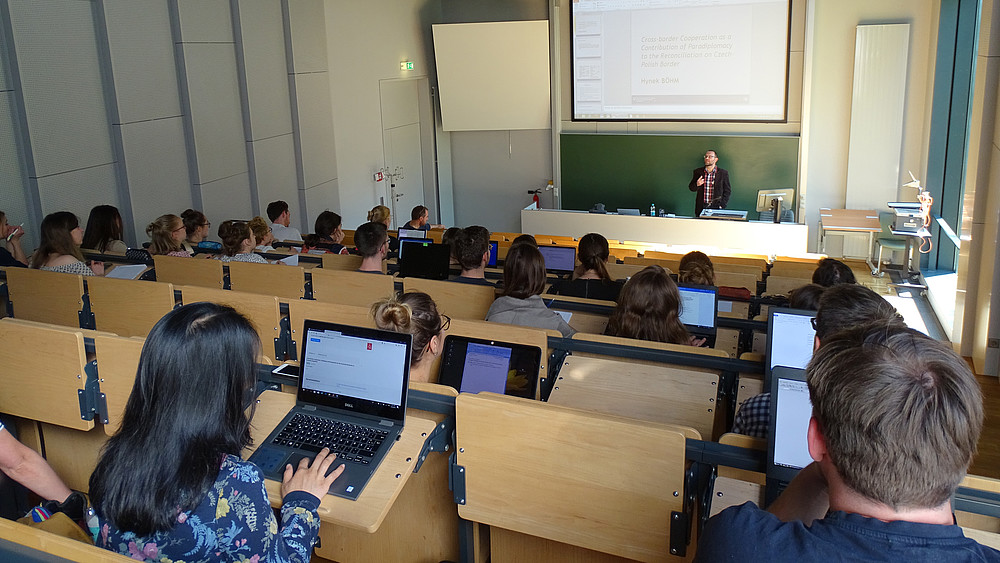
The lecture by Dr. Hynek Böhm of the Technical University of Liberec (department of Geography) on April 19, 2018, explored a border region in the heart of Europe that has received little attention from a German perspective. By way of introduction, Professor Kollmorgen highlighted the thematic connection to the two previous presentations by historian Dr. Markus Bauer and educator Jan Steffens, which had been delivered as part of the lecture series “The East-Central European Region: Old and New Borders (and Their Demarcation)”
The approximately 35 attendees then listened to the remarks of Dr. Böhm, who, among other things, serves as an expert on issues concerning the Visegrád states at the European Commission’s “Cross-border Cooperation” [CBC] program. His lecture was titled “Cross-border Cooperation as a Contribution of Paradiplomacy to Reconciliation on the Czech-Polish Border.” The fact that border regions are by no means a marginal issue is evident from the fact that, after all, a quarter of the European population lives near a border. Yet the biggest problem is the barrier in people’s minds. Many borders are areas of former conflict.
Poland and the Czech Republic differ not only in terms of their size and population distribution but also in the distinct characters of their respective capitals. Relations between the two countries show no serious problems and, historically speaking, are at their best. There are commonalities, for example, regarding migration policy, similar to the policies in the other Visegrád Group countries.
On a personal level, the situation is somewhat different. For instance, Poles like the Czechs more than the other way around. Czechs tend to ignore others—with the exception of the Slovaks, with whom they have a much better relationship 25 years after the split, the speaker notes with an ironic undertone. From the Czech side, no problems are seen in bilateral relations; from the Polish side, however, there are some, particularly with regard to the Polish minority in the neighboring country.
The lecture then turned to the central topic: the border region around the divided city of Český Těšín/Cieszyn (German: Teschen) in Silesia, south of Katowice. The territory of the former Duchy of Teschen is the subject of an aspect of shared history that is almost forgotten today: the Polish-Czechoslovak border war in January 1919. As a result, the city was divided along the Olsa River in 1920. Following the adoption of the Munich Agreement in 1938, Poland annexed the Czech part. It was not until the end of World War II that the pre-war status quo was restored. Today, the twin city—with 25,000 residents on the Czech side and 35,000 on the Polish side—is the center of the Těšínske Sleszsko/Śląsk Cieczyński Euroregion (Těšín Silesia).
The development of Euroregions began in the 1960s as a means of promoting international understanding in Western Europe. In this context, the term “paradiplomacy” —a form of parallel foreign policy—can be used. However, the actual wave of founding took place in the 1980s, followed by further expansions after the fall of the Iron Curtain and the political transition in the socialist states of Europe.
The Těšínske Sleszsko/Śląsk Cieczyński Euroregion was founded 30 years ago, on April 22, 1998. Due to the bilingualism of the Polish minority and the fundamental similarity of the two Slavic languages, there is no language barrier—unlike in the Neiße-Nysa-Nissa Euroregion. There is also close cooperation on the economic front. However, according to the speaker—who himself hails from this region—discrimination against minorities in both countries remains a problem. The Euroregion’s main areas of focus in developing the border region include transportation, environmental protection, disaster and Risk management, tourism, and education. Unlike other Euroregions, aspects of peacekeeping and reconciliation are not a priority. This was also the finding of an analysis of completed EU projects conducted by the speaker himself. Of the total of 300 projects, most were dedicated to sports and culture (51 and 71 projects, respectively). Controversial topics are largely avoided in the projects; only 16 projects addressed historical topics. And when they did, the projects were carried out by organizations representing the Polish minority, in some cases despite resistance from Czech municipal authorities.
In the ensuing discussion, the question was raised as to who such projects actually reach. The focus tends to be on the elites—a problem that is not unique to this Euroregion. Another question is what will happen if such Euroregions no longer exist. The importance of mutual trust remains as strong as ever today. Dr. Böhm offered a fitting closing remark regarding all border regions: “Here Europe is made!”

Faculty of Social Sciences
02826 Görlitz
Furtstrasse 2
Building G I,
Room 1.09
1st floor
1st floor
+49 3581 374-4274