

Message details
15. July 2016
GreK begins its work
Binational education project presented and discussed at an official kick-off event.
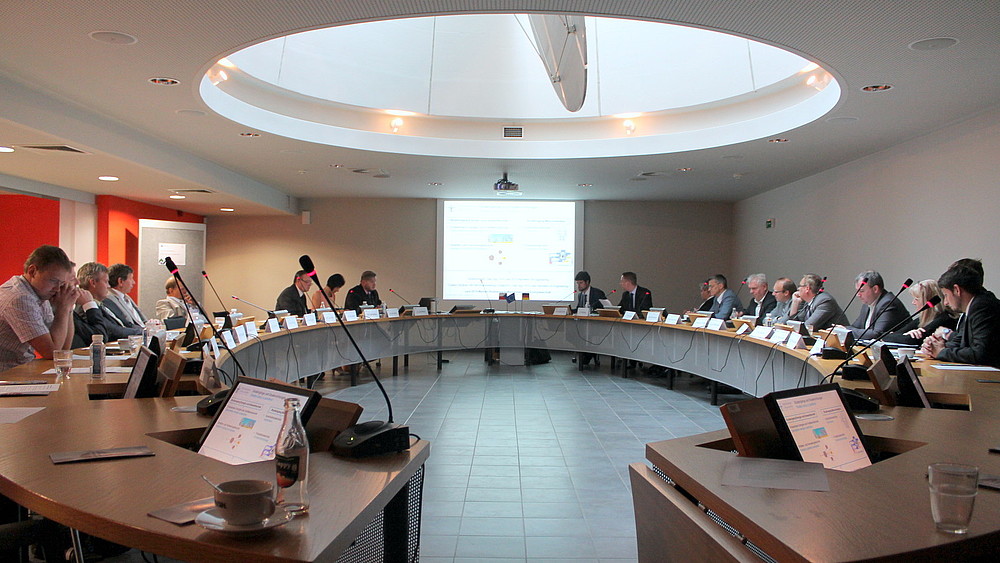
The binational educational project to develop and establish a cross-border teaching network in plastics engineering (GreK) between Zittau University of Applied Sciences/Görlitz and the Technical University of Liberec, with support from the Institute for Engineering Education at the Technical University of Dresden, was presented and discussed on June 28, 2016, in Liberec as part of an official kick-off event. The joint project, which is funded with approximately €1 million in EU funds through the “SN-CZ” program until 2019, enables the participating universities to develop and test new teaching formats in the field of modern plastics engineering, incorporating didactic methods. The aim is to combine the respective core subject expertise and technical resources of the project partners in order to significantly enhance the quality of instruction and the appeal of the educational programs on both sides of the border.
“The cross-border teaching network is intended to take the needs of industrial practice into account to a particular degree and, in addition to the fundamentals, familiarize students with the latest polymer technologies, thereby preparing them optimally for a successful start both in industry as developers or project managers and in research. “We are therefore delighted that numerous innovative plastics processors from Upper Lusatia and the Liberec Region are willing to enrich the project through activities such as plant tours, lectures, and regular exchanges,” explains Prof. Scholz, project leader of GreK, emphasizing: “With a combined total of over 250 companies in the plastics processing industry, the neighboring regions have a concentration of businesses that is well above average. If we succeed in bringing these numerous areas of expertise together more closely across the border, the Upper Lusatia-Liberec region will represent a major economic hub for the plastics industry within Europe. The universities, with their existing industry partnerships, provide an excellent starting point for this.” The mayor of Zittau, Mr. Thomas Zenker, also emphasizes the economic, social, and cultural benefits for both sides that would result from further bridging the border and highlights the growing and fruitful cooperation between the cities of Liberec and Zittau.
To meet the urgent need for young engineers in the region’s steadily growing plastics industry, the HSZG launched the “Polymer Technologies” specialization in the winter semester of 2015. “The new specialization in the Faculty of Mechanical Engineering is intended to contribute to providing students with academic training tailored to their needs,” explains HSZG Rector Prof. Albrecht, who also sees great added value for student education in this department in the university’s close ties with the newly established Fraunhofer Plastics Center Upper Lusatia in Zittau. The Technical University of Liberec also sees an improvement in the quality of teaching and the attractiveness of the program through this joint project. Prof. Nemecek, Rector of the Technical University of Liberec, pledges his full support for the project and explains: “The Technical University of Liberec has been offering education in plastics engineering since 1963 and can look back on a long tradition in this field. However, the rapid progress of today’s polymer technologies requires strong networking and continuous adaptation of teaching.” Prof. Lenfeld, Dean of the Faculty of Mechanical Engineering at the Technical University of Liberec, adds: “The GreK project significantly enriches teaching through its focus on innovative technologies and construction methods, such as textile-reinforced lightweight structures, function-integrating technologies, and the 3D printing of plastic components.”
In addition to developing bilingual lectures, exercises, and internships tailored to both technical and pedagogical needs, GreK’s specific goals also include organizing regular field trips to industry partners on both sides of the border. In addition, the program includes the development of a joint, English-language workshop for the practical instruction of the entire product development process (PEP) for a high-load plastic assembly. In this workshop, students from Zittau and Liberec will go through the individual development steps—from concept development through design, FEM analysis, and manufacturing all the way to system testing—using a small wind turbine as an example. Another goal of GreK is to establish a cross-border plastics engineering network in the Upper Lusatia–Liberec region (English:“Cross-border Plastics Network Upper Lusatia–Liberec”— CroBoPlast) to promote binational networking among companies, universities, and students, thereby incorporating practical topics into teaching, placing graduates with cross-border plastics companies, and holding regular networking meetings alternately in Zittau and Liberec.
Faculty of Mechanical Engineering
02763 Zittau
Schwenninger Weg 1
Building Z VII,
Room 210
2ND FLOOR
2ND FLOOR
+49 3583 612-4832
Fraunhofer IWU
02763 Zittau
Th.-Körner-Allee 6
Building F II (Fraunhofer),
Room 313
3RD FLOOR
3RD FLOOR
+49 3583 54086 4009