
Message details
Research facility for sustainable industrial processes
Applied research for sustainable energy and material conversion in Zittau can take off.
The decision by the Bundestag to establish a research facility for sustainable, low-carbon industrial processes in Upper Lusatia was received with great enthusiasm at the Zittau/Görlitz University of Applied Sciences.
With the planned establishment of an institute of the German Aerospace Center (DLR), the research and development potential of Zittau/Görlitz University of Applied Sciences (HSZG) and the Brandenburg University of Technology in Cottbus - Senftenberg (BTU) through cooperation and synergies, allowing them to be more fully realized.
The planned Fraunhofer Institute for Energy Infrastructure and Geothermal Energy, which is to be headquartered in Cottbus and will likely have a branch office in Zittau, will also strengthen the cooperation and synergies between the two institutions in the field of energy infrastructure.
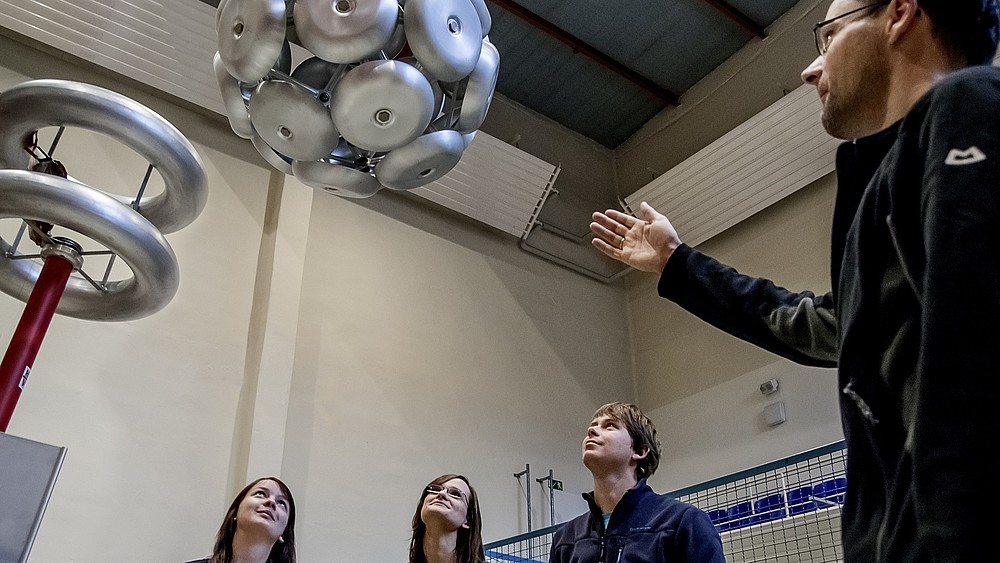
In cooperation with the BTU, large-scale experimental facilities will be used to investigate energy-saving and energy-storage processes that can thereby contribute to reducing CO2 emissions. To carry out the necessary research and development tasks, the HSZG already has a good staff—including at the Institute for Process Engineering, Process Automation, and Measurement Technology—as well as a very strong experimental foundation provided by the Zittau Power Plant Laboratory and the High-Voltage Laboratory.
In these new endeavors, efficient electricity use with modern grid and transmission technology, as well as electricity storage in the form of water vapor, hydrogen, methane, or so-called synthetic fuels—play just as important a role as the use of renewable energy and residual and waste materials in novel energy conversion and energy supply technologies. Particular attention is being paid to technologies that can be applied on a decentralized basis and that benefit local communities through value creation, such as innovative combined heat and power concepts.
“Engineering scientists at HSZG have already developed many innovations and ideas to address these challenges; their implementation requires the involvement of numerous experts from various disciplines and, above all, great perseverance and tenacity,” says the Prorector for Research at the University of Zittau/Görlitz, Prof. Dr.-Ing. habil. Tobias Zschunke.
A distinctive feature of the systems to be researched is that they are highly complex and require extensive, time-consuming, and labor-intensive testing. The digitization of control processes for physical and chemical phenomena is particularly challenging. The practical work will be accompanied by theoretical studies and modeling, as well as complex impact analyses on the environment, the economy, and society, which are to be conducted in collaboration with the new institutes and the BTU in Cottbus.
1st floor
Upper floor
1st floor
Upper floor