
Castor containers hold radioactive cargo. But what do you do with the dangerous contents? The search for a final repository for nuclear waste continues, but the containers are here and must be monitored. This is exactly the problem facing the nuclear power plant in tranquil Springfield. Homer Simpson describes his approach so far to Daniel Fiß, a staff member at the Institute for Process Engineering, Process Automation, and Measurement Technology at HSZG: open the Castor container, stir the contents, close it again, and take the container out into nature. No wonder Homer’s doctor just shakes his head. Luckily, Homer has now found his way to Zittau to look for good methods.
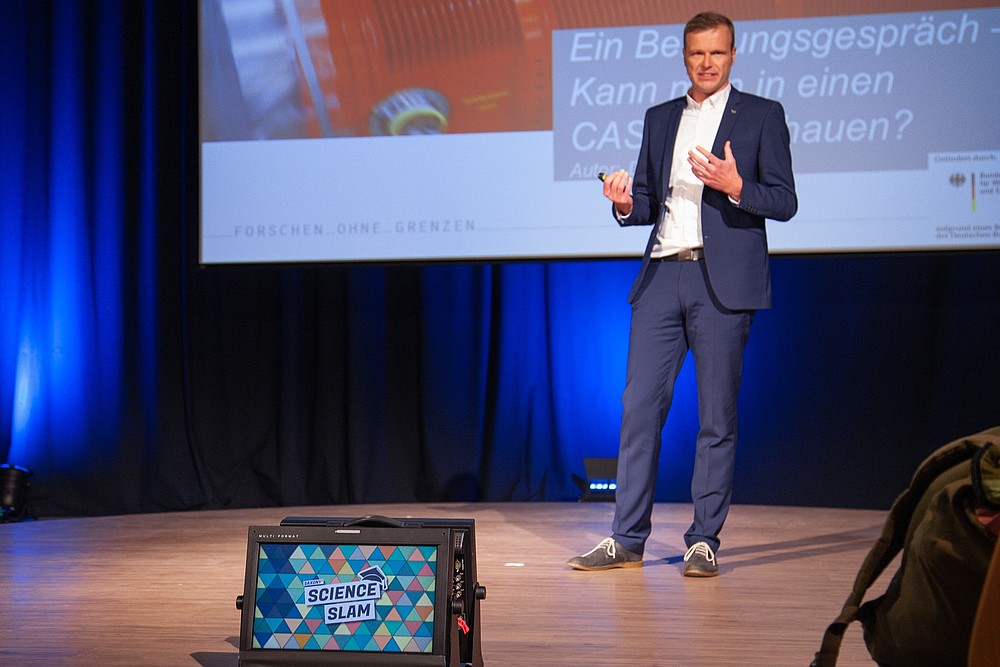
A concentrated dose of science in 10 minutes, packaged in exciting, vivid presentations—Daniel Fiß from the IPM took on this competition for the good “slam presentation.” Together with five competitors, he took the stage on October 25 at the Mittweida University of Applied Sciences TV studio to compete for the trophy at the 1st Saxony5 Science Slam. Colleagues from Zittau were also able to watch live via the MDR Wissen Facebook page to see how the presentations were received by the audience.
“Fundamental R&D work on methods for monitoring the condition of transport and storage containers for spent nuclear fuel and heat-generating high-level radioactive waste during extended interim storage”
(A collaborative project between TU Dresden and the IPM at HSZG)
What sounds like a cumbersome title is actually quite compelling in terms of its content: How do you look inside a Castor container to find out what’s happening inside it during the interim storage of fuel rods?
In addition to radiographic measurement methods that determine the radiation distribution within the Castor container—such as X-ray imaging using cosmic rays—and experiments that simulate heat distribution within the container, the researchers have reported success with two additional methods.
Vibration analysis makes the Castor “dance,” even if this can only be detected in the micrometer range. With passive acoustic emission, it was time to lend an ear to Homer, because when a rod bursts inside the Castor, the sound becomes measurable. The scientists from the IPM now plan to repeat the experiments with a real Castor container and develop a concept for how the radioactive cargo could be monitored in an interim storage facility in the medium term—and thus how monitoring of the fuel rods might look.
On Thursday evening, Mittweida’s local hero, Prof. Kristan Schneider, took the stage and won the competition. He presented his field of expertise—mathematical population genetics—using the mating behavior of great apes as an example. The audience rewarded his presentation with thunderous applause. Homer Simpson’s visit to the HSZG was also good and helped shed light on research into the socially controversial topic of nuclear waste.
All the slams can be rewatched on the Saxony5 YouTube channel.
The entire event is available as a livestream on Facebook.
More information about the Saxony5 research network is available here.



Text: Kristin Sprechert
Research Project Contact:
Institute for Process Engineering, Process Automation, and Measurement Technology
Prof. Dr.-Ing. Alexander Kratzsch
Phone: 03583 612-4282
Email: a.kratzsch@hszg.de
Contact Saxony5
TV 13 “Marketplace of Ideas”
Kristin Sprechert, M.A.
Phone: 03583 612-4792
Email: kristin.sprechert@hszg.de