
Message details
Autonome Roboter im Dienst der Umwelt und Gesundheit
Pauline Rechenberg verteidigt eindrucksvoll ihre Praktikumsarbeit zur Entwicklung eines autonomen stationären Robotersystems für Krankenhausabfälle.
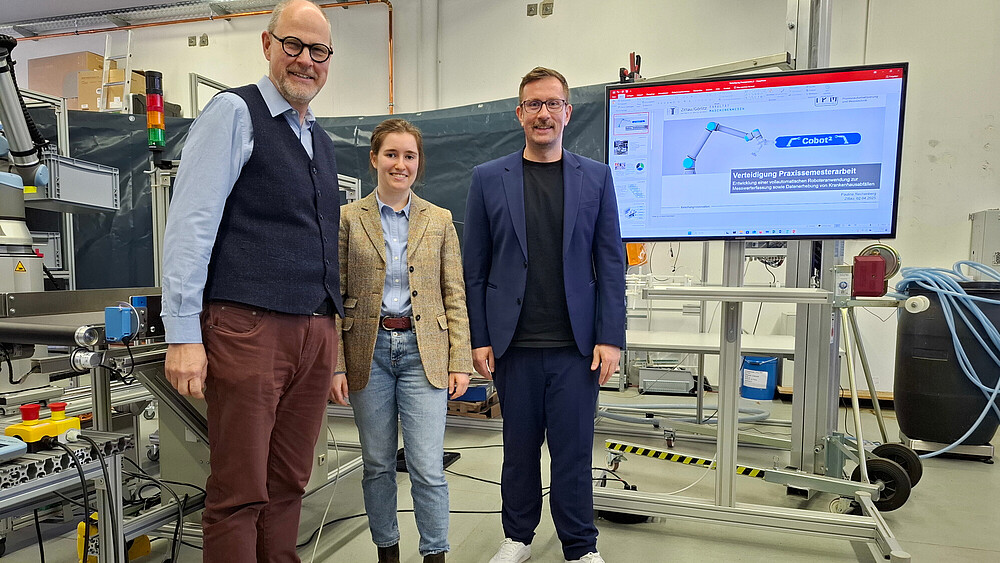
Zittau, 2. April 2025 – Heute präsentierte Pauline Rechenberg ihre Praxissemesterarbeit mit dem Titel „Entwicklung und Aufbau einer vollautomatischen Roboteranwendung zur Messwerterfassung sowie Datenerhebung von Krankenhausabfällen“ vor Gästen am real aufgebauten Versuchsstand Cobot². Die Verteidigung war nicht nur fachlich exzellent, sondern auch ein echter Einblick in praxisnahe, zukunftsweisende Forschung.
Der Versuchsstand Cobot² ist ein zentraler Bestandteil des Projektes „Cobot²: Synergien in Pflege und Recycling durch Teamarbeit“, das von drei Instituten der Hochschule Zittau/Görlitz getragen wird:
- Institut für Prozesstechnik, Prozessautomatisierung und Messtechnik (IPM)
- Institut für Gesundheit, Altern, Arbeit und Technik (GAT)
- Zittauer Institut für Verfahrensentwicklung, Kreislaufwirtschaft, Oberflächentechnik, Naturstoffforschung (ZIRKON)
Die Betreuung der Arbeit erfolgte durch Prof. Dr. Martin Sturm (Fakultät Maschinenwesen) sowie M.Eng. Christian Vogel (IPM). Beide Betreuer bescheinigten Pauline Rechenberg eine Leistung, die die Erwartungen deutlich übertraf.
Technologische Spitzenleistung mit gesellschaftlichem Mehrwert
In ihrer Arbeit entwickelte Pauline Rechenberg ein modulares Robotersystem, das die kontinuierliche Erfassung und Analyse von Krankenhausabfällen ermöglicht. Der Versuchsstand kombiniert verschiedene hochkomplexe Systeme – darunter ein kollaborativer Roboter (Cobot), ein 2,5D-Kamerasystem, Förderbandtechnik, ein Vibrationsbunker zur Materialvereinzelung, Sensorik sowie ein Basissystem zur Integration kommender Multisensorkombinationen, die für die Werkstoffanalyse benötigt werden.
Ziel des Systems ist die automatisierte Datenerhebung von Krankenhausabfällen als Vorbereitung für eine intelligente Sortierung und Recyclingstrategie. Dies ist insbesondere relevant, da jährlich mehrere Millionen Tonnen medizinischer Abfälle entstehen – ein Großteil davon wäre theoretisch recyclingfähig, wird aktuell jedoch thermisch verwertet.
Methodisch durchdacht, technisch brillant
Die Umsetzung erfolgte nach ingenieurwissenschaftlichen Standards (VDI 2222/2225) mit strukturierter Konzeption, Risikobeurteilung (DIN EN ISO 12100) und detailreicher Konstruktion mittels CAD. Neben der Auswahl geeigneter Komponenten (u. a. UR10e, OnRobot Greifer & Kamera) entwickelte Pauline ein Sicherheitskonzept, das trotz Forschungscharakters die Bedienung der Anlage sicher und nachvollziehbar macht.
Eine Besonderheit ist die modulare Architektur der Anlage. Alle Baugruppen – vom Förderband über das Regallager bis hin zum Roboter selbst – sind verschieb- und erweiterbar. Dadurch ist das System nicht nur auf aktuelle Anforderungen abgestimmt, sondern bietet eine flexible Basis für zukünftige Forschungs- und Entwicklungsarbeiten innerhalb von Cobot².
Beeindruckende Präsentation vor Gästen
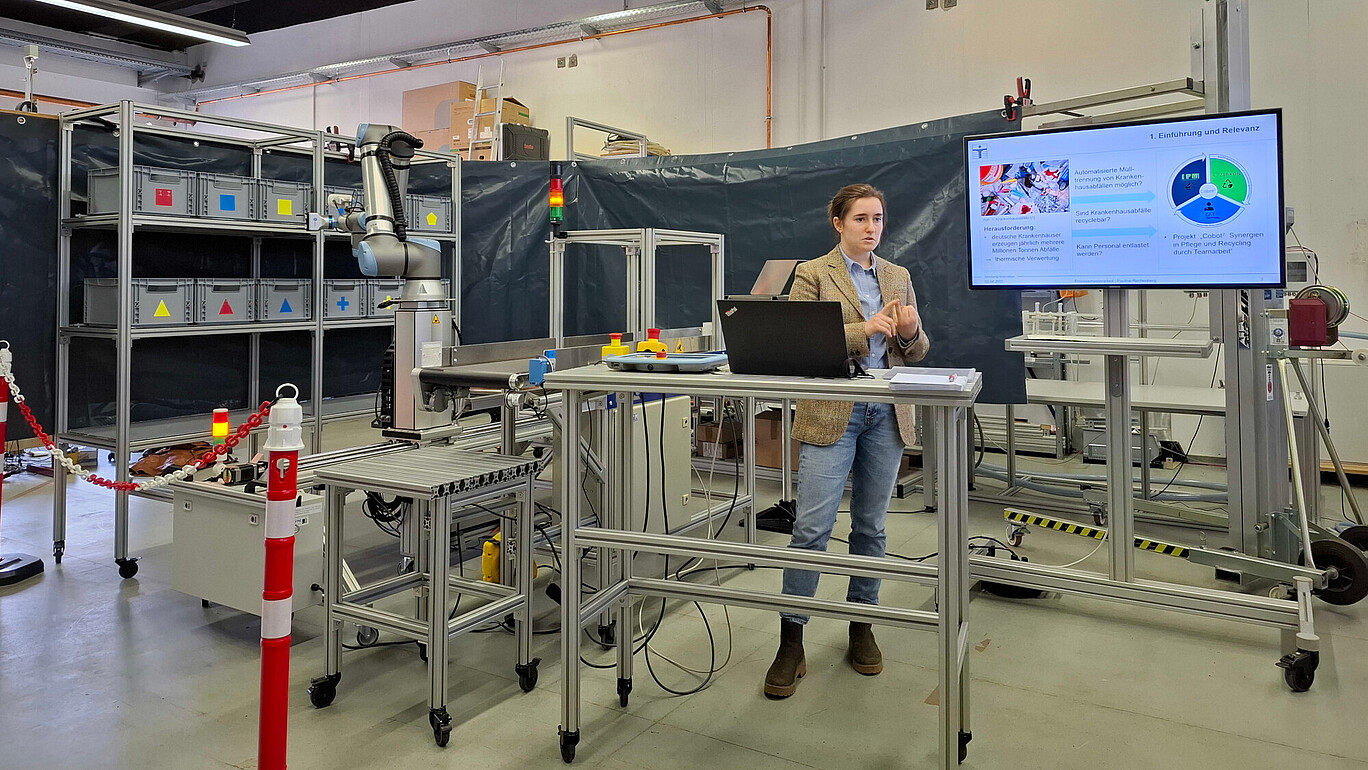
Ihre Verteidigung direkt am funktionierenden System war ein Höhepunkt: Der Versuchsstand demonstrierte eindrucksvoll die Funktionsweise des automatisierten Prozesses – vom Scannen der Kleinladungsträger, über die Vereinzelung und Datenerhebung, bis hin zum Rücktransport. Gäste und Betreuer waren gleichermaßen begeistert von der Professionalität und Tiefe der Präsentation.
Fazit: Paulines Arbeit ist ein herausragendes Beispiel für ingenieurwissenschaftliche Kompetenz, angewandte Robotik und nachhaltige Systementwicklung. Mit ihrer Lösung leistet sie einen bedeutenden Beitrag zur zukünftigen Verwertung medizinischer Abfälle und zur technologischen Weiterentwicklung des Projekts Cobot².
Wir danken Pauline herzlich für ihr Engagement und ihre exzellente Arbeit – und freuen uns auf die nächsten Schritte in diesem spannenden Projekt!
Ansprechpartner

Upper floor