
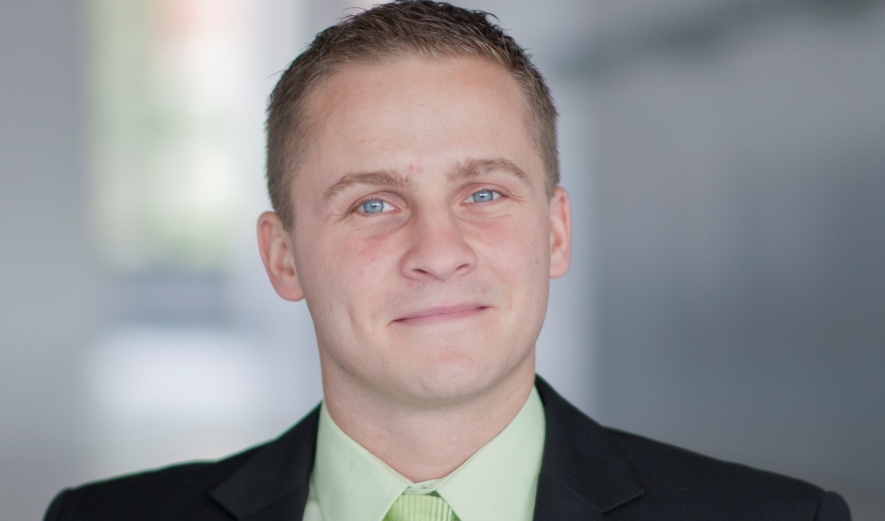
From December 2009 to February 2013, Clemens Schneider worked on a collaborative research project funded by the BMBF titled “Modeling, Simulation, and Experiments on Boiling Processes in Pressurized Water Reactors.” The research consortium included TU Dresden—with its Institute of Fluid Mechanics, the Chair of Hydrogen and Nuclear Energy Technology, and the Faculty of Medicine—as well as the Helmholtz Center Dresden-Rossendorf, Ruhr University Bochum, TU Munich, the Karlsruhe Institute of Technology, ANSYS Germany, and the Zittau/Görlitz University of Applied Sciences.
Dr. Schneider’s subproject, titled “Experimental Investigation of Boiling Processes Using Optical Methods and Parameter Determination for CFD Calculations on Small-Scale Test Benches,” made a significant contribution to the experimental component of the consortium and formed the basis for his doctoral dissertation.
The doctoral work was conducted in collaboration with the Chair of Hydrogen and Nuclear Energy Engineering at the Technical University of Dresden under the supervision of Prof. Antonio Hurtado. Supervision on behalf of the university was provided by the former rector, Prof. Rainer Hampel. In addition to numerous seminars and workshops, technical papers and presentations at national and international conferences, as well as the publication of the results in scientific journals, were an integral part of the doctoral process.
With the defense on July 28, 2015, and the subsequent publication of the dissertation titled “Experimental Investigations into Bubble Boiling in Supercooled Flows” at the “Saxon State and University Library” (SLUB) in Dresden, the program was successfully completed with the distinction “magna cum laude.”
In addition, on December 4, 2015, the traditional celebratory “post-defense” of Mr. Schneider’s doctoral dissertation took place at the DeZi-Bar in Zittau (basement of Dormitory D) in the company of his colleagues from the IPM. This “post-defense” is a traditional ritual in which the candidate must overcome the final hurdles to earning a doctoral degree. An independently appointed examination committee evaluated the PhD thesis while reading aloud two “criticisms.” The candidate was then required to demonstrate that he was familiar with the content of his work and capable of independently designing an appropriate experimental setup, conducting experiments, and evaluating the results. Dr. Schneider successfully met all the requirements of this highly rigorous academic examination and was ceremonially presented with the “official” doctoral diploma and doctoral cap by the examination committee.
Over the past 22 years, 15 researchers have earned their doctorates at the IPM.
Contact:
Institute for Process Engineering, Process Automation, and Measurement Technology (IPM)
Prof. Dr.-Ing. Alexander Kratzsch
Email: a.kratzsch@hszg.de