
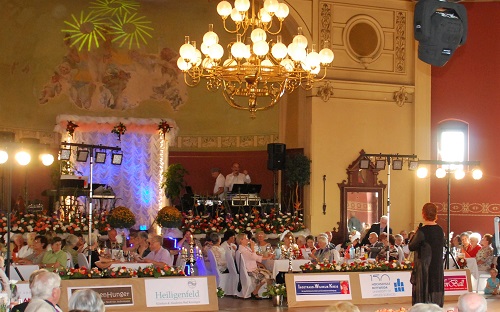
Students of the Faculty of Social Sciences supported the 5th Saxon Seniors' Ball
All waltzes for a small anniversary - The 5th Saxon Seniors' Ball
The fifth Saxon Seniors' Ball took place on September 24 and 25, 2016. The historic ballroom in the traditional Watzke building on the banks of the Elbe in Dresden once again provided an impressive backdrop. Decorated with over 3,500 flowers and 400 meters of tulle, the state capital provided a very special venue to commemorate the long-forgotten dance and ball culture - to revive it - and it was a wonderful success. And this is not a matter of course in view of the ever-increasing expenses in truly uncertain times. 135 players in the background, numerous volunteers, a ball committee supported by students from the Zittau/Görlitz University of Applied Sciences, Faculty of Social Sciences and Mittweida University of Applied Sciences with specific practical research assignments, as well as numerous sponsors and supporters made the ball possible in the first place - and the result was a glittering dance festival for and with senior citizens. Under the patronage of the Ingetraud-Wilhelm-Kreis für psychohistorische Arbeit und Generationenverständigung and with the honorary patronage of the former director of the Vienna Opera Ball, Prof. Lotte Tobisch, Baroness von Labotýn from Vienna, around 700 guests attended the magnificent dance spectacle on both days of the ball and the organizing association for social projects, SoPro e.V., was barely able to cope with the high demand for tickets in advance. The great interest in the Landesseniorenball is not only due to the accessibility in terms of price and time to an entertaining and exclusive dance show with audience dancing. It is also the festive ambience in which you can feel at ease among your peers. Guests in need are equally represented as mobile and active senior citizens. They are all united by their enthusiasm for dancing on the dance floor, despite their situation in life, to well-known melodies from the past and evergreens, as well as the joy of watching. This year, dancers from the Ottendorf-Okrilla show dance group performed acrobatic routines, star dancer Achim Nimmler, once active at the Dresden Palucca School, was once again represented on the dance floor with his Artemis Dancers in ballet and tap, the 1. Dresdner Rock'n Roll-Club presented rousing beats in formation with children and adults, the TSC Excelsior showed in a show tournament of standard dances what discipline and performance mean in dance - master couples did their rounds beaming, also in the Latin American section. Another highlight was the performance of the wheelchair dance group from Görlitz - with esprit and joie de vivre, the artists showed how relative disability can be. And another star guest did the honors: Monsieur Peter Wieland from Berlin, who at the age of 86 brought world music with a powerful voice. And in between, the audience danced to record music and the sounds of the Kubat band - and did so extremely exuberantly. The ball was recorded in its entirety for the first time, there was a spontaneous choir for the first time, a special senior ball store range was developed and sold for the first time, there was a premiere dance partner exchange and guests were allowed to take their portrait photos with them. The gala ball was hosted by Madame Adrienne Höfgen, who led through the program with charm and humour and inaugurated the new stage backdrop. However, the face of the ball is not only elegant and atmospheric. The gala event is also always very authentic when it comes to the inclusion of people in need of help and care or when current issues take center stage. For example, people with a migrant background were also guests and, unfortunately, considerable discrimination was also noticeable. Even if (apparently) only in passing, it became clear how important intercultural understanding is and remains. After our fifth ball, we can confidently say: we need each other - more than ever and regardless of how old you are and where we have our roots. And we hope that music and dance will continue to help bring us closer together.
Prof. Dr. Michel C. Hille