Review of the transfer event for the Elitenmonitor research project
On May 15 and 16, 2025, the Transfer Event of the Elitenmonitor joint research project took place at the Zeitgeschichtlichen Forum Leipzig. As part of a scientific workshop and a public conference, intensive exchange with colleagues and interested members of the public was sought—with exciting discussions, new ideas and valuable insights.
Public conference: Focus on representation issues
Following a brief introduction by Dr. Lars Vogel, spokesperson for the joint project, the public portion of the event began with a welcome address by Elisabeth Kaiser, the new Federal Government Commissioner for Eastern Germany. She praised the importance of the project Elitenmonitor, which was initiated by her predecessor Carsten Schneider and emphasized its relevance for the analysis of social participation and representation as well as the current challenges in German-German relations.
The first thematic block then presented key findings from the research project: Using the Leipziger Elitendatenbank —a comprehensive survey of biographical data on more than 4,000 individuals holding approximately 3,000 elite positions—Dr. Lars Vogel showed how the proportion of East Germans in key top positions has developed over the past six years, drawing a mixed conclusion: Slight increases in individual sectors (e.g., politics, science, media) are offset by sectors in which the numbers remain at a consistently low level or are even declining (e.g., military, business, culture). Of particular relevance here is the fact that 49.9% of positions were newly filled during the observation period 2018-2023, meaning that there would have been opportunities for a higher increase. Prof. Dr. Marion Reiser then presented the results of the Elite Survey, in which members of the elite were asked about their attitudes and self-image.
Finally, Prof. Dr. Raj Kollmorgen discussed the findings from qualitative interviews with members of the East German elite, focusing in particular on the obstacles to advancement and the factors that promote it at various career stages. According to the initial results of the interview evaluation, there are stage-specific requirements for advancement to the next career stage. The overarching mechanism is the recruitment logic of being sought after and in demand, which refers centrally to the role of social capital and networks. This in turn requires that aspirants are present early on in key institutions in the respective sector. Early leadership-oriented work also proves helpful in this regard. However, East Germans tend to be disadvantaged in both respects, as the low density of institutions and companies in the eastern German states requires early mobility on the part of East German aspirants. Reference was also made to the role of homophily—i.e., the preference for socially similar individuals—in the recruitment process.
The second block broadened the focus to include other underrepresented groups: women and people with a migrant background. In her contribution, Prof. Dr. Miriam Hartlapp (Free University Berlin) addressed the structural disadvantage of women in the Bundestag and referred, among other things, to France, where a legal parity regulation has significantly improved representation. Prof. Dr. Sabrina Zajak (DeZIM) then spoke about barriers to access for people with a migrant background. She focused in particular on the difficulty of conceptualizing this extremely heterogeneous group—a challenge that has a significant impact on data availability and interpretations in representation research.
In the third thematic block, Prof. Dr. Astrid Lorenz (University of Leipzig) presented specific recommendations for action to strengthen East German representation, which were developed as part of the project Elitenmonitor. These addressed not only individuals themselves, but also organizations and the overall system. The recommendations focus on the role of mentoring and networks, as well as the provision of scholarships to compensate for structural disadvantages. At the same time, however, they also call on East German aspirants to engage more closely with the criteria for career development and the prerequisites for successful careers. However, greater sensitivity on the part of organizations and the overall system, as well as a re-examination of current recruitment mechanisms, are also necessary.
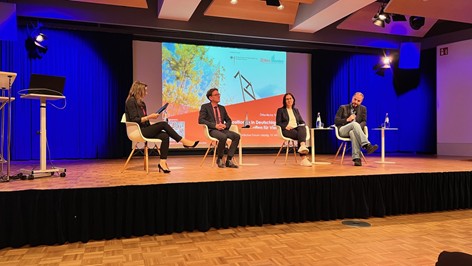
This was followed by a panel discussion among East German leaders, moderated by Prof. Dr. Astrid Lorenz and Linus Paeth, on prospects for greater diversity among the elite. Participants included:
The panel discussion covered the entire spectrum of discourse on the underrepresentation of East Germans and revealed a wide range of experiences, assessments of the current situation and recommendations for action based on personal experience. Major General Wolfgang Ohl referred to the closed career system in the military and the seniority principle, according to which East Germans are just on their way to elite positions and he therefore does not see a problem of underrepresentation. Pollmer spoke about the discursive imbalance in the media and his experience of being reduced to his East German origins. Simona Stoytchkova, on the other hand, emphasized the importance of networks, mentoring and special trainee programs to overcome the disadvantages faced by East Germans in the recruitment process. The participants agreed that it would be desirable to overcome the division between “East” and “West” as quickly as possible.
Scientific workshop: Descriptive representation and unequal recruitment opportunities for elite and leadership positions
Accompanying the conference, a scientific workshop was held on both mornings, in which the expert community exchanged views on current research on representation issues, mechanisms and barriers to advancement. In addition to East Germans, the focus was also on women and people with a migration background. Many of the contributions used quantitative approaches to analyze the extent, causes, effects and mechanisms of underrepresentation—particularly in politics and academia but also in business, administration and the judiciary. In one contribution, the TRAWOS research team (Prof. Raj Kollmorgen, Jan Schaller, and Mara Börjesson) discussed the role of habitus as a possible cause of the underrepresentation of East Germans.