
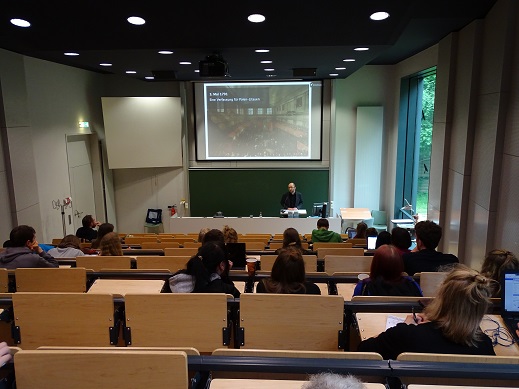
Dr. Felix Ackermann from the German Historical Institute in Warsaw gave a lecture at our university on 3 May 2018 as part of the lecture series (also East-West College) "The East-Central European Region: Old and New Border (Crossings)".
Around 35 participants listened intently to the lecture entitled "Lithuania in the shadow of the war in Ukraine - The Baltic Republic 100 years after its foundation".
In the lecture series, not only students of the Zittau/Görlitz University of Applied Sciences deal with the demarcations and border crossings of Eastern and Western Europe, their mutual perceptions and relationships as well as the membership of Eastern European states in the European Union. Many external visitors, who often view the topics from completely different perspectives, also come to the university lecture hall.
At the beginning of the lecture, Dr. Felix Ackermann gave the audience a brief introduction to the history of the still very young Republic of Lithuania, covering the most important historical dates. Starting with the Polish-Lithuanian constitution of 1791, which failed and shortly afterwards led to the division of the two countries between the Prussians, Habsburgs and Russians, the historical journey continued via the Battle of Tannenberg to the proclamation of the Lithuanian Republic in February 1918. It is worth mentioning that Lithuania was already considered a country between the Teutonic Order and the Russian Empire before the republic was founded. As a result, Germany tolerated the Republic of Lithuania, as this set it apart from the great power Russia. Russia, in turn, saw Lithuania as a German "secret service project". Just 21 years after its foundation, Lithuania lost its statehood in the course of the Second World War after the Red Army entered the country. Lithuania was part of the Soviet Union until 1990 and regained its independence after numerous protests. The republic has been a member of NATO and the European Union since 2004. The euro was also introduced in 2015. For the Lithuanian people, democracy and world peace are an important asset, which they can preserve by belonging to the EU.
After the short excursion into the history of Lithuania, Dr. Felix Ackermann gave us a small sample of his book "My Lithuanian driving license - Excursions to the end of the European Union". In it, he writes about his experiences in Lithuania, but also about political issues, as he was in the Balkan state from 2011 and was able to witness how the Crimean crisis in Ukraine affected the Lithuanian population, even though the war was apparently so far away. He reported on the feeling of a Russian threat, memories of the Hitler-Stalin Pact of 1939 and the reintroduction of compulsory military service in Lithuania in 2015, which had only been abolished seven years previously. His book also takes up the topic of multiculturalism, which is lived in Lithuania and especially in its capital Vilnius, but has become a major problem since the Crimean crisis. Supported by Russian-funded newspapers, criticism has been voiced that the Russian minority in the republic is disadvantaged, although there has never been much discussion about this since the 1990s.
The lecture was followed by a lively discussion among those present. Dr. Felix Ackermann answered numerous questions, in particular how the Lithuanian population views the EU, also in view of Russia's annexation of Crimea, whether the danger posed to Lithuanians by the great power Russia is not of a more abstract nature and in this sense is not overreacted to, and whether the attitude towards the Russian ethnic group in Lithuania has changed since the 1990s, as this was a very present problem at that time.
To conclude the lecture, the speaker read out one of the more amusing passages from his book, which was about an interesting visit to a sauna in Lithuania, which showed that people's origin, language and views were completely secondary.
Report:
Sandra Möbius & Romana Raymund, students in the Social Work program
Contact:
Cornelia Müller
E-Mail: C.Muelle r@hszg.de
Phone: 03581 3744274