
Clara Ridzewski spent four months at a Chinese university. Here she writes about her experiences with fried chicken feet, hard work and raging typhoonsHongKongmeans "fragrant harbor" and is a special administrative region of China. The metropolis is located in the south-east of the country. In my 5th semester, while studying Molecular Biotechnology, I decided to spend a semester abroad in China and applied to a La bor for Biotechnology at the Hong Kong University of Science and Technology (HKUST). I wanted to gain work-related experience and get to know a new culture. the application and visa process was a bit complicated, but went largely smoothly and after searching for ages, I found a room on Airbnb in Po Lam, a district in the north-east of Hong Kong. Rents in Hong Kong and China in general are utopian. In Hong Kong in particular, prices are so high that many young adults live with their parents. I flew to Hong Kong at the beginning of May and arrived in the early evening. The temperature was 32° C with a humidity of around 89%. Stifling! I took the bus to the bus station in Po Lam at the other end of the city and during the journey I got my first impressions of the place where I would be spending the next four months. The first thing I noticed was that everyone was about the same height as me and hardly anyone towered over me. The infrastructure is completely different to that in Germany. Due to the fact that Hong Kong is 1104 m² in size but has a population density of 6429 inhabitants per km², skyscrapers are lined up next to skyscrapers, some of which are 70 storeys high. All apartments are quite small. There are often bars on the windows to hang up laundry and prevent people from falling out of the window. When I arrived in Po Lam, my landlord Rick, 28, and his father Sim, 71, welcomed me. Rick works in an IT company, while his father is already retired. The two of them lived with Rick's mother in a three-bedroom apartment on the 14th floor of a 42-storey high-rise building on 70 square meters. There was a small Buddhist altar in the living room where his mother prayed every morning. There were Chinese symbols of good luck all over the apartment. My small room had a very short bed, a wardrobe and a small desk. Rick's father cooked us all a welcome dinner and Rick's girlfriend, who was often with him, joined us. We had Chinese soup (tong), amaranth (a salad-like vegetable that is very tasty when stir-fried) and deep-fried chicken thighs, all topped off with soy and a good portion of rice. Sim Lam and his wife could only speak a few words of English, so over time I learned to converse with them in Cantonese. I often went jogging with Sim in the nearby park in the evenings or hiked with him in the local mountains on Sundays. We often listened to Chinese music from a Walkman, which often played the same song at full volume. I was surprised to see so many older people jogging in the park. They were all very fit and limber, doing yoga and tai chi, or playing Chinese chess. There wasn't a time of day when the park wasn't good. The focal point was a huge sports field where children, barely older than 9, were training at 11pm. As there was a primary and secondary school opposite my room and I always went on day trips into the city from home for the first two weeks, I got to experience the morning routines of the school day. Every morning at 8 a.m., all the children stood in their school uniforms on the sports field in front of the school and the principal began his 10-minute roll call. All the children, no matter how small they were, stood quietly in line and listened to him.[caption id="attachment_1015" align="alignnone" width="1036"]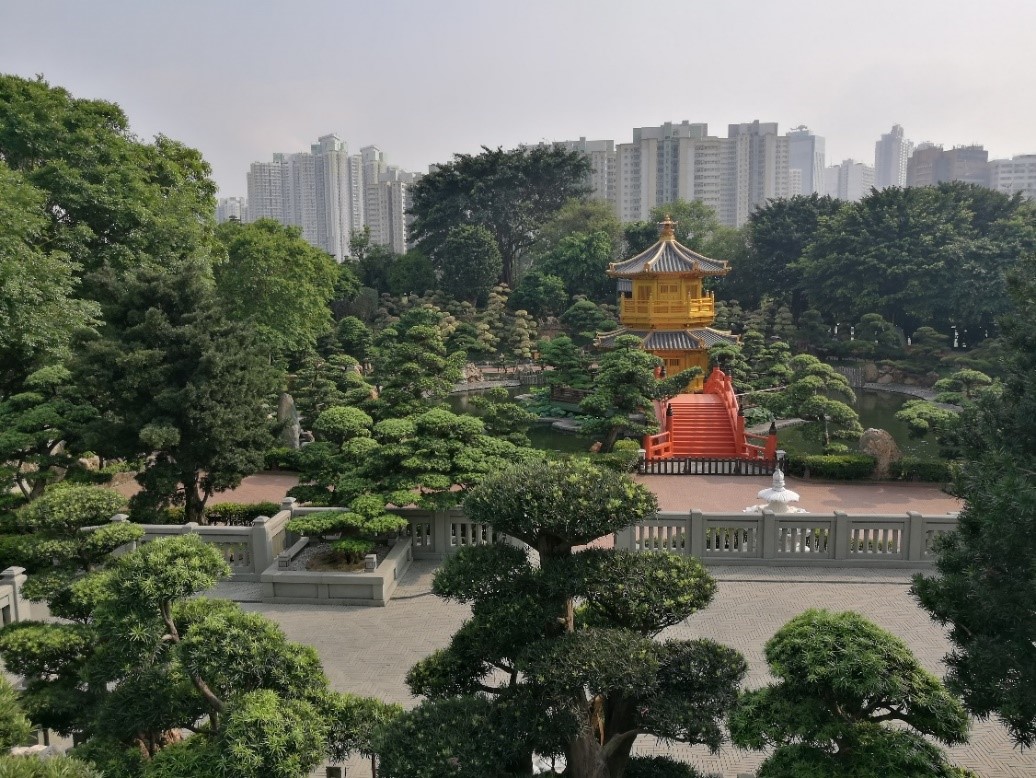 Nan Lian Garden: a paradisiacal garden with a temple complex in the middle of Hong Kong[/caption]Fascinated by the everyday life of the people, I spent my first two weeks in Hong Kong. Together with Rick and his fiancée, I went to Piek, a mountain in the middle of Hong Kong from where you could see the whole city, to Tsim Sha Tui, where at night a laser and light show was organized over the entire bay and its small alleys with traditional stores and stalls. Everywhere and on every corner you could buy something delicious to eat. I visited several temples and traditional gardens in the middle of the city between streets and skyscrapers. There was an incredible contrast between the old and the modern - that's the charm of Hong Kong. I ventured into the small, often backward neighborhoods and talked to people who were surprised to find a Westerner in this area. Here you could eat various specialties such as egg waffles, egg tarts, Portuguese egg tarts, dim sum, as well as chicken feet, to several puzzled looks. And believe it or not, it was quite tasty. Slimy, but rich in vitamins. There was usually a large portion of rice, served with roast duck, pork or chicken and a wide variety of vegetables. This variety is rarely found in Asian restaurants at home, as they are adapted to German eating habits, and after my rather intensive first few weeks, it was time to get to know my internship. I worked in a comparatively small laboratory at the HKUST under my boss Angela and my supervisor Liane. Liane came from America. We got on right from the start and she helped me wherever she could. Angela gave me the project: The Validation of Emulsion-PCR conditions for the production of monoclonal aptamer particles and their detection reactions. As it turned out later, this was not a very easy task. My other colleagues Alexander, Bin Bin and Yulei completed our team. My daily lab routine usually ran from 8 in the morning until 9 in the evening. And even if that sounds like a lot of work and little free time, there were several things that made everyday life easier. The HKUST is one of the most renowned universities in Asia with a library on three floors with a view of the sea, several canteens on different levels, a McDonald's, several cafés, a music room, an outdoor and indoor pool 50 meters long right by the sea and various sports and fitness rooms. Even if you had a lot to do, you could take an hour off once a day to relax. On Fridays, for example, all the lab members played badminton together, but although I wanted to try out all the extracurricular activities, work always drew me back to the lab. Even at the weekend. Because several future research projects were based on the method I was supposed to optimize in our lab. Liane helped me as good as she could. If something didn't work for me over a certain period of time, we would sit down in the café and read more papers and make plans on how we could solve the problem. And we usually came up with a solution and a plan for the next few weeks. We made jokes and talked while evaluating the results, which sometimes went on late into the night. So I motivated myself, put all my energy into my project, optimized the protocols, discarded them, tried another one. In the end, I came up with a protocol and a result that I could build on. A project with many ups and downs, but in the end I can say that all my work was worth it. Because now three undergraduates are continuing to work on my project for their Bachelor thesis and are using the protocols I developed for all the small sub-experiments.[caption id="attachment_1016" align="alignleft" width="858"]
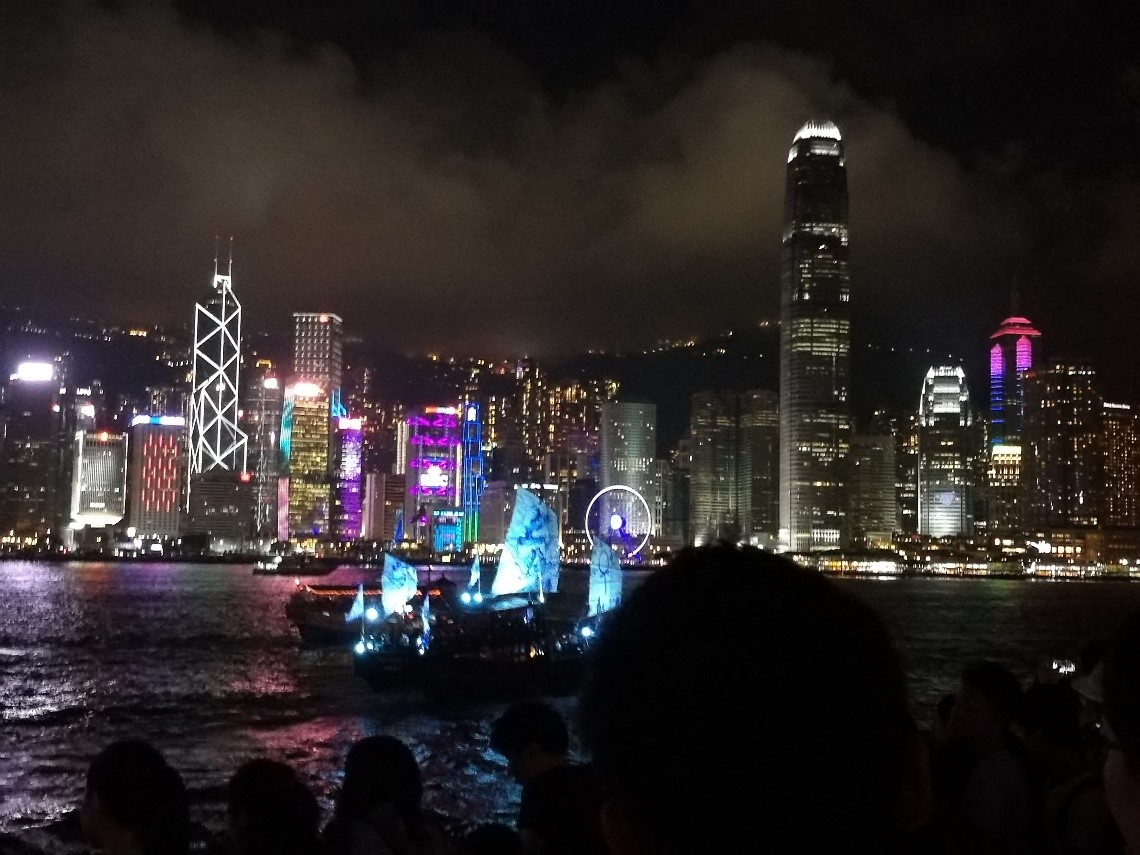 View over Kowloon Bay at the nightly laser and light show in Tsim Sha Tui[/caption]Three times I was able to witness a fascinating event: a typhoon. Typhoons are quite normal in Hong Kong. Due to the warm climate, the cyclones develop in the South China Sea and rush over the mainland during the summer months. Hong Kong is prepared for this both organizationally and architecturally. The skyscrapers are narrow and tall and therefore offer little resistance to the wind. A weather service monitors the weather and the typhoons that form and divides the situation into different categories. From level T3 you should get food and water for the next few days and at T8 you are asked to go home. Public facilities are evacuated and public transport is suspended. Then comes the wind, which continues to pick up strength, and the rain. The wind increases rapidly, up to 120 km/h and more. The roads are empty and you can't see anything because of the increasing rain. And then, all of a sudden, you see the starry sky or the blue sky, no wind blowing, nothing. Even the animals outside are silent. Because only 2-3 hours later you have escaped the eye of the hurricane. The weather remained rainy and stormy for the next few days. I was able to experience this natural phenomenon 3 times and one of these typhoons was the strongest in 30 years. Trees were uprooted, windows were destroyed by ripped out air conditioners, houses near the sea were blown away, people were injured and killed, I had a wonderful job in a great location, wonderful colleagues and a nice boss who was supportive and friendly people around me. I can recommend traveling to Hong Kong to anyone. And if you are motivated and hard-working, to work there too. Because everyone needs to be aware that the work philosophy is different from that in Germany.
P.S. If you are afraid of cockroaches, you should stay away from Hong Kong. Despite the modern age, the large version of this insect is everywhere. You should also take care to protect yourself from mosquito bites in the summer months, as there are disease-carrying insects there.
The article was written by Clara Ridzewski