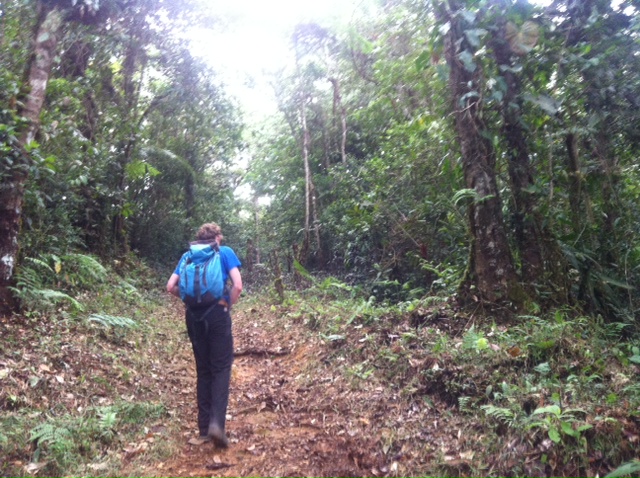
Guest article by Armin Hirche about his internship semester in Colombia:As I have been an honorary member of the NGO Dapaviva since 2012, I had clear tasks and ideas to implement in the project. In the first week of my stay, I familiarized myself with the problems of reserve protection conditions and took part in numerous meetings, for example at the "International congress of enviornmental history and economics history". It was important for me to familiarize myself with Colombian environmental legislation. My main task during these 6 months was to determine the population density of Colombian night monkeys (Aotus cf. lemurinus) and to record other data, such as vegetation. The time I spent in the cloud forests was very enriching for me on many levels. I am now able to make detailed statements about the ecosystem. I have acquired the knowledge and skills to use a very important conservation tool. With the Distance 6.0 software, I am able to plan and carry out monitoring of animals and plants. Working in the organization gave me an overview of what is most important to protect an ecosystem. In terms of further research and conservation of the nocturnal monkeys, it is important that we establish a project that focuses exclusively on the monkeys. With the data base on population density, we can now conduct in-depth research and ecological studies that will help us to protect the night monkeys and gain a better understanding of their lives.
 Working with the night monkeys was a very intense experience for me. Collecting data at night in the cloud forest was quite a challenge because you had to learn to deal with your fears. You also had to deal with the very real dangers that nocturnal animals can pose. Climbing 15 meters up a tree at night, securing and holding on and then filming or taking photos of the monkeys is not exactly an everyday task.my work in Dapa made it very clear to me how closely the interplay between ecology, economy and society influences nature conservation. These three areas cannot be considered separately in a socio-ecosystem, and while I was analyzing the data, I applied to the International Congress of Mastozoology with my practical work and have now been accepted. I could present my research results in Bogota. I have also received a job offer in the city of Yumbo for a position as an environmental educator in a private school.