
The series of events on the topic of GREENING in agriculture started ONLINE on 29.11.21 - this is intended to show what EFA (Ecological Focus Areas) can achieve for environmental and nature conservation.
If they receive an environmental premium, conventional farms are obliged to designate a proportion of their arable land as EFA areas. They have various options for this, with different creditable values.
The first event dealt with undersown crops, which are sown on the field together with a main crop. Prof. K. Schmidtke (HTW Dresden, currently Director Research and Innovation FIBL Switzerland) presented the diverse agro-ecological services of undersown crops, such as erosion protection, weed control, provision and protection against leaching of nutrients or the enrichment of organic matter in the soil. However, it also became clear that undersown crops are competitors for resources for the main crop and that a high level of agronomic experience is therefore required to avoid this competition and to exploit the positive effects of undersown crops.
Markus Neumann from Agrarbetriebsgemeinschaft Kiesdorf/Dittersbach GbR reported on practical experience. As part of his master's thesis, he examined production-biological parameters, among other things, which he recorded on 3 reference areas sown with the frost-sensitive legume undersow RapsPro. An additional yield of 1.5dt/ha was observed on one plot and an increase in oil content of 1% on all plots. Furthermore, high levels of mineral nitrogen remained in the soil after the harvest, which must be effectively utilized by the subsequent crop.
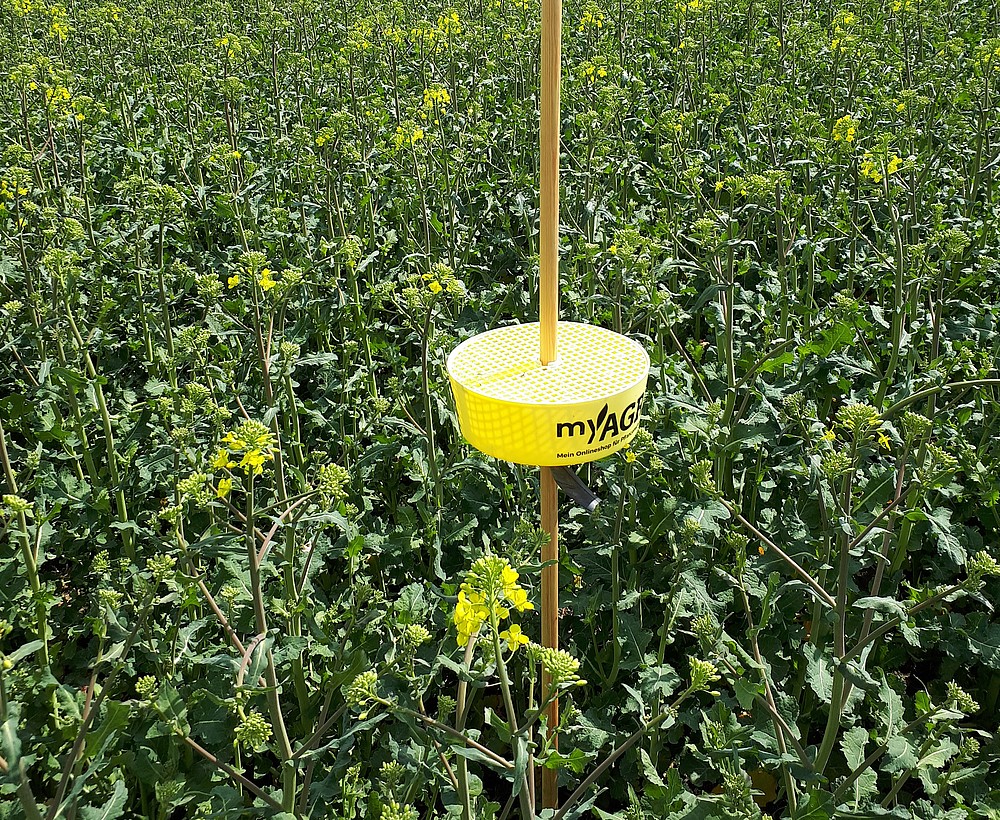
In his presentation, Tristan Schirok (HSZG) focused primarily on the effects of undersowing with RapsPro on certain insect populations, which he investigated as part of his practical semester project. The results of the yellow trap catches on the 3 test plots showed that there tended to be more insect biomass, fewer oilseed rape pests and more natural enemies of the pests in the traps on the plots with undersown crops.
From an economic point of view, however, oilseed rape undersowing only covered costs on one of the areas studied, which could be made more cost-neutral in the future if sowing is carried out together with the main crop, thus eliminating an additional (environmentally harmful) work step for sowing the undersown crop.
Christiane Dittrich (HSZG) showed that undersown crops achieve very good economic results when used as EFA areas within the framework of greening, provided that certain conditions are met, such as the omission of the usual post-harvest treatment with herbicides to control volunteer rape. Savings on pesticides and mineral N fertilizers can further improve the balance. Positive effects on the subsequent crop and soil fertility, as well as climate-relevant aspects such as increased carbon sequestration, are not yet taken into account in the balance sheet.
In the medium term, undersown crops may gain in importance in conventional cultivation, especially in view of the ban on pesticides (e.g. glyphosate planned from 2024) and the use of new undersown mixtures that rely on the reduction of pest infestation, e.g. through fragrances based on the principle of biofumigation.
The presentations of the event series are available for download.