
Utilization of raw materials in a biorefinery
In order to utilize natural resources efficiently and sustainably, their enormous value creation potential must be fully exploited.
Researchers from the recently launched Impulse Project 8 are looking at the principle of biorefineries in order to utilize plant-based raw materials as completely as possible.
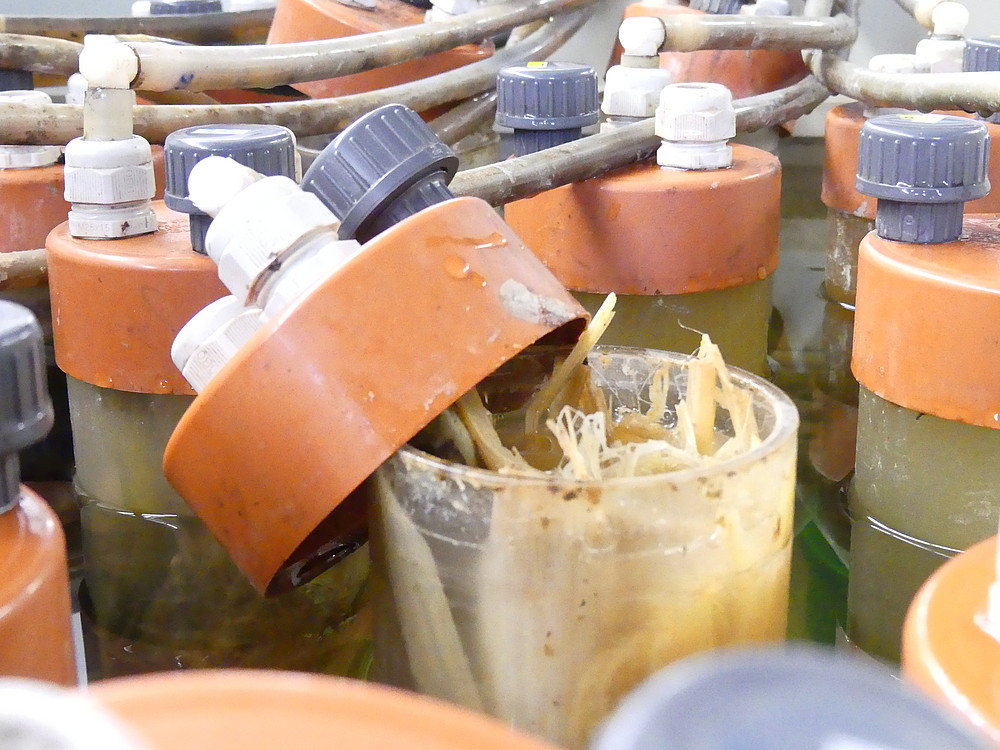
The research team is developing and optimizing a new and environmentally friendly technology for extracting fibres from plant-based raw materials such as nettle, hemp, banana, goldenrod, mallow and many more.
This new process represents a significant advance over conventional fiber extraction technologies (e.g. roasting and dry pulping), both from an ecological point of view and in terms of fiber quality. The natural fibers obtained can then be used in various ways, with disposable products, lightweight construction and automotive engineering being just some of the numerous potential fields of application.
In addition to fiber extraction, concepts for the utilization of all plant components are also being developed in Impulse Project 8. For example, acids produced during fibre pulping are to be used for energy (e.g. for the production of biogas) or material (e.g. for the production of bio-based plastics) and other valuable materials are also to be recovered and recycled (e.g. as natural fertilizer).
And since the consideration of a closed value chain is the main objective of the LaNDER³ partnership, impulse project 8 also deals with the topic of recycling natural fiber-reinforced plastics (NFRP) at the end of their useful life. Together with the satellite project NFK-Rec, the researchers are developing an environmentally friendly recycling technology for NFRP with the help of special natural fiber-decomposing fungi, in which the resulting by-products can also be reused.
In a biorefinery, as many intermediate and end products as possible are sustainably produced from biomass to be utilized and from by-products resulting from the manufacturing process.