
Event details
19. March 2018
Dr. Bruno Bartscher Visits the University
The head of the division for universities of applied sciences at the Saxon State Ministry of Science and the Arts visited Zittau.
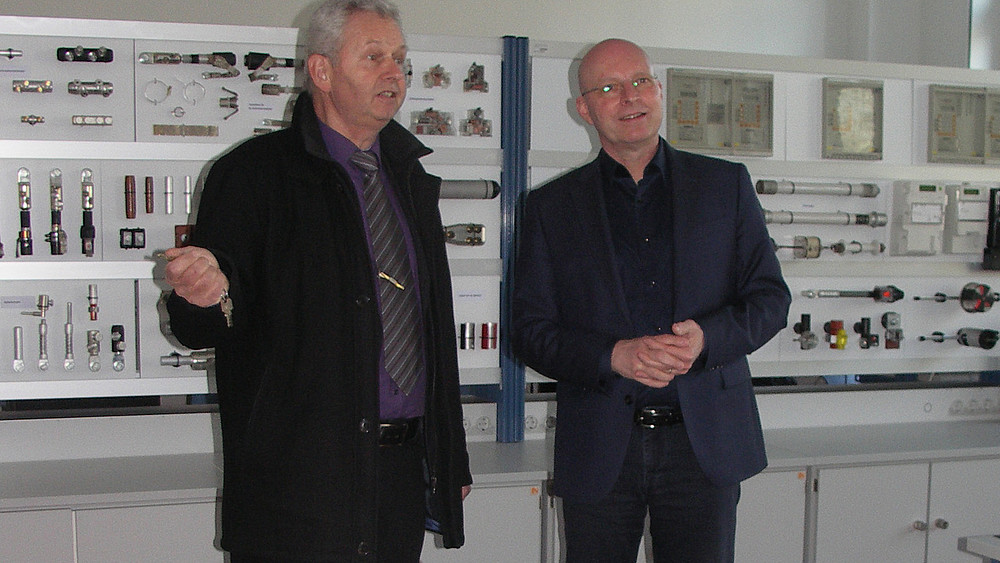
On February 27, 2018 , Dr. Bruno Bartscher, the new head of the Division of Universities of Applied Sciences and Universities of Cooperative Education at the Saxon State Ministry of Science and the Arts, visited our university. He was very keen to discuss specific topics with the University Executive Board. In particular, the discussion focused on the implementation of the Saxon Higher Education Development Plan 2025, the fulfillment of the 2017–2020 Target Agreement, the capital development plan, and the establishment of endowed chairs.
Afterward, Dr. Bartscher, guided by the Dean of the Faculty of Electrical Engineering and Computer Science, Prof. Klaus-Dieter Haim, toured the faculty’s new laboratories in Building Z I, including the Laboratory for Protection and Control Technology/Building Automation, DB’s Control and safety technology, the Smart Grid Laboratory, the EMC Laboratory, the Cable Diagnostics Laboratory, and the new Large Laboratory Hall for basic training in electrical engineering. Dr. Bartscher was impressed by the modern equipment.
After a joint lunch in the student canteen, during which discussions continued, the group visited the Zittau Power Plant Laboratory. Dr. Clemens Schneider, project manager at the Institute for Process Engineering, Process Automation, and Measurement Technology (IPM), led the tour of the laboratory and explained the large-scale test facilities installed there. Dr. Bartscher asked with interest about the application of research results and the practical use of findings from the research projects. For example: Where are phase-change materials used, where are magnetic bearings already in use, and in which areas is further research needed? How can energy systems be made more flexible using thermal energy storage systems, and how does this contribute to grid stabilization? These questions were answered in detail by staff members Christian Vanek, Hagen Hoffmann, and Clemens Schneider.
Dr. Bartscher also used his visit to speak with Prof. Sebastian Scholz, Professor of Function-Integrating Polymer Technologies at HSZG and also Director of the Technical Center at the Fraunhofer Plastics Center Upper Lusatia. Prof. Scholz explained to Dr. Bartscher the equipment available at the technical center, the opportunities this presents for research and collaboration with companies in the region, and the projects being carried out jointly with the Zittau/Görlitz University of Applied Sciences and the Fraunhofer IWU.
He then visited the “Production Engineering” and “Manufacturing Measurement Technology” laboratories, which are representative of the Faculty of Mechanical Engineering. Dr. Bartscher watched with great interest as the complex production and assembly line in the Production Engineering laboratory was demonstrated; Martin Sturm was able to answer questions regarding student training in connection with this facility. To illustrate the integration of all stages involved in the product development process within the framework of Industry 4.0, he then visited the “Manufacturing Processes” and “Manufacturing Measurement Technology” laboratories. Various tactile and optical measurement systems were demonstrated; among other things, a complex part was measured using an optical 3-D scanner. An interesting discussion ensued regarding the possibilities for integrating existing technologies into engineering education at Zittau/Görlitz University of Applied Sciences, as well as their ever-increasing relevance to the companies where our graduates will find employment after obtaining their degree.
The tour concluded with a visit to the microbiology and bioprocess engineering laboratories of the Faculty of Natural and Environmental Sciences. Prof. Thomas Wiegert explained to Dr. Bartscher the biotechnological use of living systems using various microorganisms as examples. The process was demonstrated, starting with the isolation and analysis of cells, through targeted use of genetic technology, to cultivation in a laboratory fermenter and product isolation. As a lawyer with expertise in forensic analysis methods, Dr. Bartscher showed great interest in the molecular biology testing methods and equipment used in the university’s biotechnology laboratories for research and teaching.
University Executive Board
02763 Zittau
Theodor-Körner-Allee 16
Building Z I,
Room 1.54
1st floor
1st floor
+49 3583 612-3030