
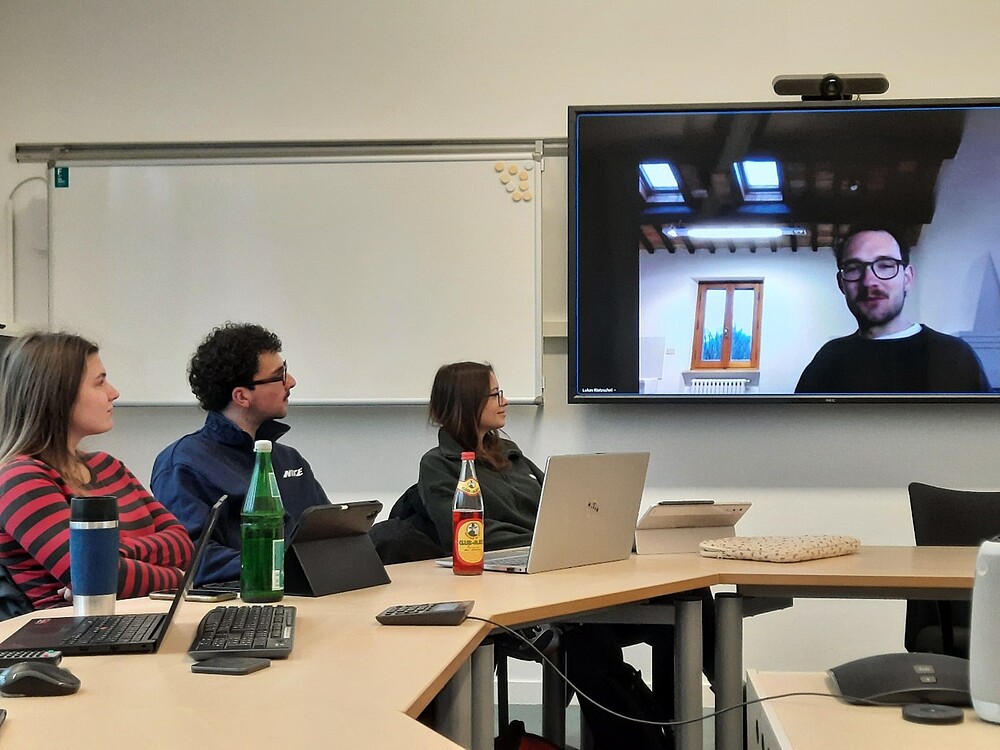
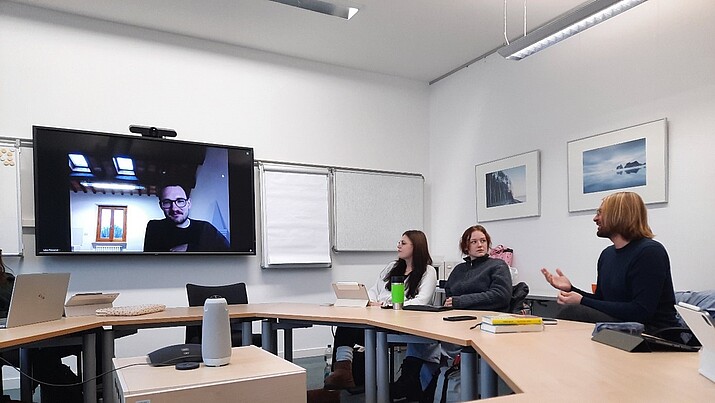
In the last week of the semester at the HSZG, students studying to become teachers of German were able to see for themselves that literature is not just something that is on the curriculum and comes from the pens of people who have already passed away. The author Lukas Rietzschel from Görlitz, who is currently on a working scholarship in Italy, was a virtual guest as part of the introductory seminar in literary studies - and answered the students' sometimes amusing, sometimes critical questions.
The questions were not just about where Rietzschel gets the material for his novels "Mit der Faust in die Welt schlagen" and "Raumfahrer", both of which are set in Lausitz - and therefore also in the students' regions of origin - and how he uses this material in his literature. It was also about what everyday life as an author is like, what is the best thing to do when you are lovesick, how cultural narrative communities are formed and the sometimes provocative effect of literature. And more fundamentally: what do literary texts actually do to the spaces in which they are created and on which they have an impact?
Last but not least, the students focused in particular on didactics. In this context, Lukas Rietzschel also talked about his own everyday school life - and the torment that the sometimes rigid and one-dimensional lessons caused him. A torment that went so far that he tried to make the well-known Hamburg reading booklets, with which pupils are supposed to get to know the classics of literature, disappear using various strategies (between hiding and burning).
Lukas Rietzschel also reports on this in the video.
What should a good literature lesson look like and what should it try to achieve? Lukas Rietzschel combines this with a fundamental approach that is geared towards individual learners and allows them to look for their own relationships to literature and talks about this in the second video.
The two prospective teachers Lysann Junge and Vincent Lieberum agreed that such events could be repeated in the future. "It was interesting that the discussion gave you a completely different approach to the texts and the author," said Junge. "There were also some very profound thoughts involved," added Lieberum.
The seminar had already been given a special setting: To kick things off, some of the students read from poems they had written themselves - an act that not only invited playful literary analysis beyond iambus and trochee, but also, above all, gained recognition and appreciation. "The course showed quite well," said Marc Weiland, deputy professor of literature at the HSZG and head of the seminar, "that literature can be something very lively; something that also has its place in our everyday lives and in our region. We want to continue working on this with our students."