
A post by Levent Köksal
With this blog post, I would like to encourage everyone to take a step into the unknown, to break out of familiar structures in order to think outside the box. It's very easy to do this during your studies, because there's the internship semester, which you can experience wonderfully abroad, even with the support of the university.
I'm Levent, a seventh-semester ecology and environmental protection student. My career path has been a little different from that of most students. I spent twenty years working in open-plan corporate offices before I decided to study. At some point I realized that life goes by when you only live from weekend to weekend and the days in between become insignificant sitting around. So I decided to jump out of my safe nest: I quit my job and started traveling, and on my travels I saw that a lot of things are simply going wrong - due to people's ignorance. The floating plastic waste, the burning piles of garbage everywhere on the roadsides, the undrinkable water and the disrespect for nature: all this horrified me. So I decided that my time had come to act. I attended a course at the Permaculture Academy in Berlin, which was eye-opening, but not scientific enough for me. So, at the age of 38, I decided to study. Namely ecology and environmental protection at the HSZG; to finally help clean up the mess.
Permaculture: " Permaculture is about designing sustainable human settlements. It is a philosophy and approach to land use that combines annual and perennial plants, animals, soil, water management and human needs into complex interconnected productive communities.(Bill Mollison, "founding father" of permaculture).
The practical semester
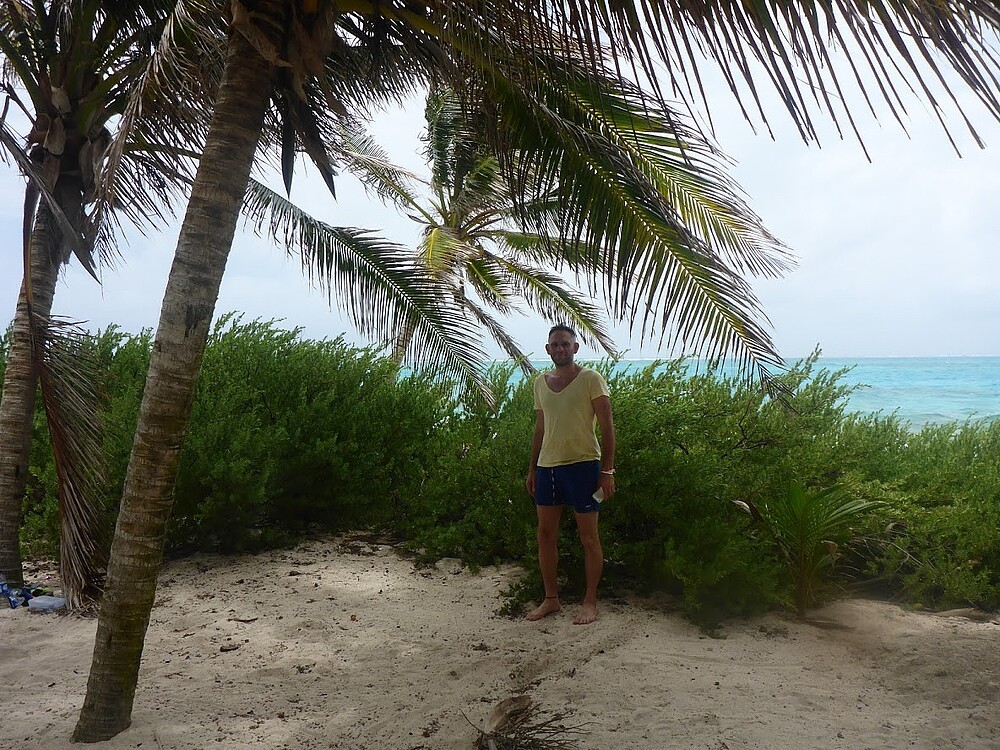
It was my wish from the outset to complete the practical semester abroad. So I was delighted to receive an invitation from an alumnus of my degree program. He lives in Cali, Colombia and works for a charitable organization. I asked him, who became my supervisor for the internship semester, for a task that had something to do with permaculture. I wanted to combine the theory I had learned in the previous semesters with the practices of the Permaculture Academy. Silvopastoral agroforestry became my topic. In other words, the simultaneous use of agricultural land for animal husbandry combined with bushes and trees, which is nothing new, but was eventually replaced by monoculture and factory farming in the course of the mechanical optimization of agriculture. With this supposed optimization came problems.[caption id="attachment_1051" align="alignleft" width="1184"] There are certainly more unpleasant places to spend your time than here on the Caribbean island of San Andres ...[/caption]
Green Colombia
The wild animals and plants that are being displaced along with the forest are suffering from this mismanagement. This is particularly serious in Colombia. The Andean mountain ranges offer many plateaus and habitats. The higher you climb, the colder it gets at night, but the stronger the sun shines during the day. In addition to the hardy ubiquists that feel at home almost everywhere, many other plants have been able to develop that are specialized in their particular niche. Oh yes, the ice age was not as severe here as in Europe. Where everything that couldn't cope with the cold and couldn't hop over the Alps was wiped out. As a result, there is an enormous biodiversity in the plant world, and with the diversity of plants, the diversity of animals has also become richer and richer. After Brazil, Colombia is the country with the highest biodiversity in the world. And number one if you look at the number of bird species and orchids. In comparison: we have around 250 native breeding bird species in Germany and the Valle del Cauca alone, where I was, has 859 of the 1921 bird species found in Colombia. 79 of these are endemic, i.e. only found in Colombia. All of these species and their habitats are endangered and in the process of disappearing.
Turquoise water and coconuts
But that's where the organization Dapa Viva, which invited me, comes in. It works to educate the population and tries to promote the protection of the forests. The goal that we set ourselves at Dapa Viva was to preserve the forest areas and niches for wildlife, and I developed a concept for this so that the cattle need less space to get enough to eat. The grazing area is divided into plots where the cattle stay for a short while until they have eaten everything. What they don't eat, they trample flat. When they move on to the next quarter, they leave a field that has been churned up by trampling and covered with their dung. This area then rests for about 40 days until the cow pats have become a lush green area again.But even though all this was exciting for me, it wasn't all research and work during my stay in Colombia. Despite my rudimentary knowledge of Spanish (Spanish A1 basic course), communication was relatively good. From day to day, I learned new words and phrases until I was able to communicate using simple vocabulary, but it was still good, and in my free time I was able to go on short trips to the cloud forests or get to know the city of Cali. You could also go on weekend trips to the Caribbean or Pacific coast to snorkel in outrageously turquoise waters or sip a cocktail from a coconut while lying under a palm tree. I have never eaten so many different types of fruit in my life. Every time I visited the market, I found new and interesting varieties to try.[caption id="attachment_1057" align="alignnone" width="880"] There were so many different types of fruit at every market[/caption]
Colombia? Isn't that dangerous?
Of course, a metropolis of millions like Cali is not comparable to Zittau. You see a lot of poverty, but also very high walls and barbed wire in front of most houses. The security checks in front of supermarkets and residential buildings are unusual for us. I didn't have any bad experiences, if you trust your instincts, avoid dark, empty alleys, don't visit some parts of the city or don't show off your valuables, then you are quite safe. The people I met were very hospitable and helpful.
Experiences
The environmental protection organization Dapa Viva is comparatively small and the resources are very limited, but it was precisely these circumstances that made it possible to tackle projects independently, and the internship semester put the many pieces of the puzzle of the theoretical studies of the last five semesters together into practical knowledge. I gained a wealth of experience. I would therefore recommend everyone to take a leap out of their comfort zone and gain their own experience. The International Office is a very good place to find out about the available offers and opportunities in advance. I am always available for tips and travel questions.
Thank you, DAAD
I would like to take this opportunity to thank the university management in particular for selecting me for a DAAD scholarship for academic education and training abroad as part of PROMOS. I was given the chance to receive a scholarship. A flight to South America is expensive, the financial support was a very good investment.Levent Köksal