University sports messages
Commitment beyond actual service tasks
Since the beginning of the year, the HSZG has been supporting the health authorities in the districts of Bautzen and Görlitz with personnel.
Working from home, homeschooling, and regular rapid tests. The pandemic has permeated every aspect of life and, in doing so, has opened up new perspectives and challenges in our daily professional lives—as several HSZG employees are currently experiencing.
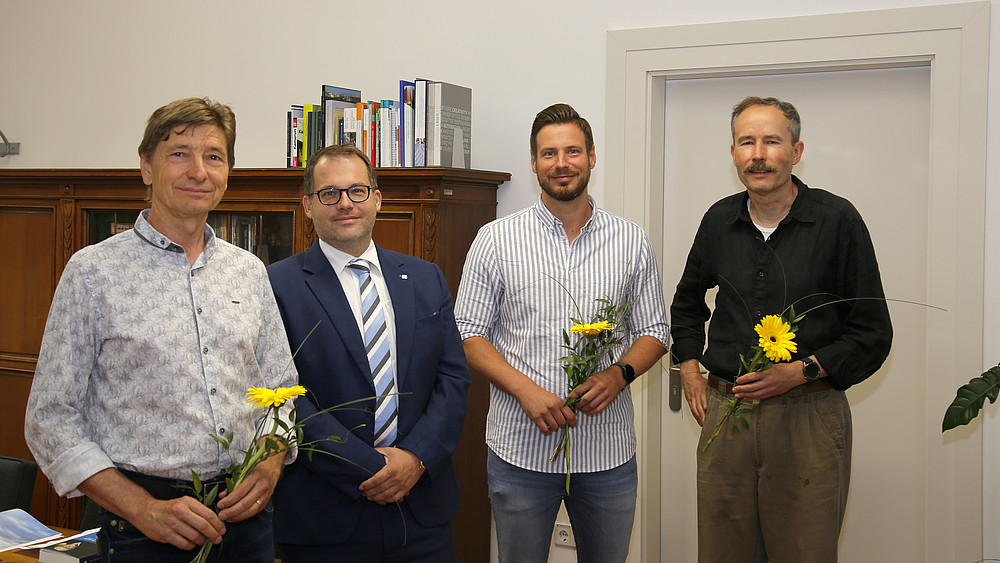
Since January 11, 2021, our Zittau/Görlitz University of Applied Sciences has been providing personnel support to the public health departments in the Bautzen and Görlitz districts with Dipl.-Lehrer Frank Schneider, Dr.-Ing. Jürgen Scheibler (both from the Office of University development and communication), and Dipl.-Sportl. Philipp Knebel from the University Administration. Another staff member is actively involved in caring for patients with COVID-19.
How did these secondments come about?
At the end of last year, the public health departments were overwhelmed. There was a shortage of staff, particularly in the area of contact tracing. The search for COVID-19 contact tracers intensified, and so the Ministry of Science called on educational institutions to nominate staff members for potential secondments.
“Due to a specific need to support the public health departments in Zittau and Bautzen, permanent staff were asked last December to indicate to the Human Resources Administration & Law division their willingness to be seconded,” says Rector Dipl.-Ing. Alexander Kratzsch, describing the initial situation.
“Protecting members of the university community and their families, and providing support in addressing the challenge faced by society as a whole of containing the pandemic, was—and remains—our top priority.” Rector Prof. Dr.-Ing. Alexander Kratzsch
”Data analysis and statistics as a decision-making aid
No one should be forced to do anything. Instead, we relied on the willingness of our employees. Like that of Dr. Jürgen Scheibler. At the end of June, he will have been working at the Görlitz district health authority for six months.
After the first few days, it became clear that his area of work would be less about contact tracing coronavirus cases and more about analyzing data and compiling statistics and reports, which would then be used by Martina Weber, head of department and second deputy to the district administrator, as a decision-making aid for measures in the district. The statistical processing of data from the hospitals was just as much a focus of his work as the collaboration on strategic projects to improve the health department's ability to act with a view to next fall.
“It was an intense and exciting time that gave me insight into the work of the public health department. It remains a major challenge during a pandemic, with such a high number of cases, to organize the necessary processes in a way that allows staff to manage them while ensuring they remain service-oriented and understandable for the public,” says Dr. Jürgen Scheibler, who works in the university’s Controlling department.
”Documentation Using Software
Frank Schneider’s primary focus at HSZG is typically on managing the Studium Fundamentale program. For many years, he has organized, among other things, the Kinder Academy and the Senior Citizens’ College at the university. Until the end of the month, he is assisting the Bautzen Public Health Department with contact tracing. Using software designed to facilitate the recording of test results, the certified teacher is helping to document individuals who have tested positive for COVID-19 and their contacts.
When the district had to contend with consistently very high infection rates this spring, he didn’t hesitate for a moment: “For me, the question was where and how I could best serve the people of Upper Lusatia.” What lessons will he take with him at the end of his time at the health department, when his “home” desk and the HSZG lecture hall beckon once again? “I learned a lot and got to know many people even better, ” Frank Schneider sums up.
Using fitness to combat the effects of the pandemic
Philipp Knebel, who is responsible for university sports at the HSZG, has been providing his services to the health department in Görlitz since January. "I work in the travel returnees team and am responsible for all entries from abroad into the district of Görlitz," he says of his job.
With all this work, is there still time to make his colleagues at the district office sweat for a change? "There are also health-promoting measures at the district administration office, such as gymnastics during breaks. There are currently no courses due to the pandemic. But as soon as it's possible, I'm supposed to give a few courses at the health department. The requests are piling up with the easing of restrictions."
The average person is said to have gained around five kilograms during the pandemic, including some students and employees. Can this fact be easily blamed on the secondment of the university sports officer?
"Of course, I always keep an eye on the fitness level of our students and university staff, especially during the pandemic, when group activities in sports clubs or face-to-face courses had to be canceled," says Diplom sports teacher Philipp Knebel.
”In April, Philipp Knebel made the online fitness program “Cyberfitness” available for free—essentially a “fitness club to go”—and since the end of May, people have been able to take advantage of the new “Sport To Go” program. “So there are plenty of ways to fight off the pandemic weight.”
Since April, university staff have been working a few days a week at their regular workstations on campus again, and starting next month, they’ll be back to full-time work.
“On behalf of the University Executive Board, I would like to thank our colleagues for their dedication thus far in supporting our Free State of Saxony as well as possible, even beyond the scope of their regular duties,” says Rector Alexander Kratzsch, acknowledging the staff’s commitment.
”Text: Cornelia Rothe M.A.