
When Data Becomes Insight
Prof. Dr. Nadine Albrecht combines mathematical statistics with practical experience from industry and has been bringing this perspective to teaching and research at HSZG since July 2026.
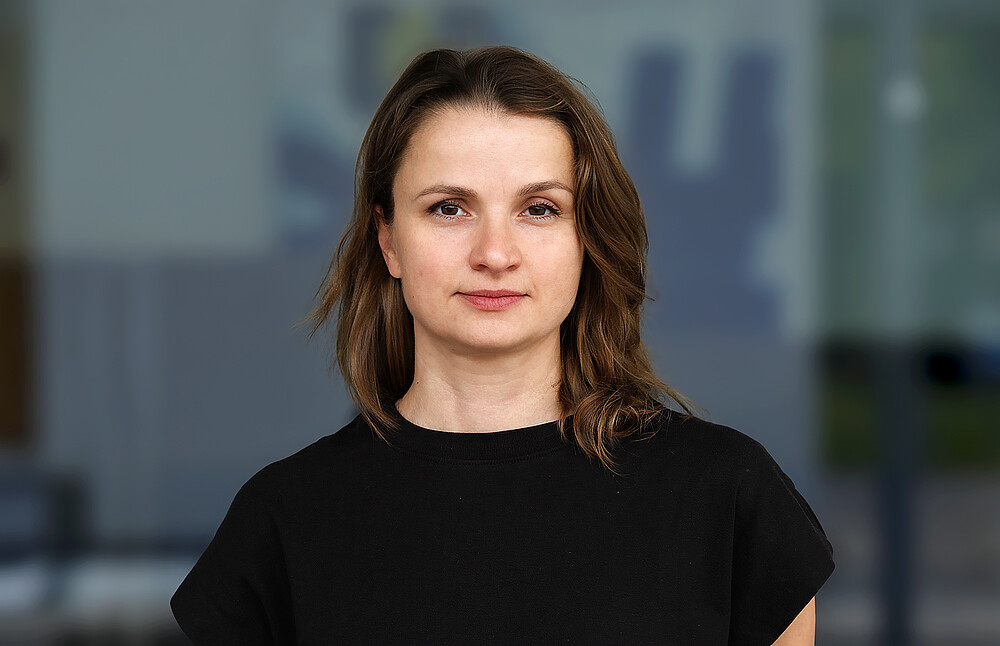
Since July 2026, Prof. Dr. rer. nat. Nadine Albrecht has been a professor of multivariate statistics and mathematics in the Faculty of Natural and Environmental Sciences at Zittau/Görlitz University of Applied Sciences. After ten years of research and teaching at TU Dresden and six years in industry, she is now returning to the university. In this interview, she talks about what fascinates her about statistics, how she hopes to combine theory and practice, and why a chalkboard is an essential part of her office.
Professor Albrecht, would you mind briefly introducing yourself to start with?
I’d be happy to. I studied mathematics at the Technical University of Dresden and graduated with a Diplom in mathematics in 2010. Afterward, I worked for ten years as a research assistant at the Institute for Mathematical Stochastics at TU Dresden. There, I focused particularly on topics in the field of mathematical statistics and gained experience in university teaching. I then completed my Ph.D. in 2020 at the Chair of Mathematical Statistics, specializing in decision tree learning.
I then broadened my horizons and moved into the private sector for six years. As a software developer at Carl Zeiss IMT GmbH, my work focused on topics such as measurement system analysis and statistical process control—that is, the connection between theoretical statistics and practical application in industrial processes.
With my professorship at HSZG, I am now looking forward to incorporating this connection into my teaching and research as well.
What inspired you to pursue an academic career?
My motivation for academic work stems from my enthusiasm for solving seemingly complex problems and, in the process, discovering structures and connections that may not be immediately obvious. Many processes across a wide range of disciplines can hardly be described deterministically because random factors play a role. Stochastics, in particular, provides us with a tool to mathematically model such uncertainties and to make systematic statements about them despite the inherent uncertainty. That’s kind of cool.
What drives me in science is my enthusiasm for solving seemingly complex problems and, in the process, discovering structures and connections that may not be immediately obvious.
”What brought you to Upper Lusatia, or rather to the HSZG?
The advertised professorship. It was one, however, that was a surprisingly good fit for my background and my vision of how I’d like to work in the future.
What exactly do you do? What are your main areas of focus at the HSZG?
In my first year, the focus of my work will likely be on teaching, which accounts for a relatively large portion of the workload at a university of applied sciences. I’ll be responsible for teaching statistics to students in the Natural and Environmental Sciences. In addition to statistical methods, students will learn how to prepare, analyze, and visualize data; how to handle large datasets; and which software tools are best suited for which research questions.
Since last year, the HSZG has also been training future mathematics teachers. I will be giving lectures there as well.
As another focus, I would like to build on the research I conducted in the field of mathematical statistics during my doctoral studies and further develop and publish the results and research questions arising from that work.
Are there any research areas that are particularly close to your heart?
I’m particularly drawn to the connection between stochastics and its applications. My work during my doctoral studies was highly theoretical, covering topics such as stochastic processes, limit theorems, and martingale methods. Through my time in industry, I then got to know a completely different side of the field, such as professional software development and specialized methods from measurement technology, including measurement system analysis and statistical process control. I now want to bring these two perspectives together and develop new research topics—ideally in collaboration with companies.
How do you structure your teaching to inspire students?
To get students excited about my field, it certainly helps to make my teaching practical and varied. To do this, I use a variety of media and tools—from the blackboard and projector to interactive polls. It’s also important to me to use real data and real-world problems, allowing students to analyze data on their own and discuss their findings with one another as early as possible. From my own experience as a student, I know that my own enthusiasm for the subject plays an important role. When I teach a subject with enthusiasm and conviction, I hope that some of that rubs off on the students.
When I teach a subject with enthusiasm and conviction, I hope that some of that rubs off on the students.
”What advice would you give to students who are pursuing an academic career in your field?
I would encourage students not to view mathematical and statistical skills as an end in themselves or a necessary evil, but rather to understand them as part of their own scientific craft. Don’t be afraid to familiarize yourself with new methods and the software tools required for them. You don’t have to be able to do everything, but you should be willing to keep learning new things.
What are your good survival tips for exam season? What tricks do you have up your sleeve to help students ace their exams?
Unfortunately, I don’t have one ultimate survival tip. As a student, I used to hole up in the library for weeks on end because I was pretty good at procrastinating and getting easily distracted. Ultimately, everyone has to find their own way. But figuring out what that is early on—that’s definitely an advantage.
Which books are you absolutely determined to read this year?
At the top of my reading list right now is “The Rules of Contagion” by Adam Kucharski. However, it’s currently in stiff competition with our family reading list—which includes books by Michael Ende and Walter Moers.
If I had tried to plan everything down to the smallest detail beforehand, I probably would never have become a professor.
”How do you balance work, leisure, and family?
That’s actually a challenge right now, especially with school-age children. I’m very fortunate that my partner and I support each other a lot and make sure we both have time for leisure and sports. Family and friends are also an important factor when it comes to balancing family and work.
I also have to say that I gave up on the idea of being able to plan everything perfectly early on. Sometimes you just have to see what solutions are available on the spot and figure out what’s important to you. If I’d tried to plan everything down to the smallest detail beforehand, I probably would never have become a professor.
What are the three things your office absolutely must have?
A whiteboard for brainstorming, my computer—I can’t do much without it, of course—and houseplants for my own well-being
Thank you very much for the interesting conversation, and continued success at the HSZG.
The interview was conducted by the Office of University development and communication, University of Applied Sciences Human Resources Division.
Ground floor