
Social Work Across Borders
Prof. Dr. Marketa Bacakova is working to integrate human rights standards with inclusive practices.
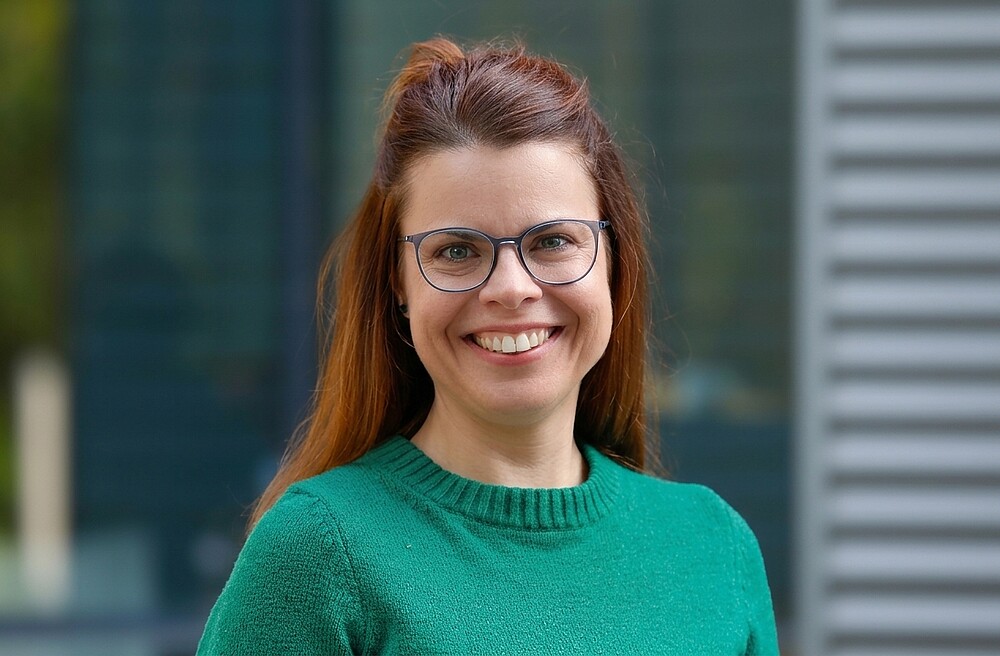
Prof. Dr. Marketa Bacakova’s career has taken her to the United Nations High Commissioner for Refugees (UNHCR) in Prague and Budapest, the Czech Ministry of Social Affairs, and universities in Leipzig. Since September 2026, she has been a professor of Social Work specializing in intersectionality and social inequality at the Faculty of Social Sciences at HSZG.
In this interview, she discusses her path into academia, her personal perspective on the border triangle, and the importance of practical relevance in Social Work.
"For me, the HSZG is simply the perfect place."
Prof. Dr. Bacakova, welcome to Zittau/Görlitz University of Applied Sciences. Would you mind briefly introducing yourself to start?
I’d be happy to. My name is Prof. Dr. Marketa Bacakova, LL.M. Since September 1, 2026, I have been a professor of Social Work specializing in intersectionality and social inequality at the Faculty of Social Sciences at Zittau/Görlitz University of Applied Sciences. I was born in 1983 in Prague, Czech Republic.
What has your career path been like so far? Which milestones have had a particularly significant impact on you?
My professional path has taken me through various fields of Social Work, education, and academia. From 2009 to 2011, I worked as an education advisor and researcher for the United Nations High Commissioner for Refugees (UNHCR) in Prague and Budapest. I then served as chair of an expert group at the Czech Ministry of Social Affairs in Prague from 2012 to 2016.
In 2017, my path led me to Leipzig, where I initially worked as a lecturer in social pedagogy at the iba University of Cooperative Education. From 2021 to 2026, I held a professorship in childhood education at the IU International University of Applied Sciences in Leipzig.
Since September 2026, I have been a professor of Social Work at the HSZG. Here, I am able to combine my previous experiences in international cooperation, educational practice, and academia.
What inspired you to pursue a career in academia?
For me, it was above all the search for a meaningful balance. Academia allows me to engage intensively with abstract and intellectually challenging questions while, at the same time, working in a very practical and people-oriented way through university teaching.
This combination of academic depth and direct, lively interaction with students makes the University an ideal place for me to work. Here, I feel that I can make a genuine and meaningful contribution.
What brought you to Upper Lusatia and the HSZG?
For me, the HSZG is simply the perfect place. Since I’m originally from the Czech Republic but feel completely at home in Germany, this location in the heart of the border triangle is truly close to my heart.
I’m particularly inspired by the combination of regional roots and a cross-border perspective. Add to that the University’s profile: Here, you don’t disappear into anonymity, but can work in a practical, meaningful way and in direct interaction with people. This is exactly the kind of environment I was looking for.
This combination of academic depth and direct, lively interaction with students makes the University an ideal place for me to work.
”Refugees, Disabilities, and Gender
What exactly do you do? What are your main areas of focus at HSZG?
As a professor of Social Work, I focus in particular on intersectionality and social inequality. My work centers on issues at the intersections of displacement, disability, and gender. These issues guide me not only in my teaching and research but also in my practical engagement with societal challenges.
Which research areas are particularly close to your heart, and why?
I am particularly passionate about topics at the intersection of inclusion, human rights, and humanitarian law. This focus is deeply rooted in my own life story. Through my studies in special needs education and international law, as well as my practical experiences—for example, at the UNHCR or in everyday school life—I have learned not only to view these values theoretically but also to live them out in daily life.
In my research, therefore, my goal is to connect abstract human rights standards with inclusive practices in action. I want to help ensure that theoretical principles lead to concrete changes for people.
Viewing Uncertainties as Creative Freedom
How do you structure your teaching to inspire students’ enthusiasm for your subject?
To me, good teaching is a dynamic, inclusive, and inquiry-based process. I aim to create learning environments that delve deeply into the subject matter, are socially equitable, and, above all, inspire a desire for genuine understanding.
Two aspects are particularly important to me in this regard. First, an inclusive approach to higher education that views diversity not as a challenge but as a valuable resource. This includes, for example, flexible assessment methods, collaboratively designed seminars, and a sense of partnership among equals. Second, I aim to foster what is known as “tolerance for uncertainty.” Social Work is often confronted with complex and constantly changing realities of life. That is why it is important to be able to deal with uncertainties and contradictory situations.
Through innovative teaching formats and interdisciplinary approaches, I aim to encourage students to view such situations not as overwhelming, but as opportunities for creative expression. My goal is not merely to impart specialized knowledge. I want to guide future professionals as they develop a strong professional attitude and genuine enthusiasm for their field.
What advice would you give to students aspiring to a research career in your field?
Never lose touch with reality or your connection to practice! Research in Social Work does not take place in an isolated ivory tower; rather, it thrives on a close connection to social reality.
My advice, therefore, is to find a topic you’re truly passionate about and to maintain a critical perspective. And above all: don’t let academic bureaucracy blind you to what really matters—the people who are ultimately at the heart of it all.
What are your good survival tips for exam season? What tricks do you have up your sleeve to ace your exams?
My first tip is: Don’t be afraid to leave gaps—and focus on understanding rather than memorizing! If you’ve truly grasped the fundamental connections and the logic behind a topic, you’ll be able to respond flexibly even in stressful exam situations.
You should also learn to deal with uncertainty. Not every exam question calls for a single “perfect” answer. Trust your own thought processes and your ability to provide well-reasoned explanations for your ideas.
And very importantly: Real breaks aren’t a waste of time! Our brains continue to process information even during rest periods. A walk in the fresh air, getting sufficient sleep, or having a coffee with fellow students can sometimes be far more beneficial during the intense exam period than a fifth hour of cramming late into the night.
I want to help turn theoretical principles into tangible changes for people.
”Which books are you absolutely determined to read this year?
At the top of my reading list right now is “Dream Count” by Chimamanda Ngozi Adichie.
Do you have any hobbies or interests that maybe not everyone knows about?
Nothing spectacular, but a pretty eclectic mix to balance out all the mental work. I love being outdoors—hiking, jogging, or rock climbing, for example. In the summer, I also love getting out on the water to paddle. When I want to completely clear my head, I go boxing. And for something a bit more low-key, I sing in a choir.
What three things are absolute must-haves in your office?
Coffee, my laptop, and a certain amount of creative chaos—in other words, just a little bit of clutter. (laughs)
Never lose touch with reality or your connection to the real world!
”Thank you very much for the interesting conversation, Prof. Dr. Marketa Bacakova. We wish you continued success at HSZG.
2nd floor