
Another 50 m to the finish
The IAESTE exchange program took student Aijia Wei from Shanghai to Zittau.
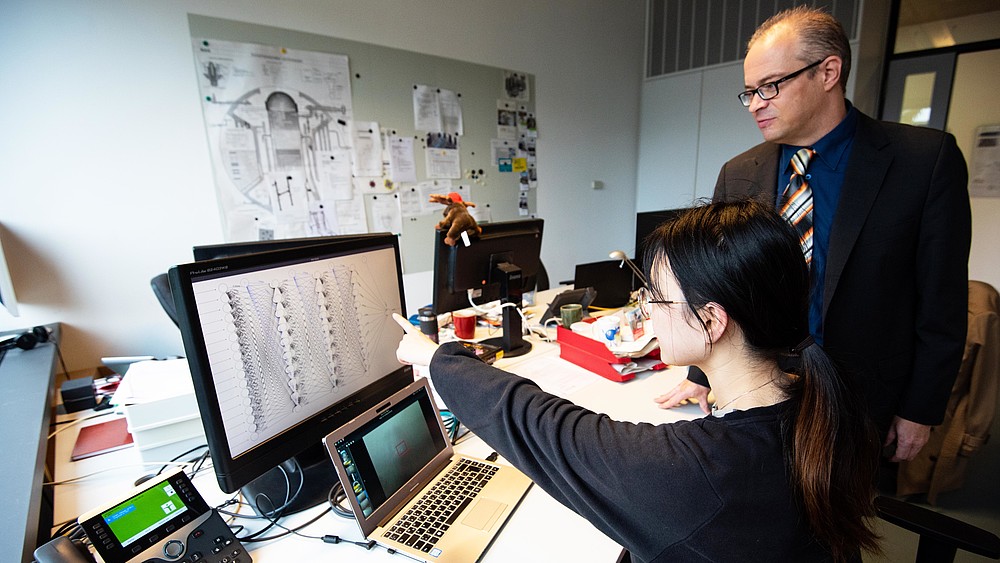
If you can’t swim one lap in the indoor pool, you won’t get your degree. That’s how simple—and yet, for some students, how difficult—the regulations are at Shanghai University. In her presentation at the colloquium in late September, Aijia Wei, an exchange student from China participating in the IAESTE program, shared some of the fascinating and curious quirks of her hometown with her colleagues from the Institute for Process Engineering, Process Automation, and Measurement Technology (IPM).
Ms. Wei’s two-month internship on the topic of “Image-Based Detection of Damage
on Rubber-Coated Rollers,” supervised by Dr.-Ing. André Seeliger (IPM), offers a microcosm of the interplay between industry and people in today’s globalized world. With its 20 million residents and tourist attractions such as the Oriental Pearl Tower—the fifth-tallest television tower in the world—Shanghai has just as much to offer as Zittau, with its Lenten cloth and natural beauty as far as the eye can see. To unwind from everyday city life, residents enjoy visiting the Yu Garden, which, with its philosophy of inner harmony between architecture and nature, reveals a great deal about Chinese traditions. Ms. Weis’s research topic, on the other hand, offers a glimpse into the future, both in the Far East and in Upper Lusatia.
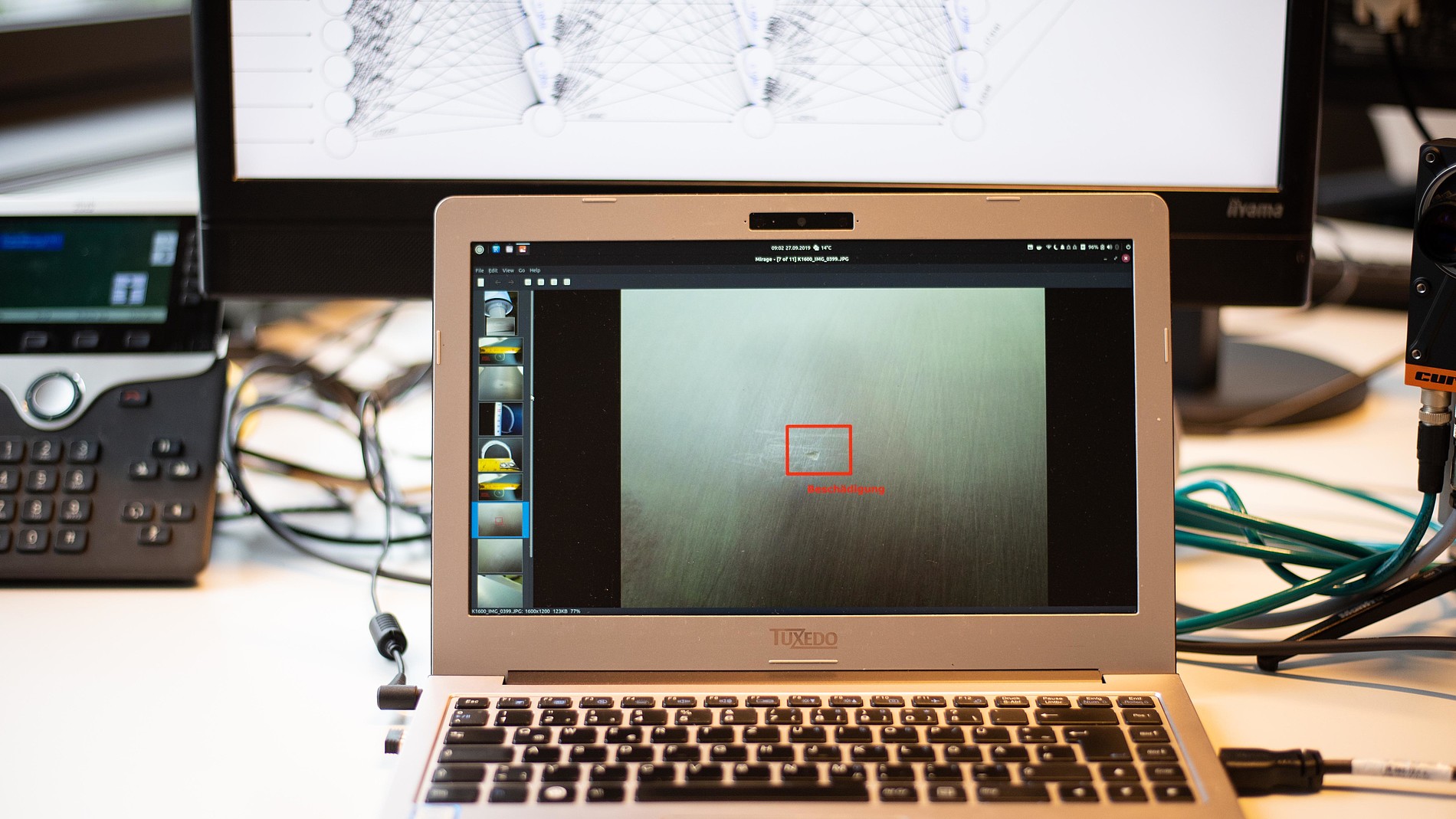
She focuses on “artificial intelligence” (AI), a field of research that many people associate with vague notions. Her work falls under the category of “weak AI,” which refers to concrete applications of machine learning. The programmed artificial neural network learns independently how to deal with newly emerging problems. Intelligent behavior is thus simulated with the help of algorithms that Ms. Wei has implemented in the Python programming language.
But working on a laptop alone would not have produced any presentable results. To achieve this, she turned to her industry partner, the long-established company Küsters-Textile in Zittau, which develops and manufactures machines for the finishing (dyeing, bleaching, mercerizing) of textiles. Küsters is now part of the internationally positioned Benninger Group, which, coincidentally, also maintains a branch in Ms. Wei’s hometown of Shanghai. Suppliers deliver rollers several meters long, coated with a layer of rubber, to the Zittau plant, and until now, these had to be laboriously inspected by hand for defects in the coating.
To automate this process in the future, Ms. Wei had a lot of work to do. First, she had to analyze the different types of defects. The goal was to categorize possible types of damage, such as holes and cracks, so that the AI could later learn to recognize them. She then took a camera into the factory, where she photographed the surface of several rubber-coated rollers piece by piece. Using this image data, she began training her neural network.
Ms. Wei did not have to pass a swimming test to successfully complete her technical internship at HSZG; that test will come at the end of her studies in Shanghai. The residents, however, have little to fear from the adjacent sea. In her presentation, she used weather maps to show that, due to its scientifically inexplicable good fortune, the metropolis is also called the “City of Typhoon Magic.” Storms often veer off just before reaching the city limits and head in a different direction. This is a nice parallel between Zittau and Shanghai, because, according to legend, Upper Lusatia, too, has little to fear from storms and other calamities, as it is also under the protection of the “Blue Stones.”
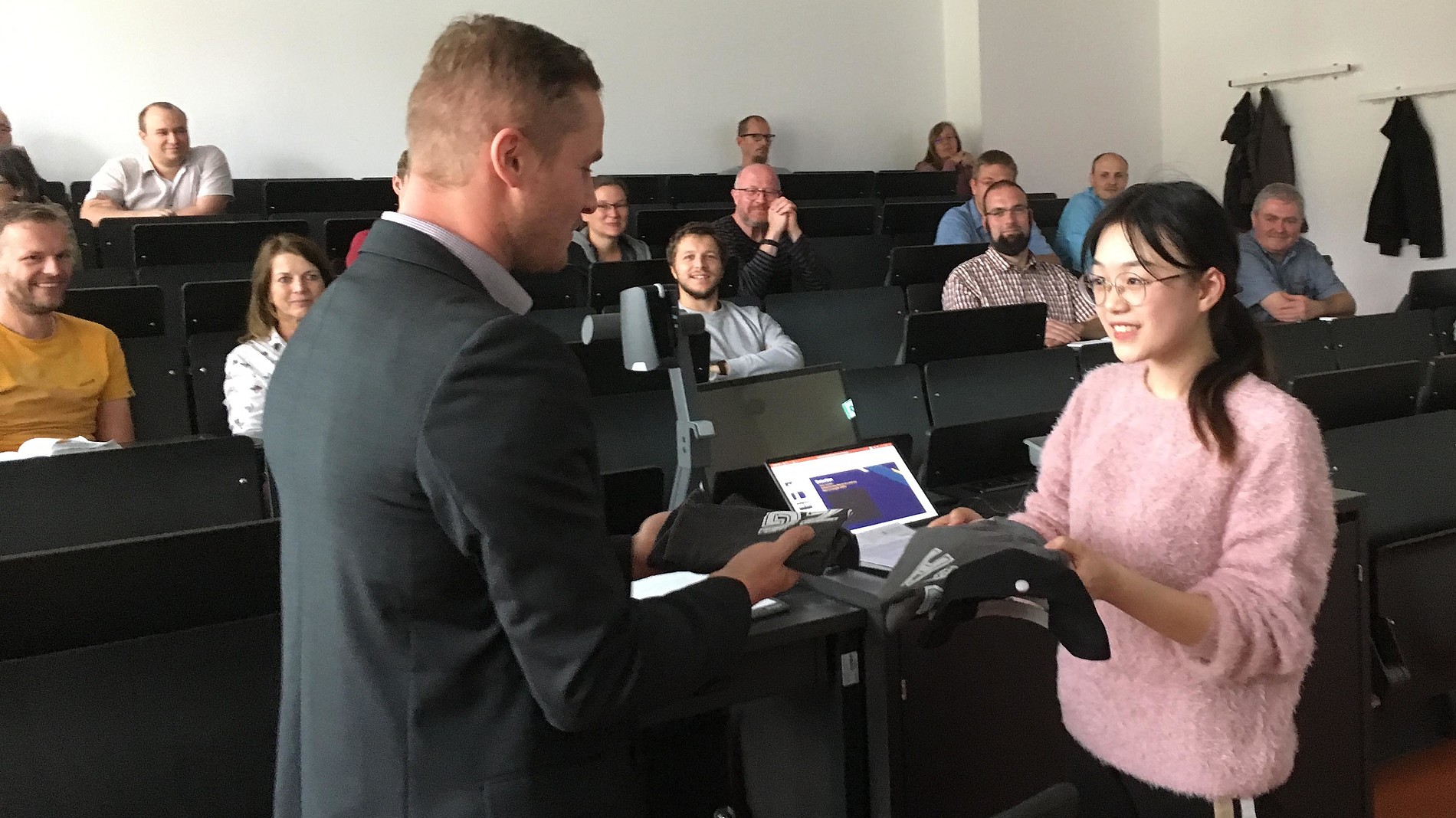
Colleagues from the IPM honored Ms. Wei’s presentation with a round of applause, and project manager Dr. Clemens Schneider presented her with gifts from the HSZG campus store. Following the two-month internship, the groundwork has been laid for the potential use of AI in a long-established Upper Lusatian company, and both colleagues and the student have gained both technical knowledge and an understanding of the world in the border triangle as well as the Asian metropolis.
For more information on the IAESTE exchange program, which arranges career-oriented internships in more than 90 countries around the world, please visit the following page.
1st floor
Upper floor
First floor
Upper floor
2nd floor