
The rapidly growing feed-in of electrical energy from renewable sources into the power grid poses major challenges for the energy supply throughout Germany. ENSO and DREWAG are also affected by this development and are seeking cost-effective solutions to address impending bottlenecks. In addition to the currently much-discussed but still too expensive storage technologies, the flexible adjustment of the load side—electricity consumption—to fluctuating generation represents a promising alternative to conventional grid expansion.
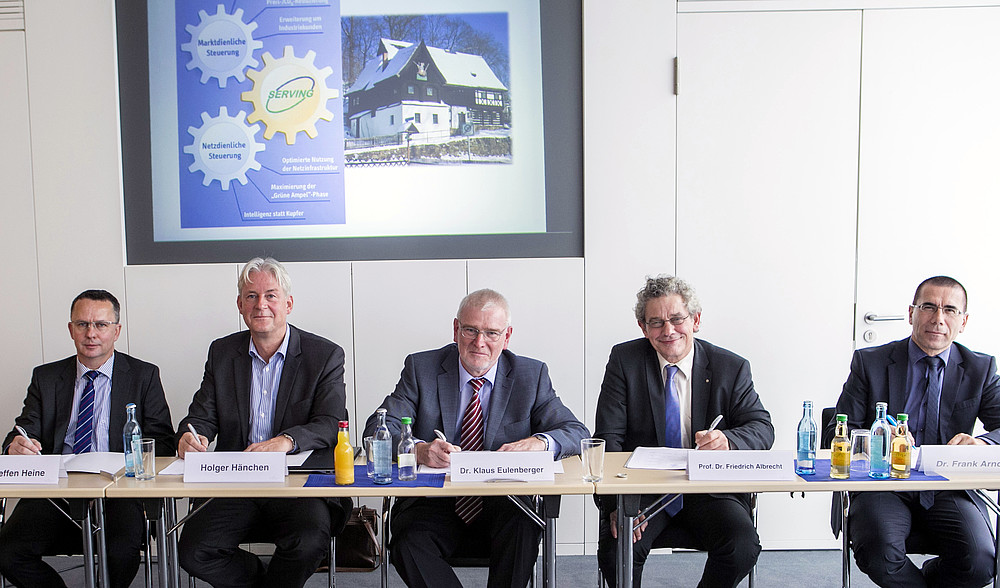
This is where a new project by Saxon universities and energy companies comes in: SERVING, short for “Distribution Network Service Platform for Integrated Load Management.” ENSO NETZ, ENSO AG, and DREWAG NETZ, along with research partners Dresden University of Technology and Zittau/Görlitz University of Applied Sciences, signed the corresponding cooperation agreement on September 23, 2015. Their four-year collaboration on this aspect of the energy transition will be funded with nearly 1.5 million euros for the research partners.
Zittau/Görlitz University of Applied Sciences is contributing 600,000 euros to the SERVING project. The university’s research partner is Prof. Dr.-Ing. Jörg Lässig and his research team.
The research focuses on the use of flexible electricity consumers such as storage heaters, heat pumps, water-based systems, and production facilities
involving thermal processes. Storage heaters, for example, are currently charged at fixed times—regardless of the situation in the power grid and the current market price of electricity. The goal of the joint SERVING research project is to charge these flexible consumers when there is a high supply of electrical energy—and thus at low prices—without causing overloads in the power grid.
If everything goes according to plan, several hundred pilot systems in eastern Saxony will be equipped with the necessary measurement, control, and communications technology between 2016 and 2019. Without compromising customer comfort, a central system will then determine the time windows during which the systems can be charged and control them remotely. In addition to reducing the strain on the grid, the project is also investigating whether making electricity consumption more flexible will yield significant advantages in electricity procurement or the marketing of controllable loads—that is, electricity consumption that can be influenced —that can ultimately be passed on to customers in the form of innovative rates.
The project is funded by the Federal Republic of Germany. The funding is provided by the Federal Ministry for Economic Affairs and Energy based on a resolution of the German Bundestag.
Photo: Lutz Weidler
Contact:
Hella Trillenberg
Press Office
Tel.: 03583 61-1403
Email: h.trillenberg@hszg.de