
To China with the HSZG lighthouse project
New guideline paper on the Indo-Pacific pays tribute to the CDHAW. Prof. Worlitz has been involved in the project since it was founded in 2004 and looks back on the successful partnership in this interview.
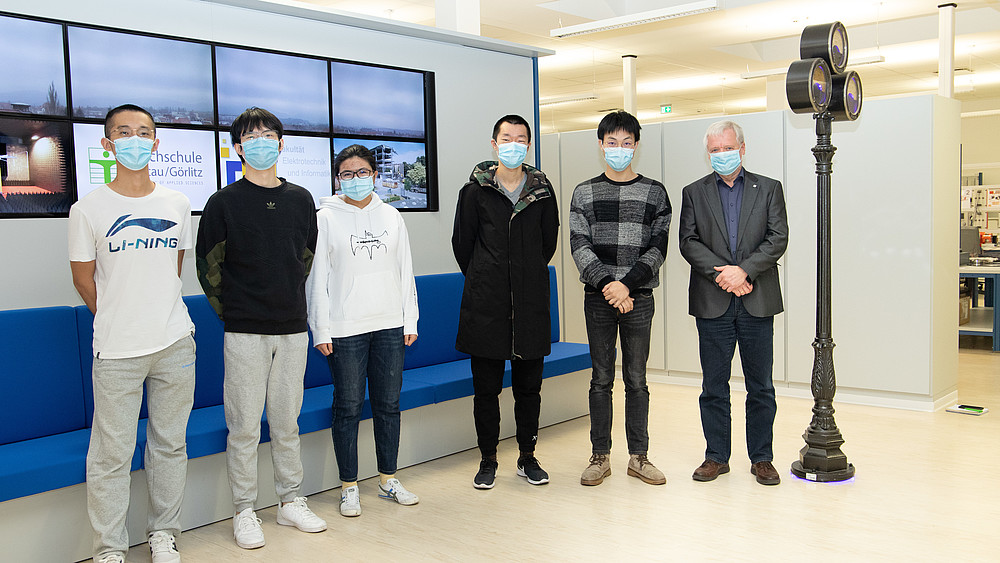
In the German federal government’s new paper, “Guidelines on the Indo-Pacific,” the Sino-German University of Applied Sciences (CDHAW) was mentioned and highlighted as a flagship project.
The CDHAW is an institution within Tongji University in the heart of the metropolis of Shanghai. The 26 German partner universities of the German University Consortium for International Cooperation—which has included the Zittau/Görlitz University of Applied Sciences since the CDHAW’s founding—participate both academically and through student exchanges as part of a dual-degree program.
At HSZG, students in the mechatronics degree programme have the opportunity to participate in the program offered by Tongji University and the German University Consortium for International Cooperation. This partnership offers students a unique opportunity to gain valuable practical experience in the heart of this breathtaking metropolis, acquire international skills, and broaden their cultural horizons in the process.
Students from China, in turn, have the opportunity to come to HSZG to study as part of this partnership. Since 2007, up to ten mechatronics students have taken advantage of this opportunity each year.
This successful bilateral collaboration is now being highlighted in a new paper by the German federal government. With its “Guidelines on the Indo-Pacific,” published in August of this year, the federal government is setting the course for its future policy toward countries in the Indo-Pacific region. The goal is to expand cooperation with countries in the Indo-Pacific, as they have gained economic and political significance in recent years.
“As part of efforts to promote sustainable cooperation in the fields of science and research, two universities were established in the Indo-Pacific region with German involvement: the Sino-German University at Tongji University, comprising the Sino-German University of Applied Sciences (CDHAW) and the Sino-German University College in Shanghai, as well as the Vietnamese-German University in Ho Chi Minh City. The Federal Government intends to continue accompanying and supporting the development of these flagship projects of German foreign science policy in the future.”
(Source: Page 59, Federal Government – Guidelines on the Indo-Pacific: GERMANY – EUROPE – ASIA, Shaping the 21st Century Together.)
Reason enough to take a brief look back at the success story of the Sino-German University of Applied Sciences (CDHAW) at the HSZG with Prof. Dr.-Ing. Frank Worlitz, visiting lecturer and program coordinator for mechatronics at the CDHAW.
Prof. Worlitz, in addition to the recognition of the CDHAW in the German federal government’s new policy paper, Tongji University was already described in 2016 by then-Federal President Joachim Gauck as “an outstanding venue for academic exchange between our countries.” How significant is the political attention given to the CDHAW bilateral project?
The idea was conceived during a Sino-German meeting between the education ministers of both countries in the early 2000s, and the German university consortium was founded as early as 2004. Between 2008 and 2019, 1,623 Chinese and German students earned a dual degree at the CDHAW. The CDHAW is, in effect, a separate faculty with its own staff and laboratories at Tongji University in Shanghai. This, too, is something unique in international higher education cooperation.
This success is attributable to the dedicated work and exceptionally good cooperation of all those involved in the ministries, the DAAD, and the universities. Political support has always been crucial. When we look back today on good 16 years of the CDHAW, it is also the result of a pioneering, far-sighted course set by political leaders that continues to guide us to this day.
What are the requirements for students at HSZG to earn a German-Chinese dual Bachelor’s degree in mechatronics?
What makes this partnership unique is that students can earn this dual degree in just two semesters. One of these semesters is a theory semester, which is offered only during the winter semester and whose lectures are conducted in English. The program is intended for students who have completed four bachelor’s semesters at Zittau/Görlitz University of Applied Sciences and can be completed in the fifth and/or sixth semester. Those seeking a dual degree must write and submit their Bachelor thesis in English. The CDHAW is funded annually through the China Scholarship Council (CSC), a quota-based scholarship program of the Government of the People’s Republic of China. These scholarships are intended for German participants in the CDHAW’s dual-degree programs and may also be applied for by students at HSZG.
How is the program received at HSZG?
More and more German students from partner universities are taking advantage of the dual bachelor’s program offered at CDHAW. This is also the case at HSZG. Currently, there are four mechatronics students enrolled in the dual degree program. Despite COVID-19-related restrictions, there are a total of 21 German students in the mechatronics program this year.
How does the partnership work for Chinese students?
Chinese students complete their first three years in Shanghai and their fourth year at one of 26 partner universities in Germany, provided they achieve the academic and language requirements—for example, here at HSZG. After earning their dual bachelor’s degree in Germany, many choose to pursue a master’s degree.
Students from Tongji University in Shanghai participated in a summer school program at HSZG last year. They conducted experiments in the state-of-the-art laboratories of the Faculty of Electrical Engineering and Computer Science and toured the Zittau Power Plant Laboratory as well as the Zittau South Signal Box. How was the program received by the students?
Yes, that’s correct—last year, seventeen students from CDHAW attended a summer school at HSZG for the first time. It has now become a tradition for CDHAW students to participate in a summer school in Germany during their semester break. What was new last year was that the two-week trip to universities in Mannheim, Göttingen, Prague, Regensburg, and Munich also included a stop at the HSZG in Zittau. The students particularly remember the South Signal Box, as well as the modern laboratories and the beautiful surroundings—especially the Oybin River. Making a stop in Zittau this year was an express request from the Chinese side, which we were happy to fulfill.
Two students from the summer school began their studies at the HSZG this fall.
Since its founding, the CDHAW has quickly become a model of success. Since 2011, it has been a subsidiary of the Sino-German University (CDH) at Tongji University. What do you think are the greatest advantages of a bilingual degree program at the CDHAW?
CDHAW’s Chinese and German alumni are in high demand on the job market. They benefit from a practice-oriented education and, in addition to international experience, acquire important language and intercultural skills. This enables them to fill key positions in companies serving as bridges between China and Germany. That’s a clear advantage.
Last October, a whole series of activities took place to further deepen international cooperation in the field of teaching. To this end, you and the current Vice President for Education and International Affairs, Prof. Sophia Keil, traveled to Shanghai to explore opportunities for collaboration between HSZG and CDHAW in the departments of Business Administration and Engineering Management, as well as to exchange experiences regarding teaching operations at a “smart factory.” What is the current status of these developments?
In the future, we also plan to collaborate with CDHAW in the Engineering Management degree programme, with the initial goal of enabling German students to complete part of their studies at Tongji University. Later, similar to the mechatronics degree programme, Chinese students will also come to Zittau to study. We are also considering developing partnerships with other universities under the DHIK consortium.
There will also be increased collaboration in research in the future. We are currently working with our Chinese colleagues to prepare a research project on “Industrial Big Data” and “Artificial Intelligence Technology.” The project is scheduled to begin in 2021. In addition to CDHAW and HSZG, other partners from China and Germany will also be involved.
Those interested in the German-Chinese dual Bachelor's degree program in mechatronics can contact Prof. Dr.-Ing. Frank Worlitz by email.
1st floor