
HSZG takes over the presidency of the BUP
Baltic University Program (BUP): A delegation from the university is participating in the 5th Rectors' Conference in Finland.
Since 2003, Zittau/Görlitz University of Applied Sciences has been a member of the world’s largest network for higher education, the “Baltic University Program (BUP).” Its main focus areas are sustainable development, environmental protection, and democracy in the Baltic Sea region.
The BUP was founded in 1991 at Uppsala University in Sweden (one of the world’s most renowned universities) by Prof. Dr. Lars Rydén. His vision was that, following the end of the “Cold War,” young people from countries in the Baltic Sea region—despite their different cultures, religions, and languages—should work together to find solutions to regional problems. The Baltic Sea is considered the most polluted and contaminated sea in the world.
Our university has been a member of the BUP since 2003; the network now includes approximately 80 universities and more than 200 partners from the field of higher education. In addition to Sweden and Germany, partner countries include Finland, Denmark, Poland, the Baltic States, Belarus (White Russia), the Czech Republic, Ukraine, as well as Kaliningrad and St. Petersburg. Each member country has a national BUP center. The German center is based at our university and is headed by Center Director Prof. Dr. Bernd Delakowitz. The BUP’s numerous research activities are coordinated by our long-standing partner and honorary professor, Prof. Dr. habil. Walter Leal, from HAW Hamburg.
The BUP offers students at member institutions a wide range of teaching units and materials in English on topics including “Sustainable Development, ” “Environmental and Biosphere Protection, ”“Water Protection Management,” “Resource and Energy Efficiency, ” “Sustainable Tourism,” and “Urban Development.” Student conferences and summer schools are organized regularly , as well as professional development events for faculty (“Teachers’ Conferences”).
A highlight is the annual sailing trip (“Sails”) aboard larger, chartered sailing ships, for which approximately 50–60 students can make applications each time. Credit (ECTS) can be earned for all programs and applied toward the respective degree program. The next sailing trip will take place from September 4 to 18 aboard the sailing ship Frederic Chopin. Lecturers are still being sought to lead a course during this trip. Those interested can contact Markus Will.
What makes these events particularly attractive to students is that participation is usually free, and accommodations and meals are covered by the BUP or the partner universities.
The presidency of the BUP rotates and will be held by Germany—and thus primarily by the Zittau/Görlitz University of Applied Sciences—during the first half of 2018.
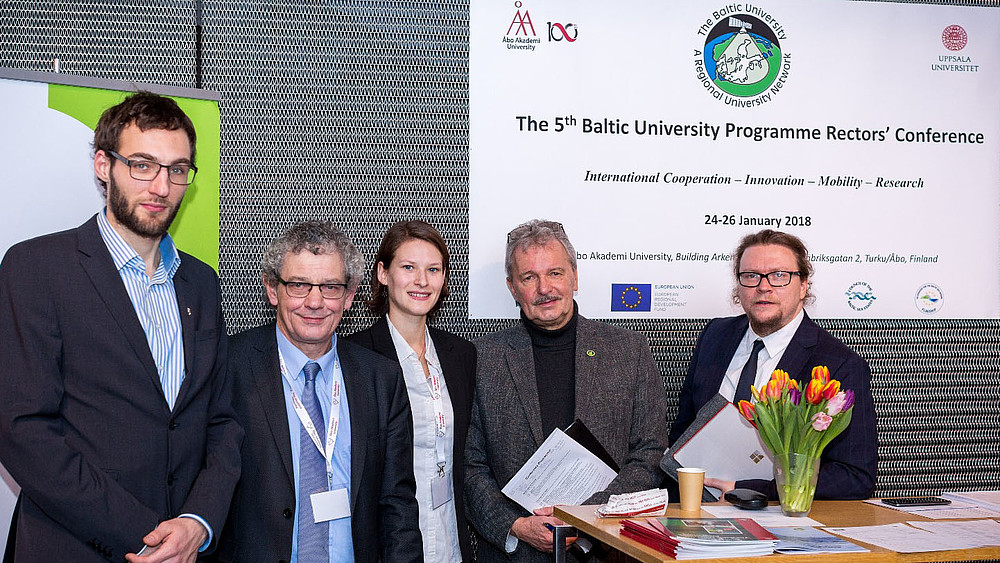
Meetings of all rectors from the BUP universities and their partners are held every three years. From January 24 to 26, 2018, the 5th Rectors’ Conference took place at the University of Turku in Finland. The Zittau delegation consisted of our Rector, Prof. Dr. Friedrich Albrecht, as well as Prof. Delakowitz, Dipl.-Ing. Markus Will (who has been very actively involved in the BUP for many years), and two students from the Ecology and Environmental Protection degree programme, Mirjam Weituschat and Jacob Fenner. The two students have already participated in several BUP events, including the 2017 sailing trip. It was a special honor that the two students were personally invited by the BUP Secretariat in Uppsala to share their impressions of the BUP with the attending Rectors at the conference, together with other students. The fact that our Rector was entrusted with leading a workshop on the topic of education in the 21st century can also be seen as recognition of our long-standing commitment. Prof. Delakowitz had the opportunity to present the international student conference scheduled for late May in Zittau on the topic of “Resource and Energy Efficiency in Production and Transport.” He also announced this year’s summer course in Hamburg on the topic of “Circular Economy.”
All participants returned with the impression that the Rectors’ Conference was extremely informative, exceptionally successful, and motivating.
First floor