HSZG celebrates 25th Neisse-Elektro Olympiad
For the 25th time, students in grades 10 through 12 from the border triangle region gathered in Zittau for the “Neisse-Elektro” Electrical Engineering Olympiad at the Zittau/Görlitz University of Applied Sciences.
Highly Focused
On April 6, 2019, high school students in grades 10 through 12 from the border triangle region gathered in Zittau for the 25th annual “Neisse-Elektro” Electrical Engineering Olympiad at the Zittau/Görlitz University of Applied Sciences.
Neisse-Elektro is a competition in which three teams from the Czech Republic, Poland, and Germany take an invigilated (written) examination. The questions cover topics in the field of electrical engineering. Students must calculate currents, voltages, and resistances in a branched resistive network, the capacitance of batteries during charging and discharging, as well as electric and magnetic fields. The students prepare for the Olympiad with the support of their teachers and through workshops at the Zittau/Görlitz University of Applied Sciences. The Olympiad winner and the other placements will be determined in a ninety-minute invigilated (written) examination, during which the students will work with intense concentration, equipped with an English-language formula book from Neisse-Elektro, a calculator, and a dictionary.
Excursion through Zittau
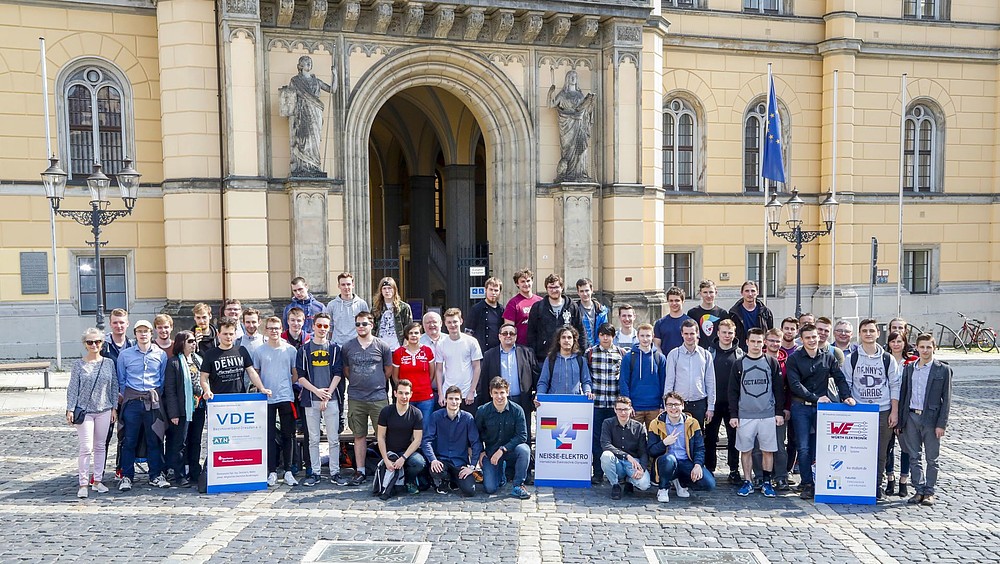
After lunch together in the student canteen, the group’s first stop this year was City Hall. Against this backdrop, the group posed for the traditional group photo. As part of the rest of the excursion, the participants got a behind-the-scenes look at the Gerhart-Hauptmann Theater in Zittau. The sophisticated video, lighting, and sound technology, the curtain control system, and the technical equipment—which allows three complete stage sets to be changed within a minute, including the 10-meter-wide turntable—evoked amazement and great interest.
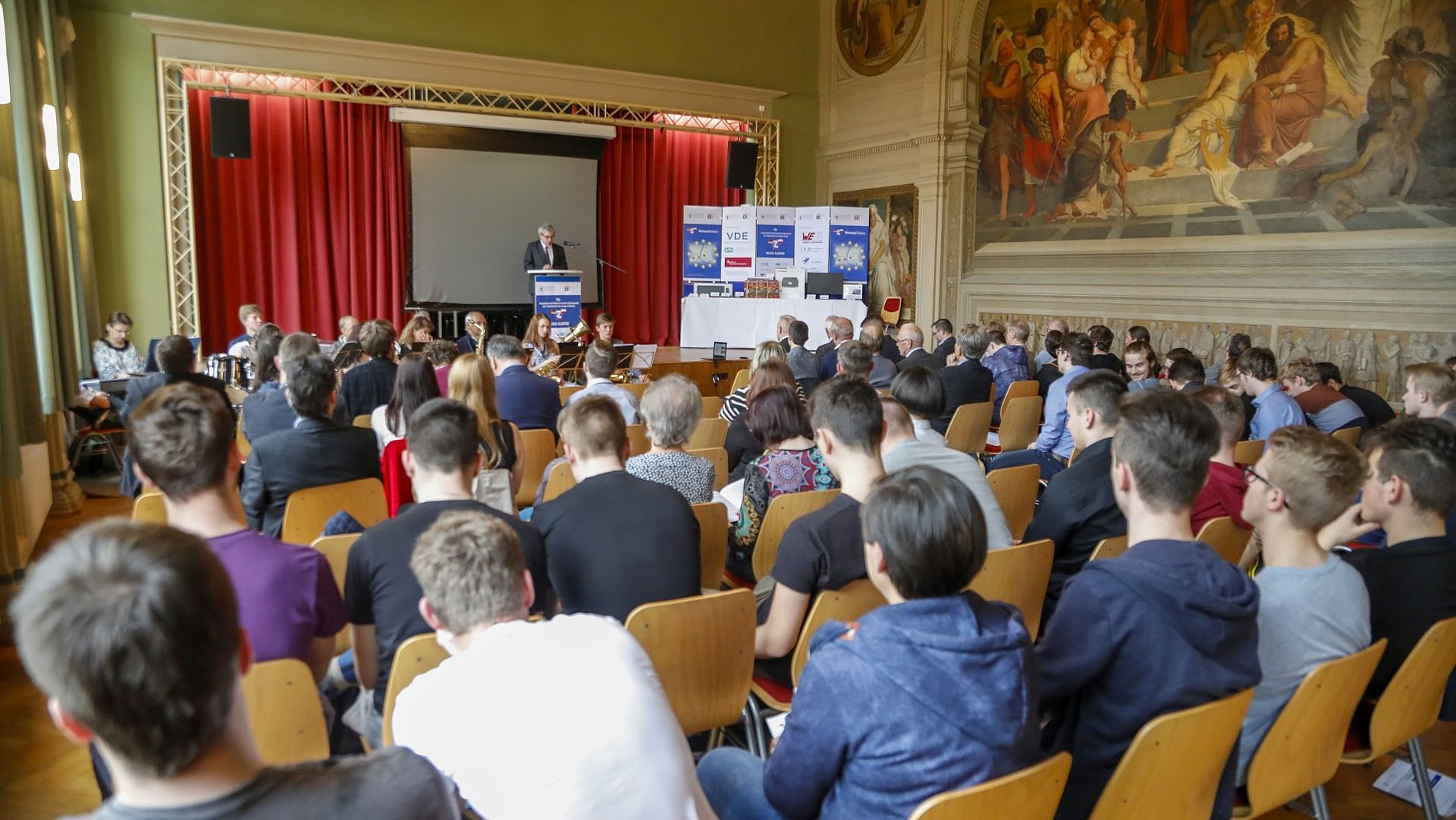
This year’s awards ceremony took place in the historic auditorium of the Christin-Weise Gymnasium. The 42 Olympiad participants were now eagerly awaiting to see who would receive the prizes. Thanks to sponsors such as VDE Dresden, ATN Hölzel GmbH, Sparkasse NOL, Honorary Senator Christian Müller, and IPM Zittau, the Olympiad was able to take place, and the winners were presented with tablet PCs, flat-screen monitors, SSD hard drives, and other prizes.
Robots and the Awards Ceremony
In her welcoming remarks, the Olympiad’s patron stated: “You are taking part in an anniversary event whose tradition began before any of you were even born. (...) Back in 1995, hardly anyone knew about the Internet. (...) Today, you have your smartphone—and with it, the entire Internet—right at your fingertips,” said Eva-Maria Stange. With these words, the minister looks to the future and continues: “Some of you may sense that artificial intelligence is fundamentally changing our lives. Computers and robots are taking over work in businesses and government agencies. We can already see the first steps in this direction today. But who is developing these robots? Who will teach them what to do? Who will take responsibility for their actions?" In doing so, she explicitly encourages all participants to actively engage with the diverse opportunities that are currently emerging. She encourages everyone to pursue a degree, for example at the Zittau/Görlitz University of Applied Sciences in the Faculty of Electrical Engineering and Computer Science.
Calculators from the 1980s
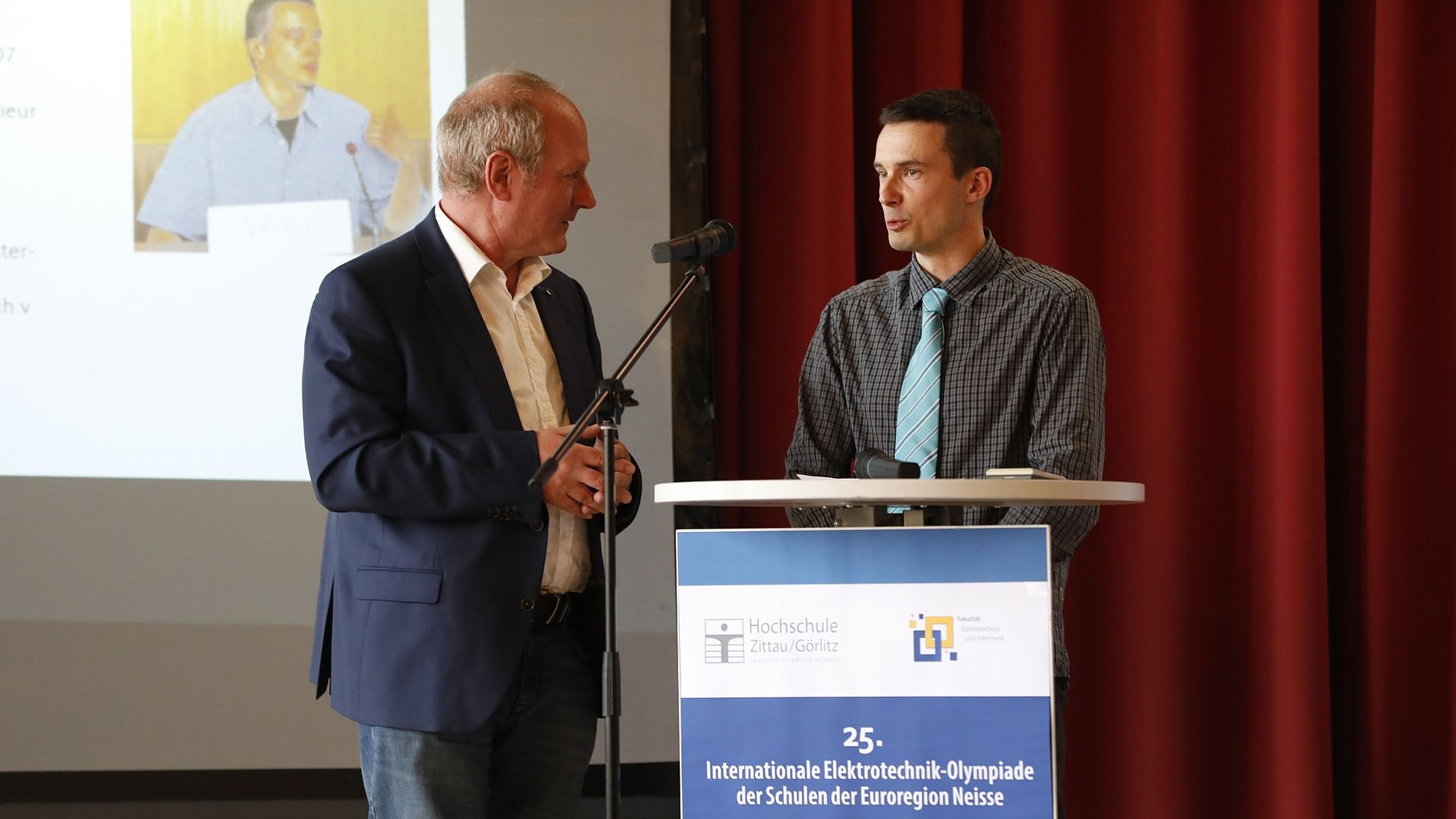
During the awards ceremony, the winner of the 7th Olympiad, Ondrej Svarc from the Czech Republic, spoke in an interview with Hartmut Paetzold, the coordinator for the dual KIA (sandwich-style) degree course at Zittau/Görlitz University of Applied Sciences. In 2001, English was his only foreign language. He already had his admission to the Technical University of Prague in his pocket. Through Neisse-Elektro, he learned about the Zittau University of Applied Sciences. He withdrew his application in Prague and decided to study abroad in Zittau, about 15 km from where he was living at the time. Ondrej attended the language preparatory program, passed the necessary exams, studied mechatronics, and subsequently enrolled in a Master's degree programme.
In his free time, he volunteered with the water rescue service, where he met his current wife. Today, he works at a Zittau-based automotive parts company in the field of design for plastic injection molds. Ondrej Svarc described how this Olympiad was a major turning point in his life. He encourages today’s participants to embrace ever-new, evolving technology and thus look forward to an exceptionally interesting career. He drew a few smiles when he pulled his 1980s calculator out of his pocket—the one he’d used for invigilated (written) examinations back then.
Congratulations to all the winners
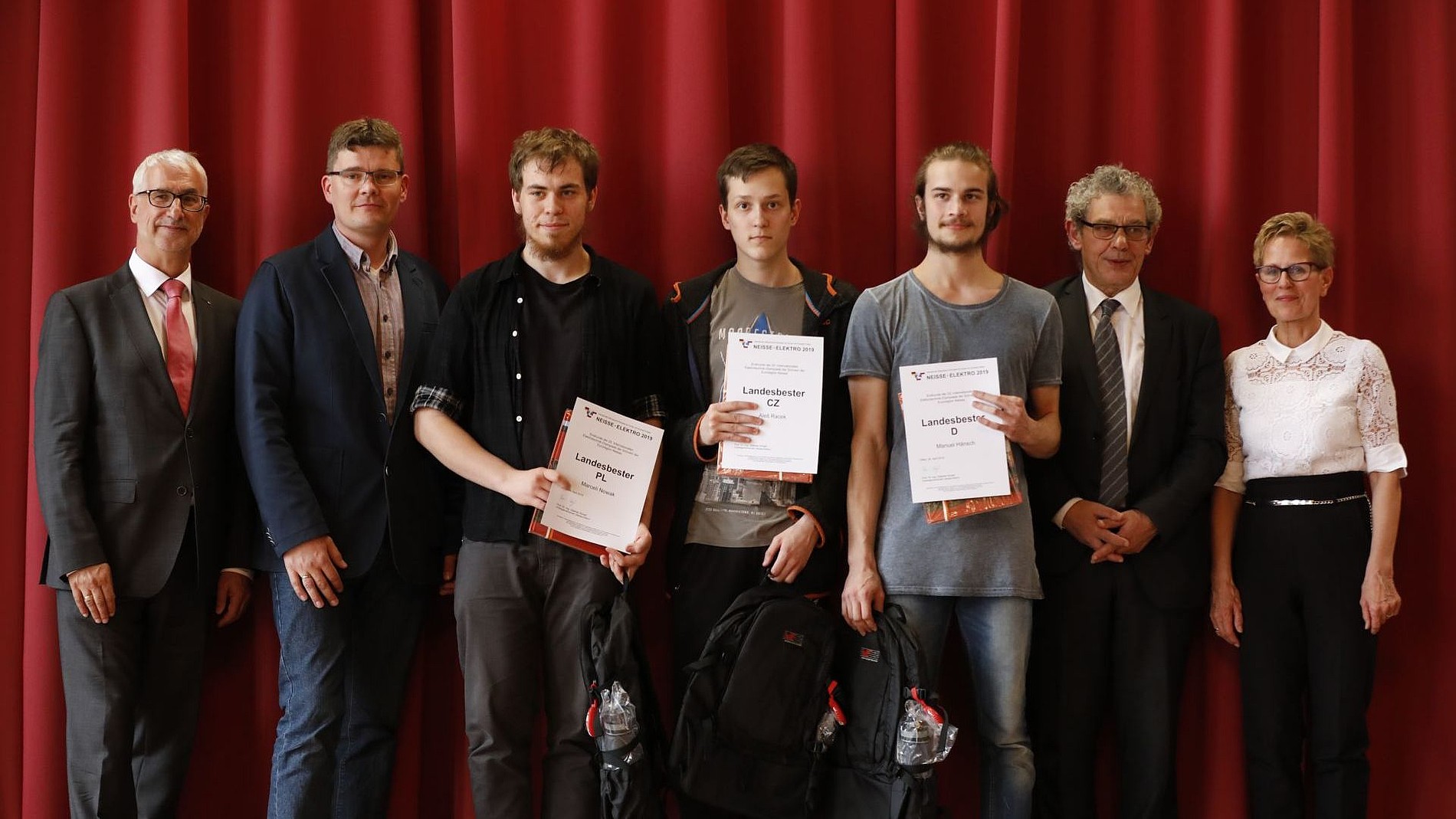
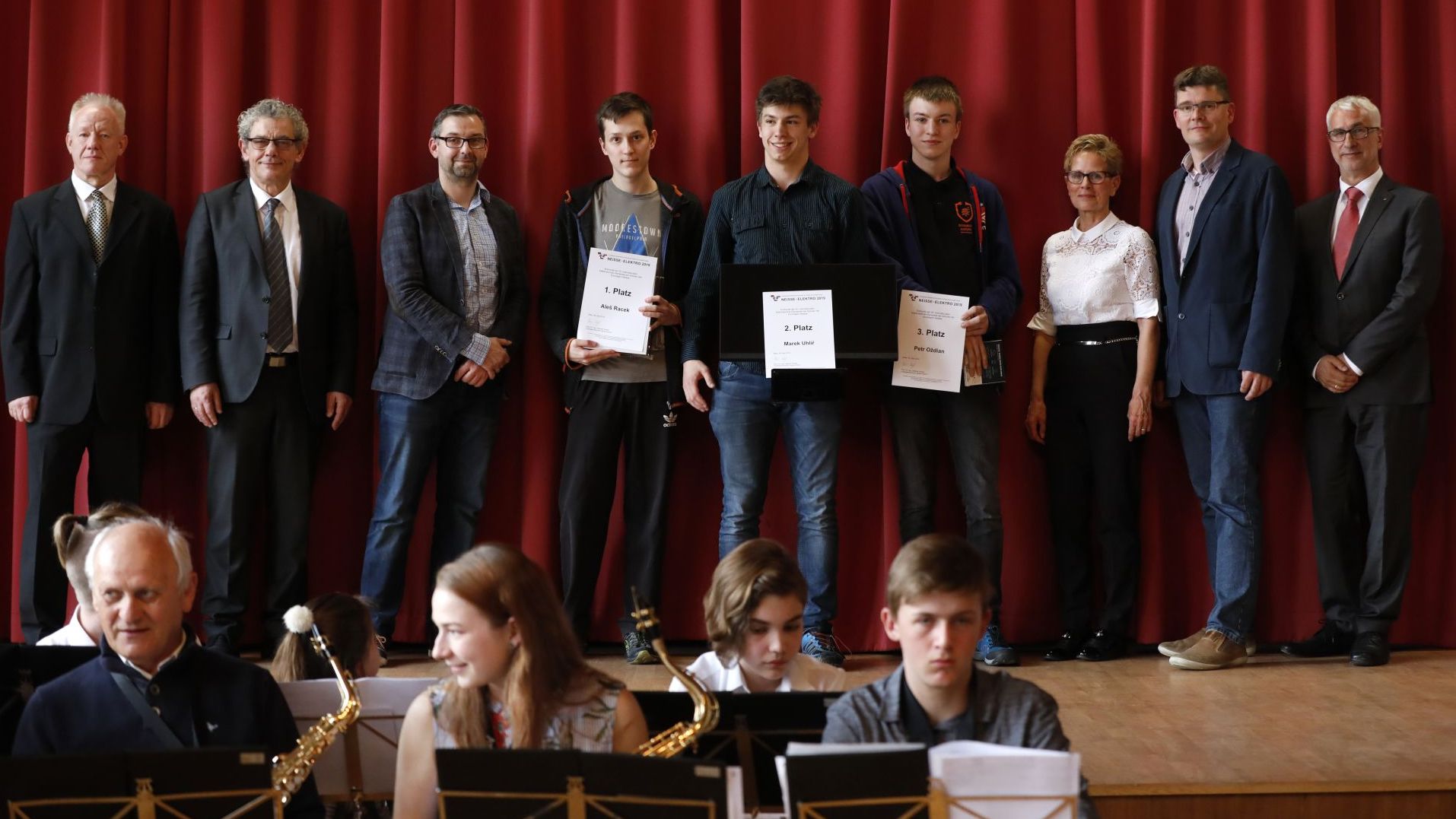
Prof. Dr.-Ing. Dietmar Scharf, head of the Neisse-Elektro Working Group, then announced the results. Both the good contestants from each of the three participating countries and the top ten overall received well-deserved applause. Thanks to the sponsors, they were presented with valuable prizes. Zittau/Görlitz University of Applied Sciences, the Faculty of Electrical Engineering and Computer Science, and all participating staff members congratulate the winners and wish them every success in their future endeavors. They would like to thank the sponsors and supporters for their—often long-standing—support in preparing, organizing, and equipping this competition.
Here are the winners of the 25th Neisse-Elektro:
| Place | name | Country | School |
|---|---|---|---|
| 1 | Aleš Racek | CZ | VOŠa SŠ Varnsdorf |
| 2 | Marek Uhlíř | CZ | SPŠSE a VOŠ Liberec |
| 3 | Petr Oždian | CZ | SPŠSE a VOŠ Liberec |
| 4 | Marceli Nowak | PL | ZSE Jelenia Gora |
| 5 | Hänsch, Manuel | D | Christian-Weise-Gymnasium Zittau |
| 6 | Ondřej Richtr | CZ | SPŠSE a VOŠ Liberec |
| 7 | Jakub Adamovský | CZ | SPŠSE a VOŠ Liberec |
| 8 | David Dostrašil | CZ | SPŠSE a VOŠ Liberec |
| 9 | Daniel Řezáč | CZ | SPŠSE a VOŠ Liberec |
| 10 | Vít Zbončák | CZ | VOŠa SŠ Varnsdorf |