

23. April 2015
University Participates in Google Project
Photos are currently being taken for Google Maps as part of a university project.
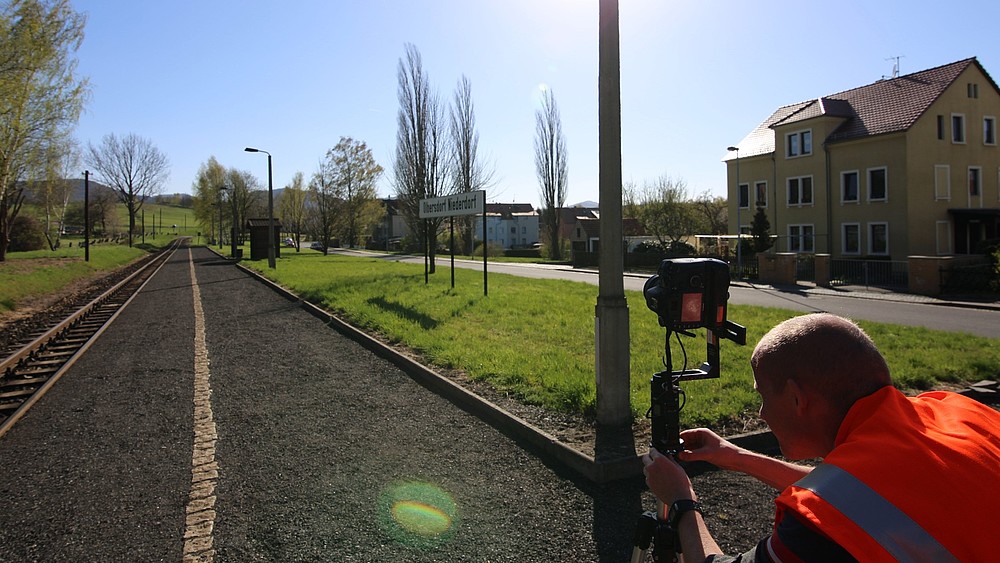
As part of a university project, photographs are currently being taken for Google Maps. The project, which is supported by the Department of Electrical Engineering, Division of Control and safety technology, aims to make the Zittau Narrow-Gauge Railway line an interactive experience. While until now it has mainly been possible to take virtual walks along streets and paths in Saxony’s major cities, Dresden and Leipzig, Germany’s first railroad line is set to go “online” shortly. The spherical panoramas recently captured along the route form the photographic basis for this project.
However, the photographs taken by Mr. Bert Siegel, a Google-certified photographer from the company art2viz, could not have been created without preparatory work. Students from the department of electrical engineering handled the planning in advance. Over the course of several months, they traveled the entire route multiple times by train. During this process, the good vantage points for approximately 40 shots were identified, photo subjects were precisely documented, convenient access routes to the tracks were sought, and the “shooting schedule” was synchronized with the train schedule. The procedure regarding occupational safety and employee notification was discussed with the railway operator, Sächsisch Oberlausitzer Eisenbahngesellschaft mbH. The collaboration went very smoothly. Then we waited for suitable weather conditions. And on April 21, 2015, the time had come: The photo shoot took place throughout the entire day. The students were on hand to offer advice and assistance. All shots were captured as planned. After processing, these will be posted online in the coming weeks.
The photographic documentation effectively supports the class / course on “Control and safety technology.” In the past, “real-world” field trips to railway facilities such as signal boxes or railroad crossings have already taken place. This will continue in the future, but the virtual track inspection represents a very efficient addition. The images thus provide a practical complement to the theoretical explanations given in the lecture. This allows students to visualize the complex railway system—including the interplay of the various fields of activity—even more vividly.
For the narrow-gauge railway and the region, the footage available online also serves as a good promotional opportunity.
Faculty of Electrical Engineering and Computer Science'
Electrical engineering department
02763 Zittau
Theodor-Körner-Allee 16
Building Z I,
Room 1.49
+49 3583 612-4571